


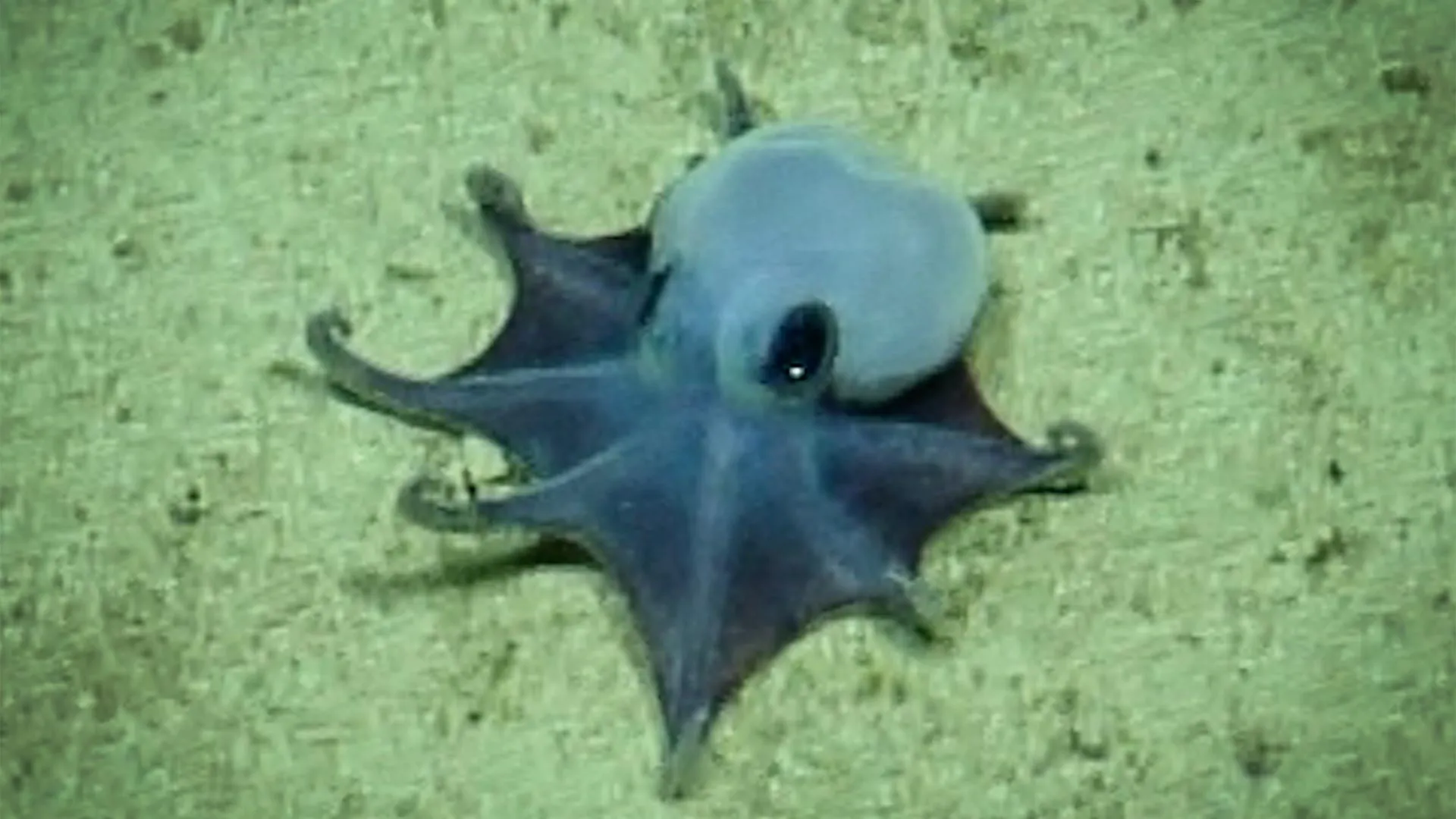
The Galapagos Islands off the coast of Ecuador are famous for animals found nowhere else on Earth, including giant tortoises and marine iguanas. Now, scientists have added another remarkable creature to that list. It’s a small blue octopus newly discovered in the deep sea surrounding the islands.
Newly described species published in magazine zoo animals After researchers confirmed that this rare octopus had never been recorded before,
The animal was first discovered during a deep-sea expedition by a research vessel in 2015. E/V Nautilus. The mission was carried out in collaboration with the Charles Darwin Foundation (CDF) and the Galapagos National Park Authority. Researchers used a remotely operated underwater vehicle (ROV) to explore the ocean floor near Darwin Island, at the northern tip of the Galapagos Islands.
Deep sea discovery near submarine mountain
As the ROV was exploring an underwater mountain some 5,800 feet (1,773 meters) below sea level, researchers noticed something unusual moving across the ocean floor. It is a small octopus with a striking blue color.
The scientists’ immediate reactions are captured in audio recordings of the expedition.
“He’s small!”
“It’s blue!”
The researchers used an ROV to collect specimens of the octopus and also recorded video footage of two other animals believed to be of the same species. After returning to the Galapagos, the researchers took dozens of deep-sea specimens to the Charles Darwin Research Station for study.
Among all the animals gathered, a small octopus immediately stood out. It was about the size of a golf ball and did not resemble any known species. Researchers at the base contacted octopus expert Janet Voigt and sent a photo of the octopus for identification.
“Right away, I knew this was something really special,” says Voight, curator emeritus of invertebrates at Chicago’s Field Museum and lead author of the study describing the new species. “I had never seen anything like it.”
Scientists use CT scans to study rare octopuses
The specimen was carefully preserved in alcohol and formalin before being shipped from the Galapagos Islands to Chicago, where Voight examined it at the Field Museum.
Identifying a new species of octopus typically requires scientists to dissect specimens and closely study characteristics such as the mouth, beak, and teeth. But with only one specimen identified, researchers faced a major challenge.
“To describe a new species of octopus, you have to see all the parts, including the mouth, beak, and teeth. And to see them, you have to cut the specimen open. Since we only had one specimen, we didn’t want to disassemble it,” Voight says.
Instead, the team turned to advanced imaging techniques. Stephanie Smith, manager of the Field Museum’s X-ray computed tomography lab, helped create a highly detailed micro-CT scan of the octopus.
“CT imaging is especially important for type specimens like this because it’s non-destructive. And that’s great for me because people often come to me with these incredibly rare and amazingly beautiful specimens that I virtually have the privilege of publishing,” says Smith, who co-authored the paper describing this new species. “There’s nothing better than spending the day seeing something no one else has seen before.”
CT scans work by combining thousands of X-ray images into a detailed 3D model, revealing both the external and internal anatomy of an object without physically cutting it.
For the little blue octopus, scans revealed clear views of its internal organs and mouth structure, allowing scientists to officially classify it as a new species and better understand its relationships with other octopuses.
“What really struck me was that the scans of this tiny octopus revealed so much information about its internal systems. Normally, soft-tissue imaging using micro-CT requires the use of heavy metal-based contrast agents, which are undesirable in such rare specimens. This really simplifies 3D modeling of the organs involved,” says Alexander Ziegler, a researcher at the University of Bonn in Germany and lead author of the paper.
New species reveals ocean mysteries
The octopus was given a name Microeredon galapagensis. Beyond the discovery itself, this species is also an important milestone for Voight, who has spent more than 40 years studying octopus evolution. This is the first time she has formally led the description of a new species of octopus.
“These are small deep-sea octopuses that very few people on Earth have seen. We feel really lucky to be able to work with them,” Voight said. “Even if you connected all the land on Earth, you wouldn’t be able to cover the Pacific Ocean. It’s a very large ocean, and there’s still a lot left to explore.”
Researchers say such discoveries are also important for protecting fragile marine ecosystems that are still poorly understood.
“This little blue octopus fascinated us as we were sorting through the dozens of specimens we collected during the expedition,” said Salome Buglas, a marine scientist at the University of California, Los Angeles, former Charles Darwin Foundation researcher, and co-author of the paper. “There was something unusual about it, so we did everything in our power to find the right people to help us identify what it was. It was a long process to get the specimen to Janet, but it was great to get to know the most precious part of our ocean a little better. I’d be happy to repeat it. Discoveries like this remind us how much of the Galapagos’ deep ocean remains unexplored. Every new species helps us better understand these hidden ecosystems and why their protection is important.”
