


Researchers at UT Southwestern Medical Center have identified a protein that acts as a key regulator of how the liver releases cholesterol-carrying particles into the bloodstream. This discovery could ultimately lead to new treatments for heart disease and fatty liver disease.
The study was published in the Journal of the American Heart Association circulationSo, we focused on a protein called HELZ2. Scientists have discovered that HELZ2 helps control the activity of apolipoprotein B (APOB). APOB is a gene required for the production of the apoB protein, which forms lipoproteins, particles responsible for transporting cholesterol and fats in the body.
“These particles are the main cause of plaque buildup in arteries,” said lead author Zhao Zhang, Ph.D., assistant professor in the Center for Host Defense and Internal Medicine Genetics at UT Southwestern. “What we discovered is that HELZ2 acts as a powerful control point that controls the number of cholesterol-carrying particles that end up in the bloodstream.”
How HELZ2 reduces harmful cholesterol
The research team discovered that HELZ2 works by shortening the lifespan of APOB messenger RNA (mRNA) in liver cells. Messenger RNA carries the instructions cells need to make proteins. Increased HELZ2 activity causes APOB messages to be degraded more quickly, resulting in less production of apoB protein and less cholesterol-carrying lipoproteins entering the blood.
“Most of the research so far has focused on what happens after apoB has already been made,” said Dr. Yiao Jiang, a postdoctoral fellow in the Zhang Lab and study co-author. “What surprised us was that HELZ2 acts much faster by controlling how long the apoB ‘message’ persists before the protein is produced.”
To uncover the role of HELZ2, the researchers used a large-scale genetic screening system developed by Bruce Beutler, MD, Nobel Prize winner, director of the Center for Host Defense Genetics, and professor of immunology and internal medicine at UT Southwestern. While studying abnormal fat accumulation in the livers of mice, researchers identified a gain-of-function mutation that increases HELZ2 activity and reduces APOB mRNA stability in the liver.
Blood cholesterol decreases, but liver fat increases
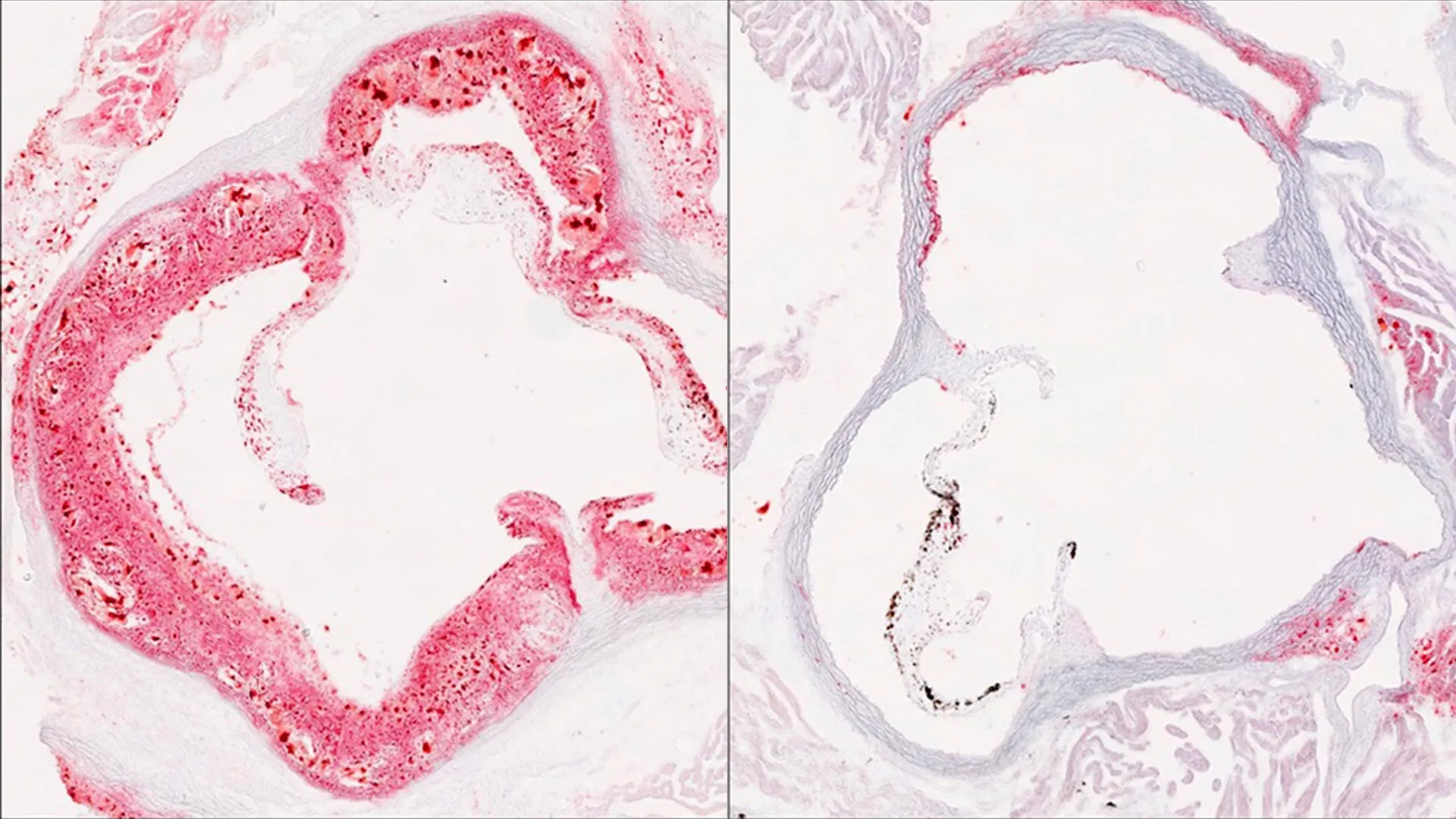
Mice with the HELZ2 mutation produced less lipoproteins, such as LDL (low-density lipoprotein) cholesterol and triglycerides, in their bloodstream. The animals also showed better protection against atherosclerosis, an artery-clogging disease associated with heart attacks and strokes.
But at the same time, more fat accumulated in the liver. Mice without the mutation showed the opposite effect, highlighting the delicate balance between cholesterol circulating in the blood and fat stored in the liver.
“You can think of HELZ2 like a dial between the liver and the bloodstream,” said Dr. Zhang. “Raising levels lowers blood cholesterol but increases liver fat; lowering them does the opposite. This balance makes HELZ2 particularly interesting as a potential therapeutic target.”
Potential alternatives to statins
Statins are the most widely prescribed drugs to lower cholesterol and reduce the risk of heart disease. But researchers say the discovery of HELZ2 points to a completely different way to control harmful cholesterol particles.
Rather than targeting cholesterol that has already been produced, HELZ2 affects the process at a genetically directed step before the protein is produced. Scientists believe that carefully modulating HELZ2 activity could ultimately lower dangerous cholesterol levels while also providing new strategies to treat fatty liver disease.
“The idea that apoB can be regulated at the RNA level has led to a major shift in the way we think about cholesterol control,” said Dr. Zhang. “This provides us with a new molecular lever, and potentially a new toolset, to tackle these situations.”
Dr. Beutler, a Regent Professor, received the 2011 Nobel Prize in Physiology or Medicine for his discovery of an important family of receptors present on immune cells. In honor of Mr. Laverne and Raymond Willey Sr., he serves as the Raymond and Ellen Willey Distinguished Chair in Cancer Research. Dr. Beutler is also a member of the Harold C. Simmons Comprehensive Cancer Center.
This research was supported by grants (R00DK115766 and R01DK130959) from the National Institute of Diabetes and Digestive and Kidney Diseases of the National Institutes of Health.
