


Important points:
Ohio State is a leader in new data center development in the Great Lakes region.
These power plants are projected to account for a quarter of the state’s total electricity use by 2040.
To address these needs, the new bill proposes restructuring the state’s energy policy to prioritize natural gas, coal, and nuclear resources.
Columbus, oh. — Ohio lawmakers are considering a bill that would redefine the state’s idea of ”clean” and “reliable” energy to include resources that burn hydrocarbons, namely natural gas and coal, while effectively banning the development of solar and wind power projects.
The departure from the scientific consensus that fossil fuel power sources significantly contribute to pollution and climate change comes from concerns about the future of energy reliability in the Great Lakes region’s fastest-growing data center hub.
With 77 such projects in development, these data centers are estimated to account for nearly a quarter of Ohio’s total energy needs by 2040, according to the University of Virginia’s Cooper Center for Public Service. Ohio’s three largest data centers alone will consume all the electricity produced by its three largest power plants. That amount is about 7,000 megawatts, enough to power about 6 million American homes, half the state’s population.
To meet the power needs of large data centers that operate 24/7, Senate Bill 294 would set a high bar for energy development in Ohio. The power plant must produce at least half of its maximum electrical output, day and night.
The bill states this as “capacity utilization rate of 50% or more.” In reality, this is a high standard that only Ohio’s nuclear, natural gas, and coal-fired power plants can achieve, but truly clean, water-saving energy sources like solar and wind fall short.
“It is becoming increasingly clear that no long-term consideration is given to Ohio’s economic and environmental future when fossil fuels are promoted over clean renewable energy,” Lee Harper, managing director of the Fresh Water Accountability Project, an Ohio advocacy group, said in testimony opposing the bill.

Prioritize dirty power sources
SB 294, which has been the subject of five hearings so far by the Ohio Senate Energy Committee, defines the state’s new public policy as “ensuring the security of affordable, reliable, and clean energy.”
Critics of the bill argue that beneath this seemingly innocuous language lies a dramatic shift in priorities. The policy mirrors an executive order issued by President Trump last January that declared an “energy emergency” encouraging new reliance on fossil fuels across the United States.
“The Trump administration is activating emergency authorities for non-emergency projects to keep the nation dependent on dirty energy sources like coal, oil and gas,” Michigan Attorney General Dana Nessel said in a Great Lakes Business Network webinar earlier this month. “This order specifically excludes wind, solar and battery energy, which are among the cheapest and cleanest energy sources in existence.”
This bill would apply this concept to Ohio. Solar and wind farms would not meet the state’s new definition of “reliability” established by capacity factor thresholds because their energy production is affected by fluctuations in the sun and wind. This is despite the fact that, as critics of the bill have shown, solar and wind make up a large share of electricity generation in other states and countries.
“Dismissing solar and wind as ‘unreliable’ ignores the existence and efficiency of battery storage and the economies of scale achieved by widespread renewable energy,” Kathy Becker, president of the nonprofit group Save Ohio Parks, said in written testimony this winter. “Denmark gets 59 percent of its electricity from wind and 11 percent from solar. Lithuania gets 45 percent of its electricity from wind and 18 percent from solar. The Netherlands gets 27 percent of its electricity from wind and 18 percent from solar. Neither of these countries deals with frequent power outages.”

Ohio’s two nuclear power plants, the Perry and David Besse sites, both located on the shores of Lake Erie, have been operating at capacity factors of 81 percent and 96 percent, respectively, over the past 12 months. Although not considered fossil fuel combustion, nuclear power plants use large amounts of water and tend to emit thermal and toxic wastes. According to 2023 permit data, the Perry facility pumps an average of 140 million gallons of water from Lake Erie each day, returning nearly all of it to the lake at higher temperatures. Last year, there was a reported spill of 78 gallons of radioactive chemicals at the facility, which was contained on-site.
Perry is also one of several nuclear power plants that received lease extensions from the Trump administration, allowing it to continue operating 20 years beyond its originally scheduled 2025 closure date.. In January, Vistra, the plant’s parent company, announced its intention to apply for subsequent license renewal. The disclosure coincided with news that Meta has signed a 20-year agreement to purchase more than 2.1 gigawatts of Vistra’s nuclear energy to power the tech giant’s regional data centers.
The state’s three largest coal-fired power plants would also meet the bill’s high standards. The Kiger Creek and Cardinal plants have been operating at 57% and 66% capacity utilization, respectively, over the past year. Both sites received part of a $175 million federal grant for infrastructure upgrades this winter, in another Department of Energy effort to use fossil fuels to strengthen power grid stability.
The James M. Gavin Power Plant (56% capacity factor), located on the Ohio River, is the state’s largest coal facility. As of September 2025, the site had more than 67 million cubic yards of coal ash (a toxic byproduct of coal combustion and a known groundwater contaminant), and 40 of 42 groundwater monitoring wells had been found to contain concentrations of toxic heavy metals exceeding federal advisory levels over the past 10 years.
The plant continues to operate despite orders from the EPA to stop dumping coal ash. Those harsh ultimatums have now stalled since the agency proposed sweeping changes in April that would ease groundwater monitoring standards for coal-fired power plants and roll back rules mandating coal ash cleanup.
“The Trump administration and coal ash polluters are trying to take us back to the bad old days when arsenic, lead, and mercury from coal ash contaminated our water,” Nick Torrey, principal attorney at the Southern Environmental Law Center, said in a statement.
Meanwhile, 53 large natural gas plants in Ohio are also operating well above the bill’s capacity utilization standards. Power is the backbone of the data center boom, despite a long legacy of water source contamination from hydraulic fracturing. According to a report from the International Energy Agency, natural gas-fired power plants are the largest power source for data centers in the United States, accounting for more than 40% of the total share of these facilities, but proposals for new power plants continue to grow.
“In the U.S., more than a third of[oil and gas]capacity will directly power on-site data centers, and more on-grid projects are planned to meet the expected increase in energy demand from AI,” says a 2025 report from Global Energy Monitor, a non-governmental organization that tracks energy use and infrastructure.
In Ohio in particular, the DOE and Department of Commerce announced a public-private partnership in March to build a large data center and 10 gigawatts of new power generation (including at least 9.2 gigawatts of natural gas generation) on federal land at the former Portsmouth Gas Diffusion Plant. That’s enough electricity to power 7.5 million to 10 million American homes.
“The Portsmouth facility, once a cornerstone of U.S. national security during the Cold War and enriching uranium for national defense, is now being retrofitted to help the U.S. win the AI race,” a Department of Energy fact sheet states.

Reliability on demand
Ohio’s claims to power are under more scrutiny than ever before. Buckeye State residents joined a chorus of concerned communities across the country in expressing concern over rising costs and unreliable power service. Recently, utility watchdogs have amplified this message.
Earlier this month, the North American Electric Reliability Council (NERC) issued a “Level 3 alert” in response to sudden power grid fluctuations, outlining steps utilities should take to protect consumers from emerging large-scale power users: data centers.
“The goal is to enable more industrial-scale consumers to actively participate in practices that protect grid stability as they connect to the electrical grid,” the alert reads.
PJM, Ohio’s largest electric utility, found itself in a state of emergency last week. The utility received approval from the Department of Energy overnight to allow data centers and other large users to operate on backup generators amid a regional heatwave and planned generator outages for maintenance.
“The projected level of generation outages and projected demand pose a significant risk of an emergency that could threaten electricity reliability and public safety,” the utility wrote in its request.
Monitoring Analytics, an independent regional power grid watchdog, also reported this week that PJM’s wholesale power costs in the region rose 76% from 2025 to the first quarter of 2026. Congestion costs alone (costs incurred when power lines reach capacity and are passed on to consumers) rose by 300%.
“The price impact for customers is significant and irreversible,” the monitors wrote in their report. “Unless issues related to data center loads are addressed in a timely manner, the price impact will be even greater in the short term.”
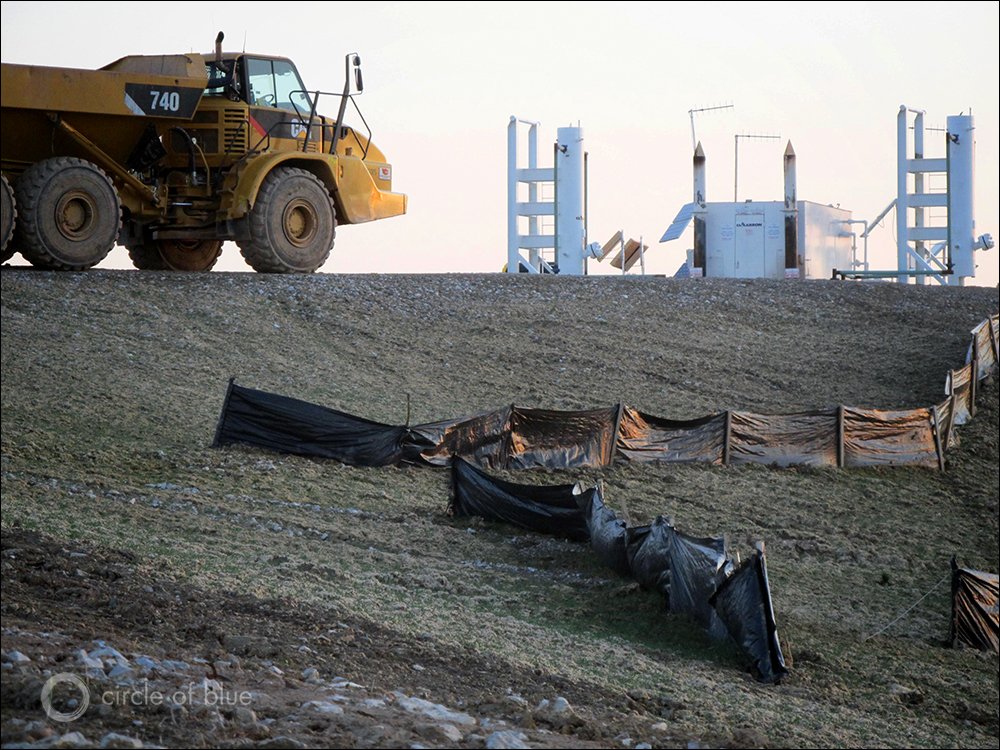
Header image: Shale gas development on the lower Ohio River. Credit: Keith Schneider
