


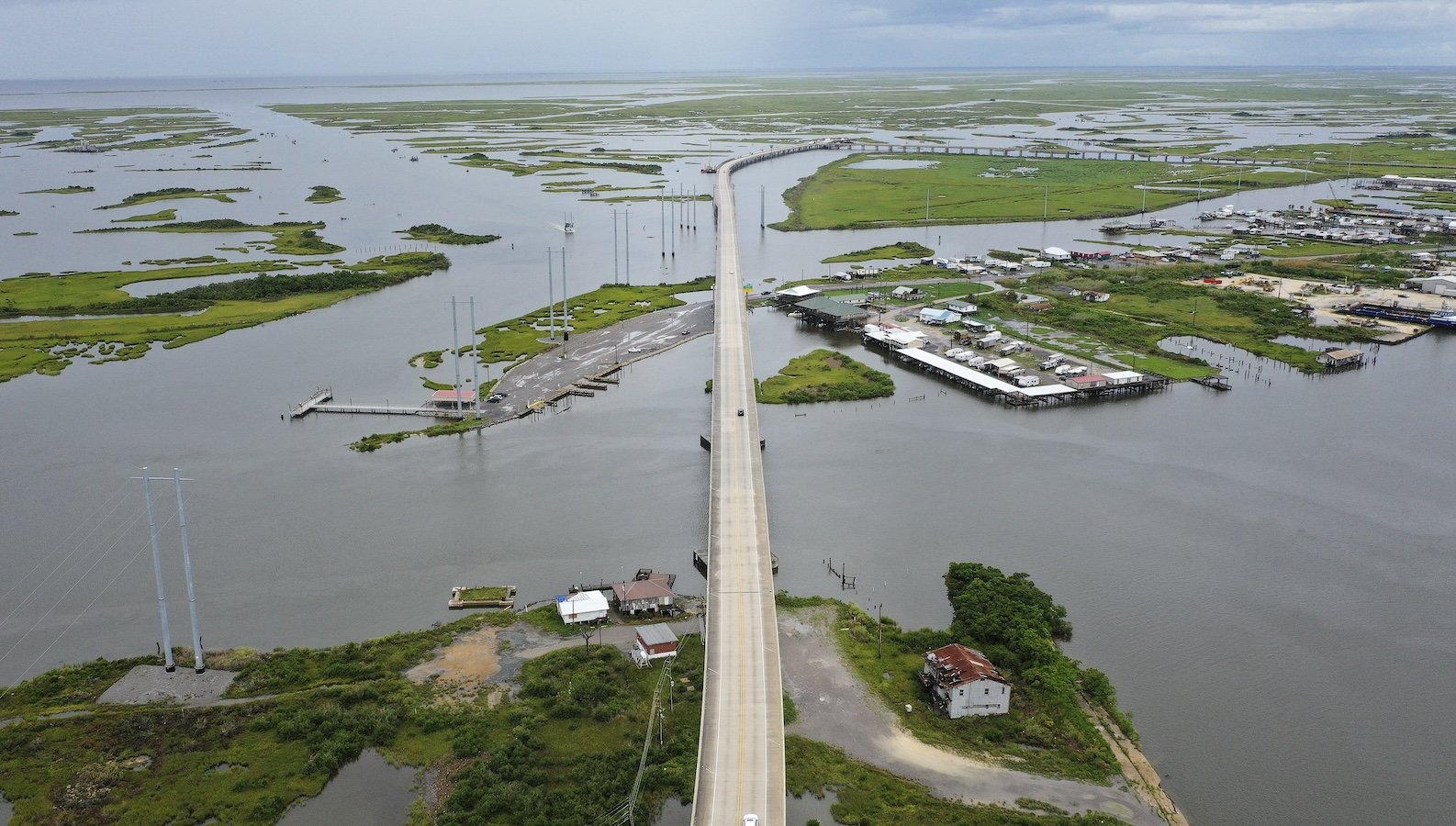
A new paper in which authors claim New Orleans, Louisiana’s largest city, is at risk of being surrounded by open water by the end of the century has caused considerable consternation and eye-rolling.
The paper said coastal Louisiana is likely “already past the point of no return” as man-made global warming continues to cause sea levels to rise. Under the current warming trajectory, southern Louisiana’s remaining coastal wetlands are expected to disappear, putting more than 1 million residents “at risk,” the authors say. That may sound shocking, but it wasn’t the controversial part of the paper published this month in Nature Sustainability – at least not to some harsh critics.
Instead, the authors were criticized for arguing that New Orleans should consider a managed withdrawal or relocation further inland to higher ground to avoid the worst climate impacts.
“Stop saying, ‘Relocate New Orleans.’ It’s not going to happen,” Christopher Ard, an 11th-generation New Orleanian, wrote in an opinion column for The Lens, a local nonprofit newsroom. “If people want to migrate, they will,” Professor Ard added, adding that researchers should instead use “words like ‘abandon’ or ‘give up’ or even ‘find somewhere new'” to describe this migration. “Relocation sounds ridiculous,” he wrote.
In their paper, the authors estimate that coastal Louisiana could face sea level rise of 3 to 7 meters (about 10 to 23 feet), and also predict that parts of the state’s coastline will move inward by 100 kilometers (62 miles), closer to Baton Rouge. And while they acknowledge that the timeline for these processes is uncertain, they argue that it will take decades, not centuries, for the region to develop a migration plan to escape these dangers. The paper does not suggest when or how people living in the Mississippi River Delta should move, but rather argues that preparing for anticipated sea level rise “is a long process that cannot be postponed.”
What would happen to people whose jobs and livelihoods are tied to coastlines, such as fishermen, in a managed withdrawal scenario is outside the paper’s scope. Louisiana is the second largest producer of seafood in the United States after Alaska, and New Orleans is a fishing center for wild-caught shrimp, crabs, and finfish, as well as oysters, catfish, crawfish, and alligators.
“It would be devastating for Louisiana’s fishermen to lose or be unable to use New Orleans as a base, as a source of infrastructure, as a place to sell their seafood (New Orleans consumes a large amount of seafood as a market),” said Jeffrey Plumlee, an assistant professor in Louisiana State University’s School of Renewable Natural Resources.
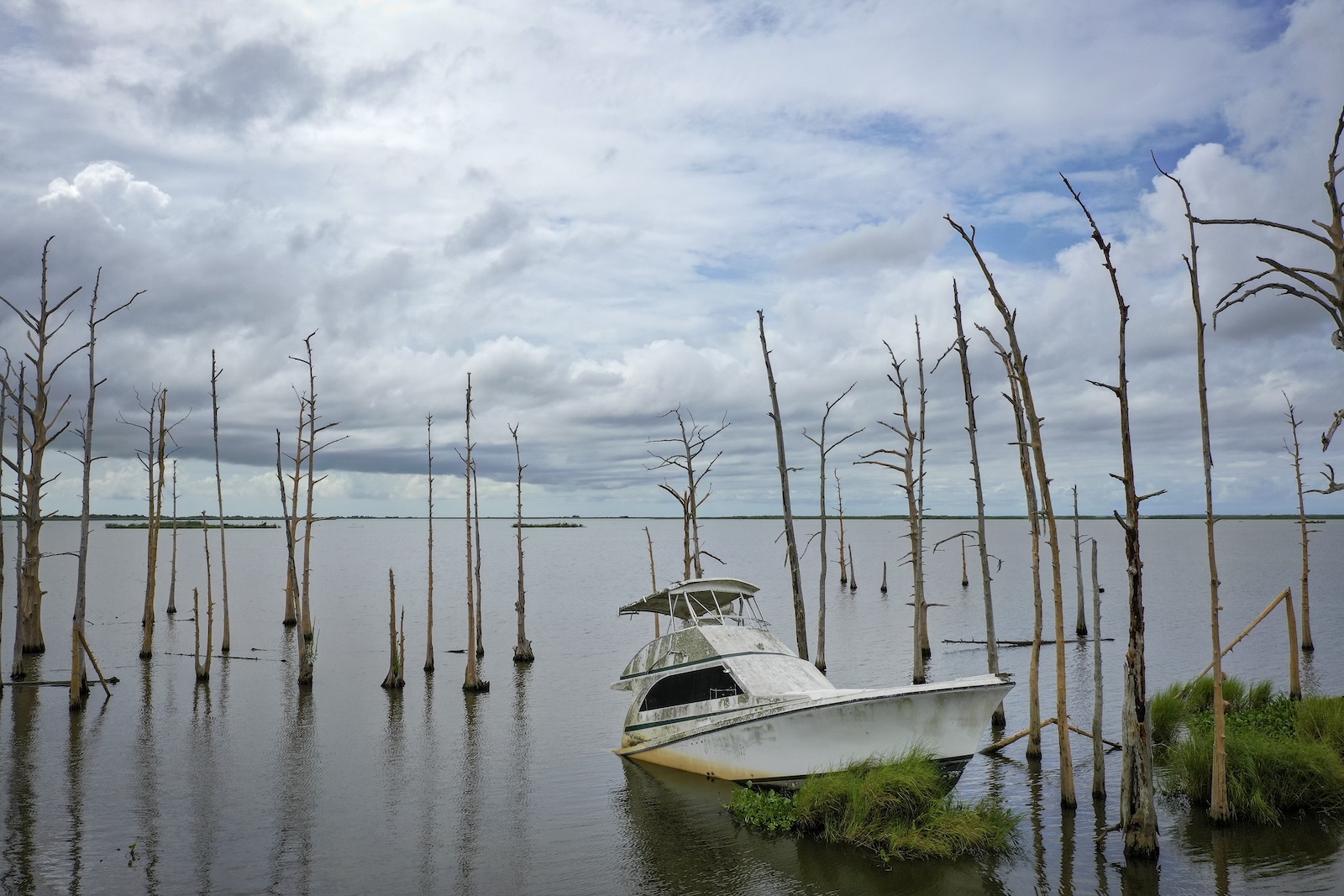 An abandoned boat lies in the waters off the coast of Venice, Louisiana.
Drew Angerer/Getty Images
It is important to note that although the paper advocates a controlled withdrawal from the coast, the authors caution against exaggerating the effects of sea level rise. “Eventually, yes, this will no longer be a nice place to live,” says Thorbjörn Tornqvist, one of the study’s co-authors. But “New Orleans will continue to exist until the end of this century,” he said. It may be similar to Venice, Italy, a city completely surrounded by open water.
Such a process would undoubtedly impact Louisiana’s seafood industry. Louisiana has already been hit hard by worsening hurricanes, among other factors that have turned the fishing profession into precarious work. Severe storms have caused significant damage to critical infrastructure for the fishing industry, including ice houses and fuel docks. When these facilities are destroyed or not repaired or replaced, work becomes more difficult and people begin to look for opportunities elsewhere.
Additionally, young people become aware of the challenges in the industry and begin to consider other career options. “It’s called ‘fleet aging,'” Plumlee said. This is a term used to describe the aging of fishing workers.
The process is similar to what’s happening in broader south Louisiana, where the population has declined four times in the last five years, according to census data. This population decline is not solely or specifically linked to abnormal weather or environmental conditions.
“What we’re seeing in coastal Louisiana is an aging population. Young people are leaving the country for jobs and places with more opportunities,” said Beth Fassel, a sociologist and demographer at Brown University. peer reviewed Managed retreat paper. This migration “probably has nothing to do with their perception of environmental risks,” she says. Admittedly, it is difficult to say with certainty who qualifies as climate migrants or climate refugees. And in the case of coastal Louisiana, Tornqvist and his co-authors acknowledge that migration from the region is “multiple causes.” However, there is no denying that environmental factors influence the kinds of jobs and economic opportunities available to people. For example, insurance companies are raising premiums or leaving Louisiana altogether.
The challenge of moving to a new place and finding new ways to make a living is why people living in low-lying communities like New Orleans need to start planning sooner rather than later, said Lawrence Huang, a policy analyst at the Migration Policy Institute.
“That’s why it’s important to start early and plan now, because it takes a very long time to help people find new skills and new jobs,” Huang said. As major U.S. cities become uninhabitable due to rising sea levels and people decide to relocate, “we’re going to have to retrain people to find jobs in new places. That’s the unfortunate reality,” he added.
Read next
The world is too hot to feed itself
If the idea of taking an entire community and running it sounds far-fetched, one only needs to consider recent history, especially the experience of indigenous peoples, to see that Huang is right. In south Louisiana, the Jean Charles Choctaw Nation, a state-recognized Native American tribe, received nearly $50 million from the federal government in 2016 to relocate to higher ground after the island the tribe lived on lost 98 percent of its land mass to severe coastal erosion and subsidence.
This tribal nation is considered the country’s first climate immigrant. In a 2022 interview with StoryCorps, Jean Charles Choctaw Chief Albert Nakan said that as the island’s geography changed, the way its members supported themselves changed. “We used to walk to school, but now we use boats to get around,” Naquin said. “And we used to catch and raise cattle, but now we raise shrimp.”Nevertheless, many tribal members say the relocation was a failure. “It’s not worth it. I wouldn’t recommend it to anyone,” one relocated tribe member told The New York Times.
There are countless issues related to migration, and they are not limited to the question of what kind of job to get after moving. Huang emphasized that “planned relocation and administrative withdrawal are not common terms because people don’t want to move.”
Therefore, he argued, any conversation about human migration due to climate change “should start from that point.” Still, he admitted, “We’re having a good conversation.”
