


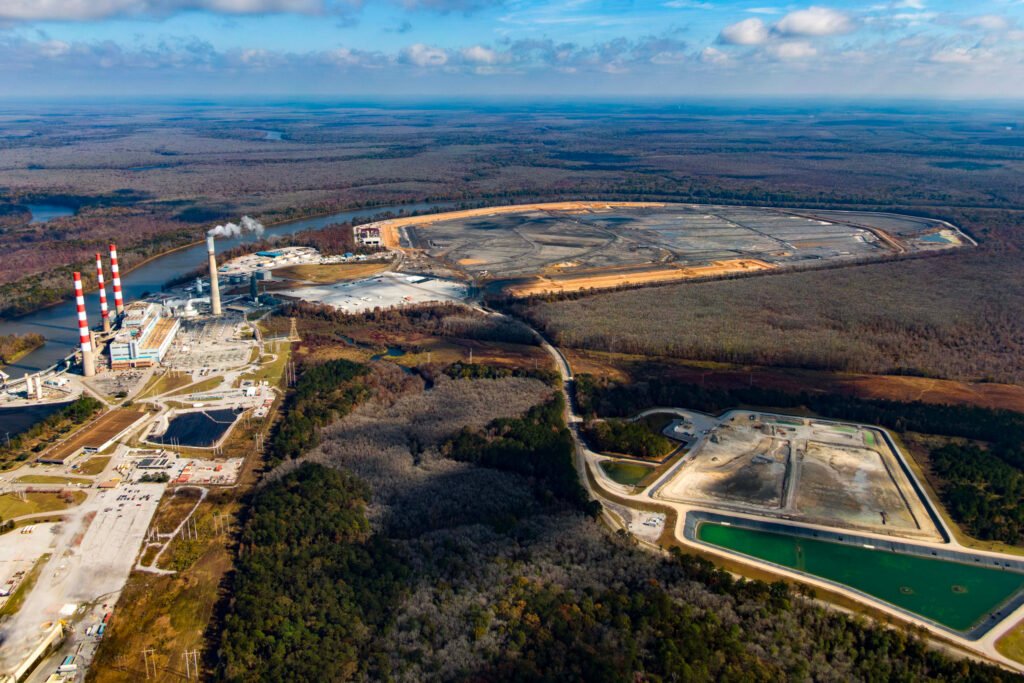
A years-long legal battle over 21.7 million tons of coal ash in one of Alabama’s most environmentally sensitive regions will continue after an appeals court ruling handed down Monday.
The U.S. Court of Appeals for the 11th Circuit has ruled that a lawsuit by Alabama-based environmental group Mobile Baykeeper challenging Alabama Power Co.’s plan to dump coal ash can proceed, overturning a lower court’s decision to dismiss the complaint.
Mobile Baykeeper’s lawsuit alleges that the approximately 600-acre coal ash pond at Alabama Power’s James M. Barry Generating Station near Mobile violates the Environmental Protection Agency’s coal ash regulations, primarily because much of the coal ash remains saturated with groundwater.
Baykeeper Cade Kistler told Inside Climate News that he hopes the ruling will prompt Alabama Power to agree to remove coal ash rather than continue fighting to keep toxic waste from coal-fired power plants in storage ponds.
“We certainly feel vindicated, but more importantly, I think we feel like this is an opportunity for Alabama Power to understand that there’s another path forward other than fighting this,” Kistler said.
Alabama Power said through a spokesperson that its coal ash ponds comply with the law.
“Alabama Power continues to comply with all applicable federal and state environmental laws and regulations,” the company’s response said. “We will continue to abide by the final decisions of courts and authorities. As litigation related to the Plant Barrie coal ash project is ongoing, we are unable to comment further at this time.”
Coal ash, or coal combustion residue, is the solid material left behind when coal is burned. They often contain substances such as arsenic, mercury, lead, and heavy metals that can cause human health problems, including cancer. At large coal-fired power plants like Barrie, this ash material was dumped into unlined wet reservoirs and ponds for decades, accumulating large amounts of toxic substances and often significantly contaminating the area’s groundwater.
The EPA’s new coal ash rule, enacted in 2015, requires utilities to close most unlined coal ash ponds by moving the ash to lined landfills or covering the ash in situ, if the operator can prove that contaminants from the ash are not contaminating groundwater.
Alabama Power soon announced plans to cap all ash ponds in place, and continued to stick to that plan despite significant opposition, especially around Plant Barry. Barry’s Ash Pond is located on the banks of the Mobile River just upstream of the Mobile Tensaw Delta.
The Delta is an undeveloped region of tangled streams, bayous, and wetlands that flows south toward Mobile Bay and the Gulf of Mexico. It is one of the most biodiverse places in North America and is home to an incredible variety of plant and animal species, earning it the nickname “America’s Amazon.”
Alabama Power was fined $1.25 million in 2018 for groundwater contamination violations around coal ash ponds, and received an additional $250,000 fine in 2019.
In 2023, the EPA issued a notice to Alabama Power of potential violations regarding Plant Barry’s coal ash, stating that the company “may not meet standards to effectuate closure of the Plant Barry ash pond.”
This story is funded by readers like you.
Our nonprofit newsroom provides free advertising for our award-winning climate coverage. We rely on donations from readers like you to continue our work. Donate now to support our work.
donate now
The EPA, under then-Secretary Michael Regan, took the position that coal ash ponds could not meet legal requirements if coal ash remained in contact with groundwater.
Monday’s ruling said the court was the appropriate forum to decide the issue.
“First, the simple question at the heart of this case is whether federal law allows capping a reservoir while coal ash remains in contact with groundwater,” the ruling said. “Federal courts can answer that question.”
Initially, Baykeeper’s lawsuit was dismissed primarily on procedural grounds.
The United States District Court for the Southern District of Alabama granted Alabama Power’s motion to dismiss the lawsuit in 2024, agreeing with the company’s argument that Mobile Baykeeper lacks standing to sue and is not ripe for consideration of its claims due to the changing national coal ash regulatory landscape.
On Monday, the Court of Appeals said in its ruling that it sent the case back to district court for trial: “We disagree on both counts.”
Mobile Baykeeper is represented in this lawsuit by the Southern Environmental Law Center.
“We are grateful that the Court of Appeals saw through Alabama Power’s baseless claims and delaying tactics and ordered this case to proceed,” Barry Bullock, senior attorney and director of the Southern Environmental Law Center’s Alabama office, said in a news release. “This lawsuit holds Alabama Power accountable. The company’s reckless plans at Plant Barry are a danger to communities around the Delta and Mobile Bay.”
Alabama Power has already announced plans to recycle more coal ash at Plant Barry, but it’s unclear how much will or can be recycled.
An Alabama Power spokesperson said an on-site recycling plant is under construction and is expected to be operational later this year. The company plans to keep all non-recycled materials covered.
Kistler said the company should work to recycle or remove all of Plant Barry’s ash.
“Nobody in coastal Alabama wants this coal ash to be here. This is a great opportunity for Alabama Power to figure out a way to solve this problem. Everyone who comes out will feel a little better,” he said.
About this story
As you may have noticed, this article, like all news we publish, is free to read. That’s because Inside Climate News is a 501c3 nonprofit organization. We don’t charge subscription fees, keep our news behind paywalls, or fill our website with ads. We provide climate and environmental news free to you and anyone who wants it.
That’s not all. We also share our news for free with dozens of other news organizations across the country. Many of them cannot afford to do environmental journalism themselves. We’ve established bureaus across the country to report on local news, partner with local newsrooms and co-publish stories to ensure this important work is shared as widely as possible.
The two of us started ICN in 2007. Six years later, we won the Pulitzer Prize for national reporting and now run the nation’s oldest and largest dedicated climate newsroom. We tell the story in its entirety. We hold polluters accountable. We expose environmental injustice. We debunk misinformation. We explore solutions and inspire action.
Donations from readers like you fund all aspects of our work. If you haven’t already, will you support our ongoing work, our coverage of the biggest crises facing our planet, and help us reach more readers in more places?
Please make a tax-deductible donation. Each one makes a difference.
thank you,

Dennis Pillion
alabama reporter
Dennis Pillion is a reporter for Inside Climate News based in Alabama. He joined ICN in 2024 after 17 years at Alabama Media Group, including nine years as a statewide natural resources reporter. His work at AL.com and the Birmingham News has won him numerous Green Eyeshade Awards and Alabama Press Association Awards for his coverage of Alabama’s environmental issues. He was born and lives in Birmingham, Alabama.
