


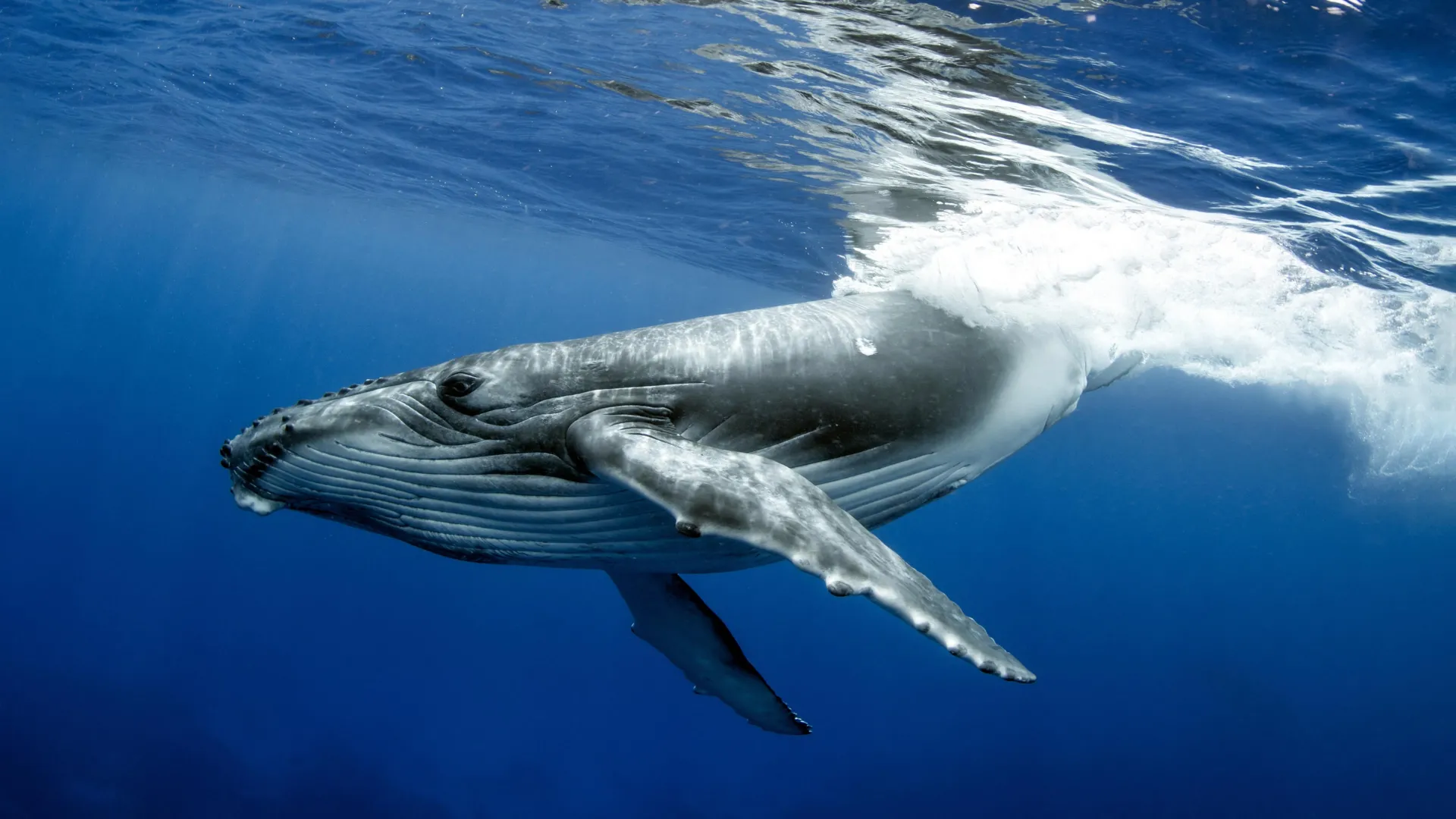
Scientists have recorded the incredible feat of whale migration for the first time, confirming that humpback whales traveled more than 14,000 kilometers of open ocean between eastern Australia and their breeding grounds in Brazil.
This discovery marks the largest distance ever recorded between individual sightings of humpback whales around the world.
“Discoveries like this are only possible thanks to decades of investment in long-term research programs and international collaboration,” said co-author Stephanie Stack, a PhD candidate at Griffith University.
“Even though these whales were photographed by different people, decades apart and in opposite parts of the world across two different oceans, we are still able to piece together their journeys.”
Whaletail photos reveal journey record
Researchers identified the whale by comparing tens of thousands of photos of humpback whale tails, known as trematodes. Each whale has unique markings that allow scientists to recognize individuals over time.
One whale was first photographed in 2007 in Hervey Bay, Queensland. It was seen again in the same waters in 2013, and then appeared near São Paulo, Brazil, in 2019.
The shortest straight-line distance between these breeding grounds is approximately 14,200 kilometers, roughly equivalent to the distance from Sydney to London.
Scientists noted that the whale likely traveled much further as only the start and end points of its journey were recorded. The exact route of migration remains unknown.
The second whale had even more surprising results. Researchers first photographed the whale in 2003 at Brazil’s Abrollhos Banco, the country’s main humpback whale farm off the coast of Bahia. At the time, a pod of nine adult whales was swimming lively.
Twenty-two years later, in September 2025, the same whale was found alone in Hervey Bay, Australia. The distance between recorded sightings was 15,100 kilometers, setting a record for the longest known migration of an individual humpback whale.
Decades of research and citizen science
The study is based on 19,283 high-quality fluke photographs collected in eastern Australia and Latin America between 1984 and 2025. Images were provided by both professional researchers and citizen scientists through the global whale tracking platform Happywhale.
The scientists compared the photos using automatic image recognition software and manually checked all potential matches to confirm the results.
“This type of research highlights the value of citizen science,” said Dr. Cristina Castro, principal investigator at the Pacific Whale Foundation.
“Every photo contributes to our understanding of whale biology and, in this case, helped uncover one of the most extreme movements ever recorded.”
Despite the incredible distances, the researchers emphasized how rare these migrations are. Out of more than 40 years of data covering approximately 20,000 confirmed humpback whales, only two were found to have migrated between two breeding grounds. This represents only 0.01 percent of the recorded whales.
Why rare whale crossings are important
Scientists say even these rare movements can play an important role in the long-term survival of whale populations.
“Despite their rarity, these exchanges are important for the long-term health of whale populations,” Stack said.
“Occasionally, the movement of individuals between distant breeding grounds helps maintain genetic diversity across populations, and may even transmit new song styles from one region to another. Humpback whale songs are known to spread culturally across ocean basins, similar to musical trends in human populations.”
The finding also supports what researchers call the “South Sea Exchange” hypothesis. This idea suggests that humpback whales from different breeding populations may occasionally meet at common feeding grounds in Antarctica. Some whales may then return along different migration routes and eventually settle in entirely new breeding areas.
Researchers believe climate change could make these unusual crossings more common in the future. Changes in Antarctic sea ice and changes in the distribution of Antarctic krill (whales’ main food source) may be changing whale migration patterns over time.
The study, “First evidence of two-way exchanges between distant humpback breeding populations in eastern Australia and Brazil,” Royal Society Open Science.
