


Shimmering crystals get their colorful appearance from the precise placement of atoms in space. In 2012, Nobel Prize-winning physicist Frank Wilczek proposed that a similar order might exist in time rather than space. He suggested that certain quantum systems could be organized into infinitely repeating patterns without the need for external energy. He called these systems time crystals. They exist in the lowest energy state while still exhibiting constant repetitive motion. Scientists experimentally confirmed its existence in 2016.
Researchers from Aalto University’s Department of Applied Physics have achieved a major milestone by linking a time crystal to an external system for the first time. The study, led by Academy researcher Jere Mäkinen, shows how the team converted time crystals into opto-mechanical systems. This approach could lead to technologies such as high-precision sensors and improved memory systems for quantum computers, which could improve performance.
The survey results are nature communications.
“In the quantum realm, perpetual motion is possible as long as it is not disturbed by external energy inputs, such as by observation. That is why time crystals have never been connected to an external system before,” Mäkinen says. “But we did just that, showing for the first time that this method can be used to tune the properties of crystals.”
Creating and maintaining time crystals
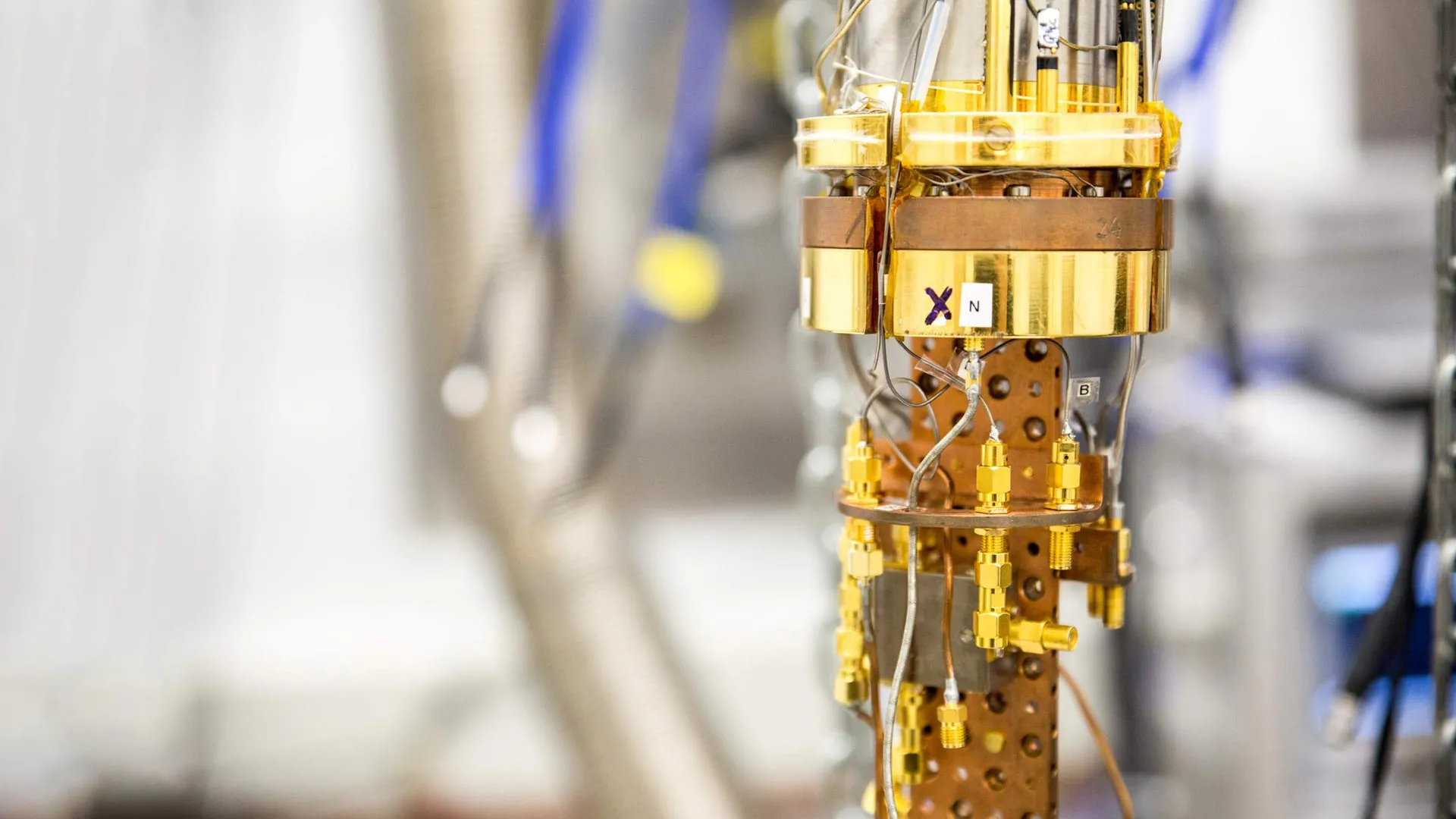
To build the system, the researchers used radio waves to inject magnons into a helium-3 superfluid cooled to temperatures near absolute zero. Magnons are quasiparticles, that is, groups of particles that behave as if they were individual particles. Once the radio input was turned off, Magnon and the others organized the time crystals.
This time, the crystal continued to move for an unusually long period of time, lasting up to 108 cycles or several minutes before decaying to unmeasurable levels. As it gradually weakened, the time crystal interacted with nearby mechanical oscillators. The nature of this interaction depends on the frequency and amplitude of the oscillator.
Connecting time crystals to optomechanics
“We have shown that changes in the frequency of time crystals are completely analogous to opto-mechanical phenomena widely known in physics. These are, for example, the same phenomena used in detecting gravitational waves at the US Laser Interferometer Gravitational-Wave Observatory. By reducing energy losses and increasing the frequency of the mechanical oscillator, we can optimize the setup to reach closer to the boundaries of the quantum realm,” Mäkinen says.
This link to optomechanics is important because it provides a way to control and tune the behavior of time crystals that was previously impossible.
The potential of quantum computing and sensing
Time crystals could play an important role in the advancement of quantum technology. Their ability to survive much longer than typical quantum systems makes them particularly promising.
“Time crystals will last many orders of magnitude longer than the quantum systems currently used in quantum computing. The best-case scenario is that time crystals could power and significantly improve the memory systems of quantum computers. Time crystals could also be used as frequency combs, used in very sensitive measurement devices as frequency standards,” Mäkinen said.
The research was carried out using the Cryogenic Laboratory, which is part of Otanano, Finland’s national infrastructure for nano, micro and quantum technologies. The team also used computational resources provided by the Aalto Science-IT project.
