

Close Menu

    Subscribe to Updates

    Get the latest creative news from FooBar about art, design and business.

    What's Hot

    Scientists discover unexpected way to force pancreatic cancer cells to self-destruct

    June 29, 2026

    Remote work can threaten relationships

    June 29, 2026

    Children under 2 years old should avoid screen time to protect their future health

    June 29, 2026
    Facebook X (Twitter) Instagram
    Facebook X (Twitter) Instagram
    Health Magazine
    • Home
    • Environmental Health
    • Health Technology
    • Medical Research
    • Mental Health
    • Nutrition Science
    • Pharma
    • Public Health
    • Discover
      • Daily Health Tips
      • Financial Health & Stability
      • Holistic Health & Wellness
      • Mental Health
      • Nutrition & Dietary Trends
      • Professional & Personal Growth
    • Our Mission
    Health Magazine
    Home » News » Stanford’s new chip enhances light 100 times at surprisingly low energy
    Nutrition Science

    Stanford’s new chip enhances light 100 times at surprisingly low energy

    healthadminBy healthadminMay 6, 2026No Comments4 Mins Read
    Stanford’s new chip enhances light 100 times at surprisingly low energy
    Share
    Facebook Twitter Reddit Telegram Pinterest Email


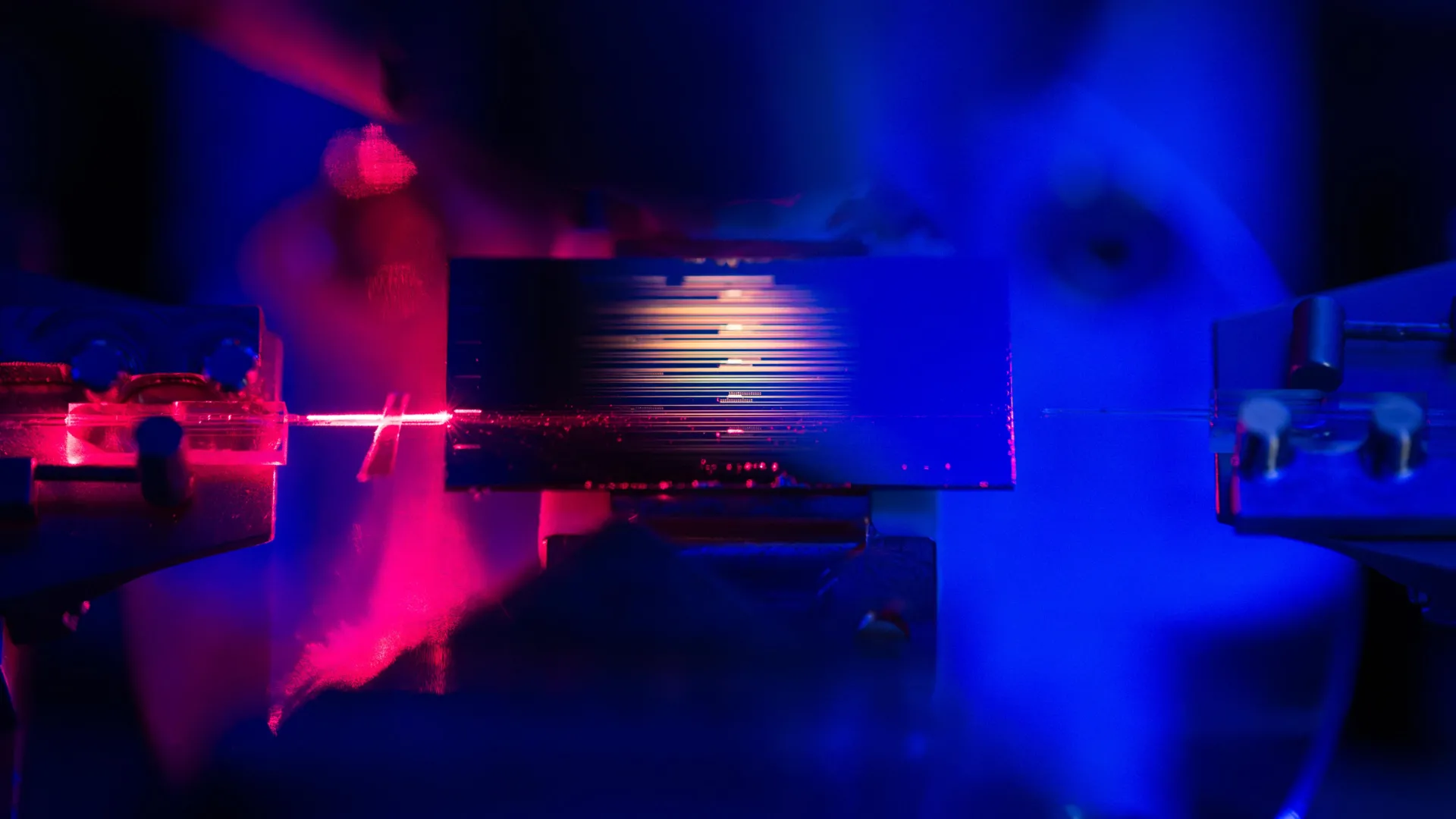
    Light plays a central role in modern technology, powering everything from televisions and satellites to the fiber-optic cables that carry Internet data around the world. Now, physicists at Stanford University have developed a way to push light even further. They created a compact optical amplifier, about the size of a fingertip, that can enhance optical signals while maintaining full bandwidth using very little energy.

    Optical amplifiers are similar to audio amplifiers, except that they amplify light rather than sound. Traditional compact versions require significant power to operate, which limits their efficiency. The new device, published in the journal Nature, overcomes this challenge by reusing much of the energy needed to operate.

    “We have demonstrated for the first time a truly versatile, low-power optical amplifier that can operate across the optical spectrum and is efficient enough to be integrated on a chip,” said Amir Safavi Naini, lead author of the study and associate professor of physics in Stanford University’s School of Humanities and Sciences. “This means we can now build much more complex optical systems than before.”

    An amplifier developed at Stanford University can increase the strength of an optical signal by about 100 times while using only a few hundred milliwatts of power. This is much less energy than similar devices typically require. Efficient and small, they run on batteries and can be integrated into devices such as laptops and smartphones.

    Reduce noise and increase bandwidth

    Like their audio counterparts, optical amplifiers can introduce unwanted noise when boosting the signal. The researchers showed that their design minimized this noise. It also operates over a wider range of wavelengths than existing amplifiers, allowing it to transmit more data with less interference.

    This type of amplifier relies on energy stored in a beam of light to act as a “pump.” Its performance is determined by the intensity of the pump light.

    “By recycling the energy of the pump that powers this amplifier, we increased the efficiency of the amplifier, without sacrificing the other properties of the amplifier,” said Devin Dean, co-lead author of the study and a doctoral student in Safavi-Naini’s lab.

    Recycle light energy for a stronger signal

    The research team achieved this efficiency using a resonant design similar to the method already used in lasers. Dean described this as an “energy recycling trick.” Simply put, this system can send light back to itself, increasing its intensity over time, much like light reflecting between two mirrors.

    Inside this amplifier, pump light is generated within a resonator and travels in a continuous circular path resembling a racetrack. The light increases in intensity as it loops, allowing it to more effectively amplify the target signal. This approach produces more powerful output while requiring less input energy.

    The device is compact and energy efficient, allowing it to operate on battery power and be integrated into small electronic devices.

    “If we can do that, the possibilities are huge, because it’s so small that it can be mass-produced and it can be powered by batteries,” Dean said. “They could be used for data communications, biosensing, creating new light sources, or a variety of other things.”

    Potential applications and research support

    Other Stanford co-authors include co-first author Taewon Park, a doctoral student in Safavi Naini’s lab. Professor of Applied Physics Martin Fejer. Postdoctoral researcher Hubert Stokowski. and doctoral students Sam Robison, Alexander Huang, Luke Chee, and Jason Herman.

    Dean, Park, Safavi-Naeini, and Stakowski are inventors on a patent application covering how to achieve quantum benefits in power-constrained photonic sensors.

    This research was supported in part by the Defense Advanced Research Projects Agency, NTT Research, and the National Science Foundation.


    Source link

    Visited 8 times, 1 visit(s) today
    Share. Facebook Twitter Pinterest LinkedIn Telegram Reddit Email
    Previous ArticleThe Dark Side of Weight Loss Drugs: The Surprising Hidden Cost of Ozempic
    Next Article Breakthrough biomaterial heals tissue from the inside out
    healthadmin

    Related Posts

    Scientists discover unexpected way to force pancreatic cancer cells to self-destruct

    June 29, 2026

    Clarifying the 2025-2030 Dietary Guidelines Contradictions

    June 29, 2026

    Millions of people take omega-3 fish oil for brain health, but new study finds no benefit

    June 29, 2026

    These fat-filled brain cells may be worsening multiple sclerosis

    June 29, 2026

    Physicists create strange new quantum state called fractional Fermi sea

    June 29, 2026

    Brain activity under anesthesia casts doubt on what we know about consciousness

    June 29, 2026
    Add A Comment

    Comments are closed.

    Categories

    • Daily Health Tips
    • Discover
    • Environmental Health
    • Exercise & Fitness
    • Featured
    • Featured Videos
    • Financial Health & Stability
    • Fitness
    • Fitness Updates
    • Health
    • Health Technology
    • Healthy Aging
    • Healthy Living
    • Holistic Healing
    • Holistic Health & Wellness
    • Medical Research
    • Medical Research & Insights
    • Mental Health
    • Mental Wellness
    • Natural Remedies
    • New Workouts
    • Nutrition
    • Nutrition & Dietary Trends
    • Nutrition & Superfoods
    • Nutrition Science
    • Pharma
    • Preventive Healthcare
    • Professional & Personal Growth
    • Public Health
    • Public Health & Awareness
    • Selected
    • Sleep & Recovery
    • Top Programs
    • Weight Management
    • Workouts
    Popular Posts
    • 1773313737_bacteria_-_Sebastian_Kaulitzki_46826fb7971649bfaca04a9b4cef3309-620x480.jpgHow Sino Biological ProPure™ redefines ultra-low… March 12, 2026
    • pexels-david-bartus-442116The food industry needs to act now to cut greenhouse… January 2, 2022
    • 1773729862_TagImage-3347-458389964760995353448-620x480.jpgDespite safety concerns, parents underestimate the… March 17, 2026
    • 1773209206_futuristic_techno_design_on_background_of_supercomputer_data_center_-_Image_-_Timofeev_Vladimir_M1_4.jpegMulti-agent AI systems outperform single models… March 11, 2026
    • 1774403998_image_28620e4b6b0047f7ab9154b41d739db1-620x480.jpgGait pattern helps distinguish between Lewy body… March 24, 2026
    • Leukemia-620x480.jpgBiomimetic platform powers CAR T therapy for… March 9, 2026

    Demo
    Stay In Touch
    • Facebook
    • Twitter
    • Pinterest
    • Instagram
    • YouTube
    • Vimeo
    Don't Miss

    Scientists discover unexpected way to force pancreatic cancer cells to self-destruct

    By healthadminJune 29, 2026

    Research published in onco target highlights a promising new approach to combating pancreatic cancer. The…

    Remote work can threaten relationships

    June 29, 2026

    Children under 2 years old should avoid screen time to protect their future health

    June 29, 2026

    Study links diabetes to worse health outcomes with long-term COVID-19 infection

    June 29, 2026

    Subscribe to Updates

    Get the latest creative news from SmartMag about art & design.

    HealthxMagazine
    HealthxMagazine

    At HealthX Magazine, we are dedicated to empowering entrepreneurs, doctors, chiropractors, healthcare professionals, personal trainers, executives, thought leaders, and anyone striving for optimal health.

    Our Picks

    Study links diabetes to worse health outcomes with long-term COVID-19 infection

    June 29, 2026

    Researchers develop new model to study advanced melanoma

    June 29, 2026

    Artificial intelligence models show major gaps with traditional human intelligence tests

    June 29, 2026
    New Comments
      Facebook X (Twitter) Instagram Pinterest
      • Home
      • Privacy Policy
      • Our Mission
      © 2026 ThemeSphere. Designed by ThemeSphere.

      Type above and press Enter to search. Press Esc to cancel.