


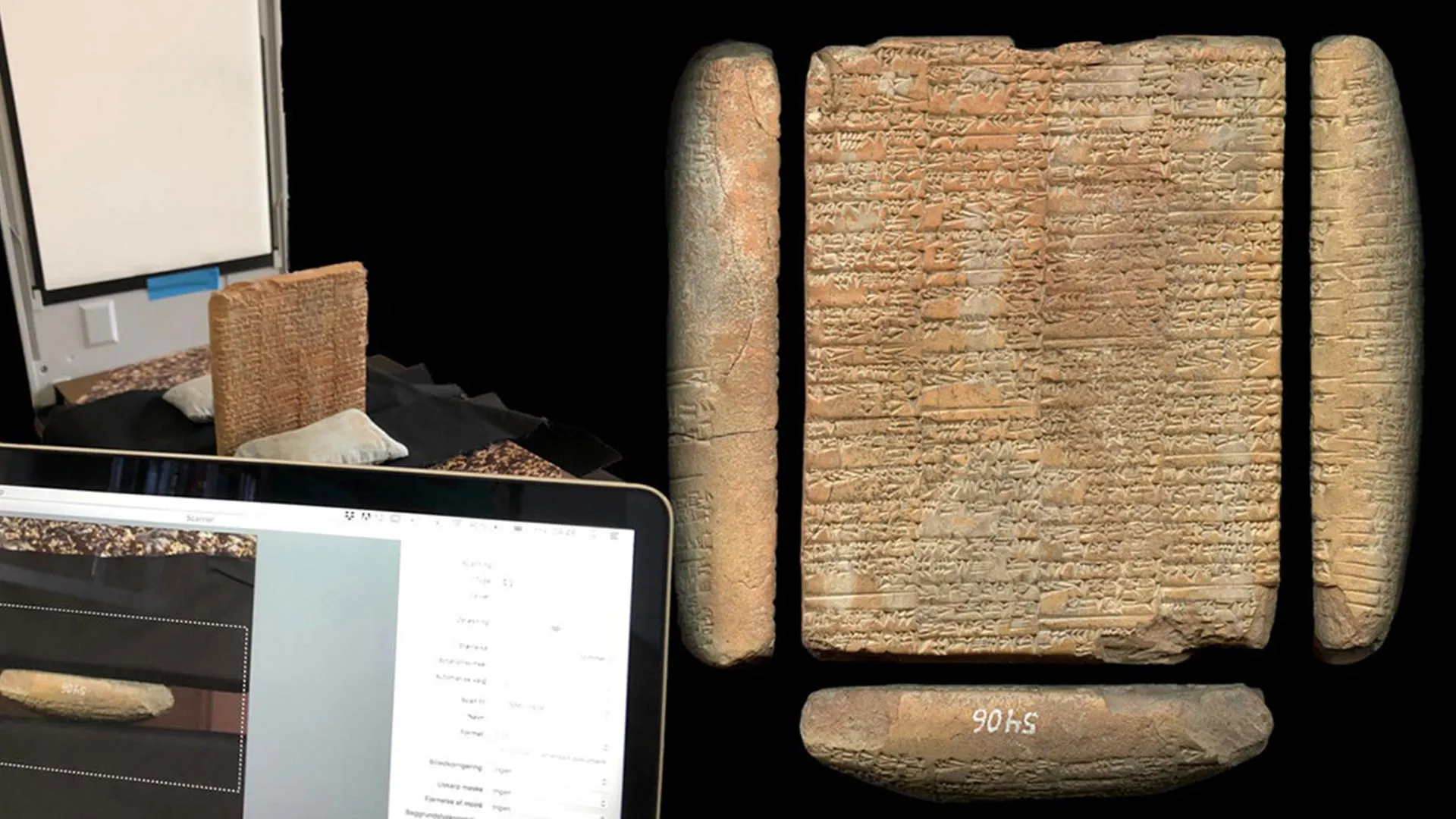
For more than a century, the National Museum has preserved an amazing collection of clay tablets from some of the earliest civilizations of the Middle East. Many of these artifacts are over 4,000 years old and written in long-lost languages. For decades they remained largely untouched, but researchers have now deciphered them and discovered documents ranging from magical rituals to royal records and daily administrative notes.
About 5,200 years ago, the people of what is now Iraq and Syria began stamping symbols into clay to record information. This early writing system, known as cuneiform, supported the rise of complex cities and organized governments by allowing people to track goods, people, and decisions.
Over the past century, the National Museum has amassed an important collection of these tablets. However, until recently they were not well studied. Researchers from the museum and the University of Copenhagen have completed the first comprehensive effort to analyze, identify and digitize the entire collection as part of the project ‘Hidden Treasures: The National Museum’s Cuneiform Collection’.
Valuable documents of ancient Hama
When the researchers examined the tablet closely, they found a wide range of contents, including letters, financial records, medical orders, and magical texts.
A particularly important group comes from the Syrian city of Hama, which was first explored by Danish explorers in the 1930s. In 720 BC, Assyrian forces destroyed the city and removed many of its valuables to their capital, Assur, located in modern-day Iraq. Several tablets were left at the ruins and eventually became part of the National Museum’s collection.
“The documents in the collection that come from Hama are almost 3,000 years old and concern medical and magical spells. They were left behind in ruins in what we believe must have been the library of a large temple. All other documents were gone,” explains Troels Pank Arbor, an Assyriologist involved in the Hidden Treasures project.
According to Arbol, these Hama documents are particularly rare because few similar examples have been found from that region and period. One tablet in particular stood out.
“One of the tablets was found to contain a so-called anti-witchcraft ritual, which was of great importance for Assyrian kingship, because it had an amazing ability to prevent misfortunes, such as political instability, that could befall the king,” says Troels Pank Arbor.
This ritual lasted all night and involved burning small dolls made of wax and clay while the exorcist chanted certain spells. Such rituals were closely tied to Assyrian power centers, so researchers were surprised to find the text so far from the empire’s core regions. Hummer was located on the outskirts of these cultural centers.
kings, legends and historical records
Among the finds is a copy of the famous King List, which records both mythical and historical rulers. This document is important because it traces back the kings to the time before Noah and the Flood.
The version found in the National Museum appears to have been used for education and includes rulers from the late 3rd millennium BC. Other versions of this list also mention the legendary King Gilgamesh, known from the Epic of Gilgamesh.
“So this king’s list is one of the few artifacts we have that suggests that Gilgamesh may have actually existed. I had no idea that a copy of that list was here in Denmark. It’s quite spectacular,” says Troels Pank Arbor.
Letters, government, and daily life
Another set of tablets was excavated in 1957 at Tell Shemsharah, located in what is now northern Iraq. These documents include correspondence and administrative records between local leaders and Assyrian kings from around 1800 BC.
Documents like this emphasize how important writing was to running early societies. Many tablets contain practical information such as inventory, employee lists, and financial accounts.
“The sheer number of cuneiform tablets we have today are evidence of a highly developed bureaucracy. Needing to keep track of the advanced societies that were being built, we discovered numerous cuneiform tablets containing practical information such as accounts and lists of goods and personnel. It is therefore not surprising that one of the tablets in the National Museum’s collection contains something as commonplace as a very old beer receipt,” concludes Troels-Punk-Arbor.
Digitizing ancient knowledge
The project “Hidden Treasures: The Cuneiform Collection of the Rijksmuseum” is led by Nicole Blish (University of Hamburg) and Anne Haslund Hansen (Rijksmuseum). This research was supported by the Carlsberg Foundation, the Augustinus Foundation and the Eduba Foundation.
