


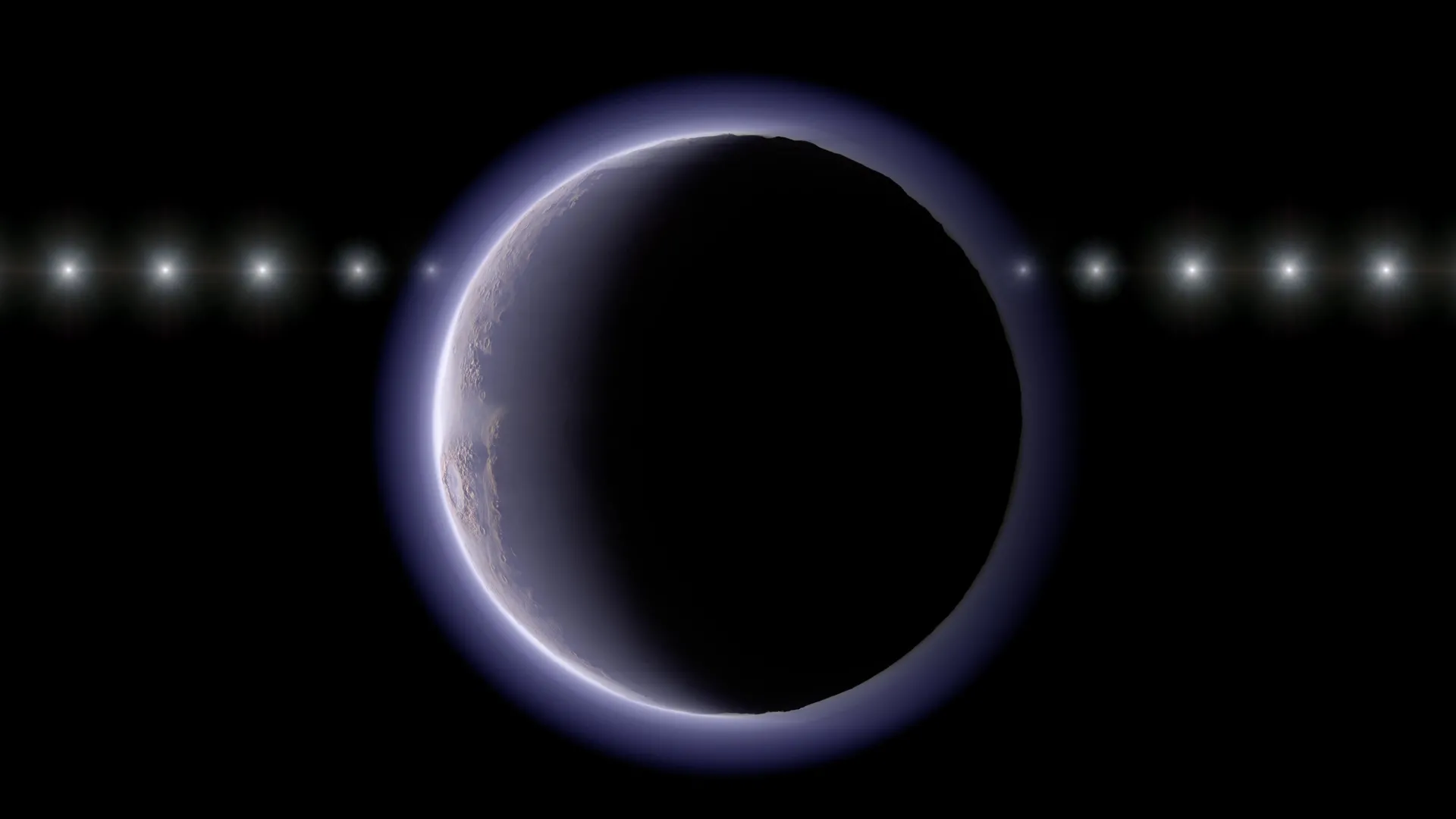
A group of professional and amateur astronomers in Japan has discovered evidence that small, distant objects in the outer reaches of our solar system are surrounded by a thin atmosphere. The discovery is surprising because the object is too small to retain gas for long, and raises new questions about how and when its atmosphere formed. Future observations will be needed to better understand its composition and origin.
Far beyond Neptune’s orbit, thousands of icy objects known as trans-Neptunian objects (TNOs) orbit the sun. Pluto is the best-known example and one of the few known to have a thin atmosphere. However, most TNOs are less likely to retain gas due to the combination of extremely low temperatures and weak gravity. As a result, scientists generally expect these distant objects to have no air.
Unusual stellar alignment reveals clues
Astronomers took a rare opportunity to test that assumption using a TNO called (612533) 2002 XV93. The object, commonly shortened to 2002 XV93, is about 500 km in diameter, much smaller than Pluto, which is 2,377 km long.
On January 10, 2024, 2002 XV93 passed directly in front of the background star as seen from Japan. Such phenomena, known as stellar occultations, allow scientists to study distant celestial objects in detail. If a celestial body had no atmosphere, starlight would suddenly disappear when it was blocked. If an atmosphere is present, the star’s light will gradually disappear as it passes through the surrounding gas.
Observations suggest a thin atmosphere
A research team led by Wataru Arimatsu of the National Astronomical Observatory of Japan’s Ishigakijima Observatory observed this phenomenon from multiple locations across Japan. Their measurements showed that the pattern is consistent with the gradual dimming expected when light passes through a thin atmosphere. These results strongly suggest that 2002 XV93 is surrounded by a layer of gas.
Short-lived and mysterious origins
Further analysis shows that this atmosphere should not last long. Calculations show that unless continually replenished, it will disappear in less than 1000 years. This means that the atmosphere must have formed or been updated relatively recently.
Data from the James Webb Space Telescope provides another piece of the puzzle. Observations show no evidence of frozen gases on the surface that could slowly transform into vapor and sustain the atmosphere. This leads scientists to consider other explanations. One possibility is that material inside the object was brought to the surface, releasing gas. Another is that the comet impact ejected or released enough material to create a temporary atmosphere.
Further observations will be needed to determine which scenario is correct and to better understand how such a small, distant object can temporarily retain an atmosphere.
