


BOGOTA, Colombia (AP) — Iran is has exposed deep vulnerabilities in the global economy. It’s not just our dependence on oil, gas and coal for fuel, but also on petrochemicals that underpin everything from food production to plastic packaging.
As confusion spreads, energy marketthis war highlights how fossil fuels are embedded far beyond transportation and electricity. In the short term, increased dependence on petrochemicals will lead to higher prices for a myriad of products, while in the long term the pollution caused by petrochemicals will exacerbate climate change.
A two-week ceasefire announced late Tuesday is a sign of hope that the war and energy chaos will subside. But no matter when it ends, for many environmentalists and energy experts alike, the war is ultimately a clear sign that the status quo needs to change.
“We cannot continue to rely on fossil fuels for energy or materials,” said Delphine Levi Alvarez, global petrochemical campaign manager at the International Environmental Law Center. “We cannot continue to rely on fossil fuels for everything around us.”
Petrochemicals are expected to be a central topic of discussion in the northern Colombian coastal city of Santa Marta when governments are scheduled to gather from April 24 to 29 for an international conference on the transition away from fossil fuels. Experts say the debate will focus on reducing demand, as the sector is a key driver of future fossil fuel use. Indeed, environmentalists have long argued that fossil fuel companies see petrochemicals as a place for their products, recognizing that green technologies like electric cars and solar power threaten their industries.
Petrochemicals are primarily made from oil and gas and are used to make a wide range of everyday products, from plastic packaging and synthetic fibers to fertilizers, paints, and medical devices. Unlike fuels that are burned to obtain energy, petrochemical products are materials, so although they are less visible to the naked eye, they are deeply ingrained in our daily lives.
Much of the world’s petrochemical industry is concentrated in the Persian Gulf region of the Middle East, including major producers of chemicals used to make fertilizers and plastics.
Petrochemicals are a driver of increased demand for fossil fuels
A gas company operates near a submerged tree in Manaure, Colombia, Thursday, February 6, 2025. (AP Photo/Ivan Valencia)
A gas company operates near a submerged tree in Manaure, Colombia, Thursday, February 6, 2025. (AP Photo/Ivan Valencia)
Add AP News to Google
See more stories on Google by adding AP News as your preferred source.
Share Read more
Petrochemicals already account for a large share of global oil use and are expanding rapidly even as some countries reduce their use of fuels for electricity and transportation.
Fredrik Bauer, a senior lecturer on industrial transformation in chemicals and plastics at Sweden’s Lund University, said the sector is becoming central to the fossil fuel system.
“Petrochemicals are more than just by-products and co-products,” Bauer said.
He said petrochemicals account for 15-16% of oil demand and are among the fastest growing applications, and new industrial facilities are increasingly being designed to maximize chemical production rather than fuels.
For consumers, that demand is largely invisible. Because petrochemicals are incorporated into everyday products such as plastics, fertilizers, and synthetic materials, their role in the economy is often overlooked.
Petrochemical supply chains are vulnerable
A farmer spreads fertilizer on his land on March 25, 2026 in Limuru, Kenya. (AP Photo/Jackson Njehia, File)
A farmer spreads fertilizer on his land on March 25, 2026 in Limuru, Kenya. (AP Photo/Jackson Njehia, File)
Add AP News to Google
See more stories on Google by adding AP News as your preferred source.
Share Read more
Beyond fuel markets, disruptions to oil and gas flows could quickly spill over into industries that rely on petrochemical feedstocks, especially agriculture, which relies heavily on fossil fuel-based fertilizers.
Bauer said the Middle East plays an important role not only in oil and gas exports, but also in the supply of petrochemical raw materials such as ammonia and urea and fertilizers. Disruptions to the planting season could have repercussions for the global food system.
“This is not just a disruption to global oil trade,” he said. “This is also a disruption to global trade in chemicals.”
That could lead to soaring food prices and widespread economic strain, he warned.
Tricia Farrelly, an environmental anthropologist at the Cauthron Institute in New Zealand, said the crisis highlights how the global system remains at risk after decades of dependence on fossil fuels.
“For me, this is like a wake-up call to another coronavirus,” she said, pointing to the risks to food security and livelihoods due to rising costs and supply disruptions.
He said agriculture is one of the most difficult sectors to transition away from petrochemicals, given its dependence on fertilizers, pesticides, plastics and fuels.
There is no simple alternative
A worker sorts empty bottles at a plastic recycling factory in Lahore, Pakistan, August 7, 2025. (AP Photo/KM Chaudary, File)
A worker sorts empty bottles at a plastic recycling factory in Lahore, Pakistan, August 7, 2025. (AP Photo/KM Chaudary, File)
Add AP News to Google
See more stories on Google by adding AP News as your preferred source.
Share Read more
Experts say cutting petrochemicals could significantly reduce dependence on fossil fuels, but there is no one solution.
Mr Farrelly said reducing the use of petrochemicals, particularly plastics, would “certainly” reduce dependence on fossil fuels. But she cautioned against thinking that alternatives like bio-based plastics could simply replace them.
“We need to regulate non-essential plastics,” she said, arguing that demand reduction is essential alongside all material substitution.
In recent years, international negotiations on plastic pollution have failed to reach an agreement. The main reason for this is that major oil-producing countries have balked at attempts to limit plastic production.
Bio-based plastics are generally more expensive to produce than traditional plastics made from fossil fuels and chemicals, limiting their large-scale adoption, according to the European Commission’s Joint Research Center, the European Union’s scientific knowledge agency. They currently account for about 0.5% of global plastic production, according to the center.
Mr Farrelly said a shift to alternatives without appropriate safeguards risked creating new environmental and social problems, particularly if they promoted land use change or increased demand for agricultural inputs.
Bauer said the same was true across the sector. Renewable energy such as solar, wind, and geothermal energy can reduce the greenhouse gas emissions associated with production, but it is much more difficult to replace fossil-based feedstocks. Recycling can help, but only if it is accompanied by a reduction in overall consumption, he said.
Reducing dependence on petrochemicals also requires a change in consumption, Levi Álvarez said, pointing to measures such as reducing the use of heavy packaging, supporting local food systems, and connecting more directly with farmers and producers to reduce dependence on synthetic fertilizers and pesticides.
The petrochemical industry says its products are essential to modern life and the energy transition, and demand is likely to remain strong.
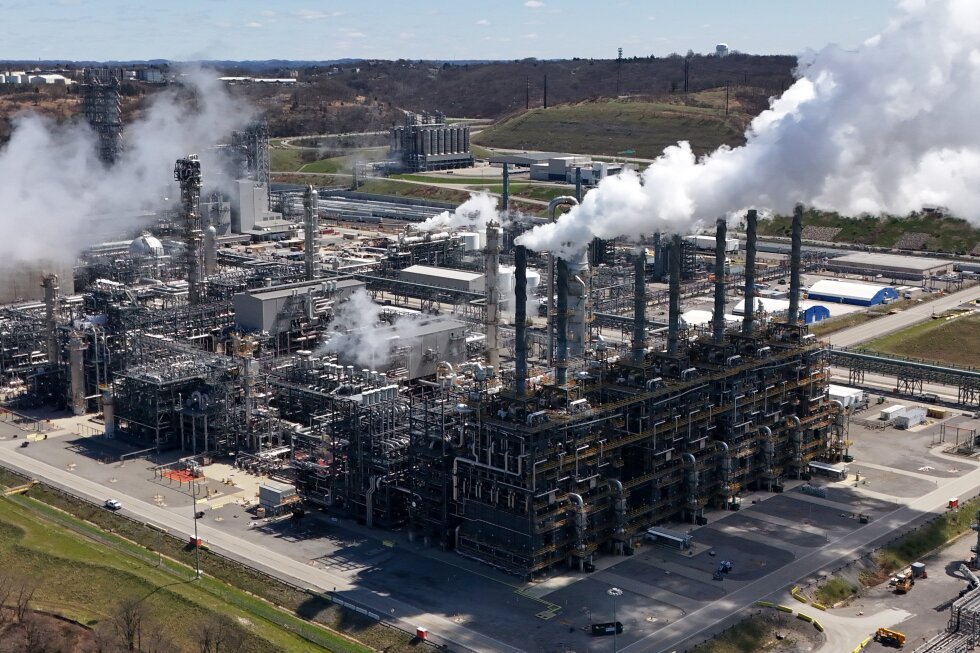
Shell Polymers Monaca Plant, a petrochemical plant, operates Tuesday, April 7, 2026, in Monaca, Pennsylvania. (AP Photo/Gene J. Puskar)
Shell Polymers Monaca Plant, a petrochemical plant, operates Tuesday, April 7, 2026, in Monaca, Pennsylvania. (AP Photo/Gene J. Puskar)
Add AP News to Google
See more stories on Google by adding AP News as your preferred source.
Share Read more
The American Chemistry Council, which represents U.S. chemical manufacturers, told The Associated Press in a written response to questions that petrochemicals are used in a wide range of products, from medical devices and semiconductors to building materials and packaging, and are key to renewable technologies such as wind turbines, solar panels and electric vehicles.
The group said companies were working to reduce emissions through efficiency improvements, recycling and new technologies, and rejected the idea that demand should fall, saying petrochemicals were “foundational” for sectors such as healthcare, food production, water and infrastructure.
Levi Alvarez, campaign manager at the International Environmental Law Center, said petrochemicals are so ingrained in everyday life that many people don’t realize how much they rely on them, but individuals and communities can start by rethinking their consumption and engaging more closely with local institutions.
“It’s not a consumer choice,” she said, noting that while many people are constrained by what’s available, they may still start looking at everyday items differently.
___
Associated Press climate and environment reporting receives funding from several private foundations. AP is solely responsible for all content. Find AP standard Please see below for our philanthropic efforts, list of supporters and areas funded. AP.org.
