


President Donald Trump stood on the Truman Balcony of the White House last week during the “Great American Agriculture Celebration” and announced what he called a “historic” boost for the nation’s farmers.
President Trump said the Environmental Protection Agency will require a record amount of crop-based biofuels to be blended into the nation’s gasoline supply, a move the administration promises will bring jobs and cash flow to the agriculture industry, which is feeling the double whammy of the president’s tariffs and soaring fertilizer prices linked to the Iran war. President Trump has called himself a “true friend and champion” of the nation’s farmers, an important political constituency that Trump is courting again in an aggressive and festive manner.
But some analysts and researchers say the administration’s plan has serious flaws. The United States does not produce enough vegetable oils to meet the demands of the new formulation goals. This means more foreign vegetable oils will need to be imported, endangering climate-critical tropical forests thousands of miles away as they are cleared to grow more oil crops.
In addition to these negative climate impacts, the new target will actually increase diesel prices by 30 cents per gallon this year and 36 cents per gallon by 2027, according to the EPA.
“According to EPA’s own analysis, this particular rule will cost approximately $20 billion over the first two years after it goes into effect,” said Dan Lashoff, a senior fellow at the World Resources Institute. “And far from having any environmental benefits, it actually causes deforestation and increased heat-trapping carbon emissions.”
The global vegetable oil market is highly interlocked. When vegetable oils are diverted from food to fuel uses, the oil for food may need to be sourced elsewhere, from areas where carbon-rich tropical forests are cleared to produce soybean and palm oil.
Jeremy Martin, a senior scientist at the Union of Concerned Scientists, says bio-based diesel consumption in the United States has skyrocketed in recent years. Imported vegetable oils and animal fats met about 70% of that demand.
The EPA has set biofuel volumes at approximately 27 billion gallons for 2026 and 2027, of which 15 billion gallons will be corn-based ethanol, the same amount as the previous year. But the new mandate calls for increasing biomass-based diesel, including plant-based and renewable diesel, by 60%, or about 9 billion gallons, by 2025.
“This 60% increase is huge,” Martin said. “That would be a huge shock to the U.S. and global vegetable oils and fats markets.”
Martin pointed to a recent study by Aaron Smith of the University of California, Berkeley, showing that between 2002 and 2018, global demand for biomass-based diesel led to the deforestation of more than 4 million acres in Southeast Asia, releasing more than 1 gigaton of carbon dioxide. This conversion means that biomass-based diesel actually has higher carbon emissions than fossil fuel-based diesel.
“Increasing the use of vegetable oils as fuel has a dramatic impact on deforestation,” Martin says. “The amount of vegetable oil available for fuel in the United States has increased by less than 60 percent, so an increase of this magnitude would have a dramatic impact on the trade balance, forcing the United States to import even more vegetable oil.”
Paul Winters, a spokesman for the Clean Fuels Alliance America, the nation’s largest biodiesel industry group, said the EPA reviewed Martin’s claims and “concluded that North American feedstock supply is not a limiting factor in meeting the final RFS amount.”
“A strong U.S. market for biodiesel and renewable diesel is needed to keep agriculture, the production of food, animal feed, and other agricultural products, economically viable,” Winters added.
This story is funded by readers like you.
Our nonprofit newsroom provides free advertising for our award-winning climate coverage. We rely on donations from readers like you to continue our work. Donate now to support our work.
donate now
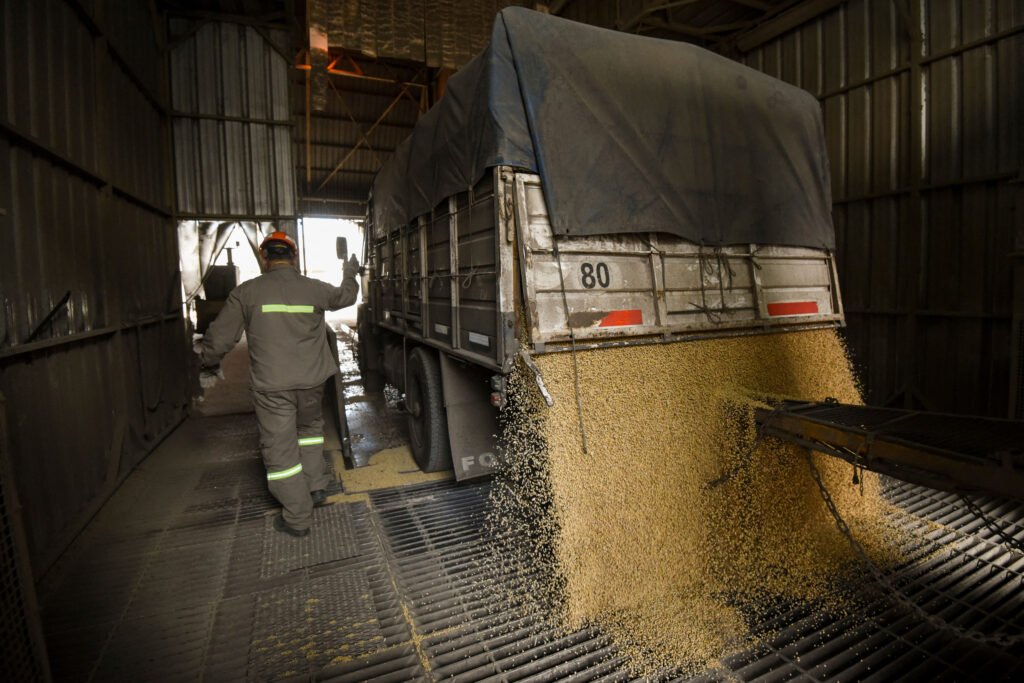
U.S. producers are now stuck with unsold soybeans, largely because their biggest buyer, China, turned to Latin America in response to President Trump’s trade tariffs last year. But building up production capacity to turn these soybeans into oil will take years.
Palm oil is primarily produced in Malaysia and Indonesia and is primarily used in food and cosmetics, but its cultivation leads to too much deforestation to qualify under the U.S. Renewable Fuels Standard or the European Union.
“However, this rule will encourage increased demand for soybean oil, which will result in higher prices for all highly correlated vegetable oils,” Rashoff said. “The problem is that in the meantime, other vegetable oils are used to make biofuels, and then palm oil is used to backfill that oil in the food market.…They are very closely tied as substitutes in the international market.”
The EU recently announced that it will no longer allow soy-based biofuels to be included in renewable fuel mandates, similar to palm oil, because they pose a high risk of deforestation and land use conversion. “The expansion of palm oil and soybean production areas into areas with high carbon stocks is so important that greenhouse gas emissions resulting from land-use changes offset any greenhouse gas emissions reductions from fuels derived from this feedstock when compared to the use of fossil fuels,” the EU regulator said in its assessment of the new rules.
The United States is moving in exactly the opposite direction.
Princeton University researcher Tim Sursinger, who has long questioned the emissions benefits of biofuels, said the new EPA mandate is “very bad for the climate and for nature.”
“Every gallon of U.S. biodiesel increases by almost exactly one gallon of vegetable oil imports,” he explained. “The sources of new vegetable oils around the world are mainly the expansion of oil palm into the tropical forests of Southeast Asia and its expansion in Africa and Latin America, as well as the expansion of soybean in Latin America.”
Sahinger said the expansion of biodiesel alone would likely lead to more than 7 million acres of tropical deforestation, resulting in greenhouse gas emissions that would be “three to four times the fossil emissions of diesel over 30 years.”
Winters of Clean Fuels Alliance America rejected the data behind indirect land use change.
“Environmental activists promoting the theory of indirect land use change (ILUC) have had no success in preventing deforestation over the past several decades,” Winters wrote in an email. “National and state-level policies that protect existing forests are the only mechanism that works. The level of uncertainty and unreliability in the ILUC model is surprising, and the results are entirely dependent on assumptions.”
About this story
As you may have noticed, this article, like all news we publish, is free to read. That’s because Inside Climate News is a 501c3 nonprofit organization. We don’t charge subscription fees, keep our news behind paywalls, or fill our website with ads. We provide climate and environmental news free to you and anyone who wants it.
That’s not all. We also share our news for free with dozens of other news organizations across the country. Many of them cannot afford to do their own environmental journalism. We’ve established bureaus across the country to report on local news, partner with local newsrooms and co-publish stories to ensure this important work is shared as widely as possible.
The two of us started ICN in 2007. Six years later, we won the Pulitzer Prize for national reporting and now run the nation’s oldest and largest dedicated climate newsroom. We tell the story in its entirety. We hold polluters accountable. We expose environmental injustice. We debunk misinformation. We explore solutions and inspire action.
Donations from readers like you fund all aspects of our work. If you haven’t already, will you support our ongoing work, our coverage of the biggest crises facing our planet, and help us reach more readers in more places?
Please make a tax-deductible donation. Any of those things make a difference.
thank you,

Georgina Gustin
washington dc reporter
Georgina Gustin covers agriculture for Inside Climate News and has spent much of her journalism career reporting on the intersection of agriculture, food systems, and the environment. Her work has earned her numerous awards, including the John B. Oakes Award for Excellence in Environmental Journalism, and she has been named Glenn Cunningham Agriculture Journalist of the Year twice and once with her ICN colleagues. She has worked as a reporter for The Day in New London, Conn., the St. Louis Post-Dispatch, and CQ Roll Call, and her articles have appeared in the New York Times, Washington Post, and National Geographic’s The Plate, among others. She is a graduate of Columbia University Graduate School of Journalism and the University of Colorado Boulder.
