


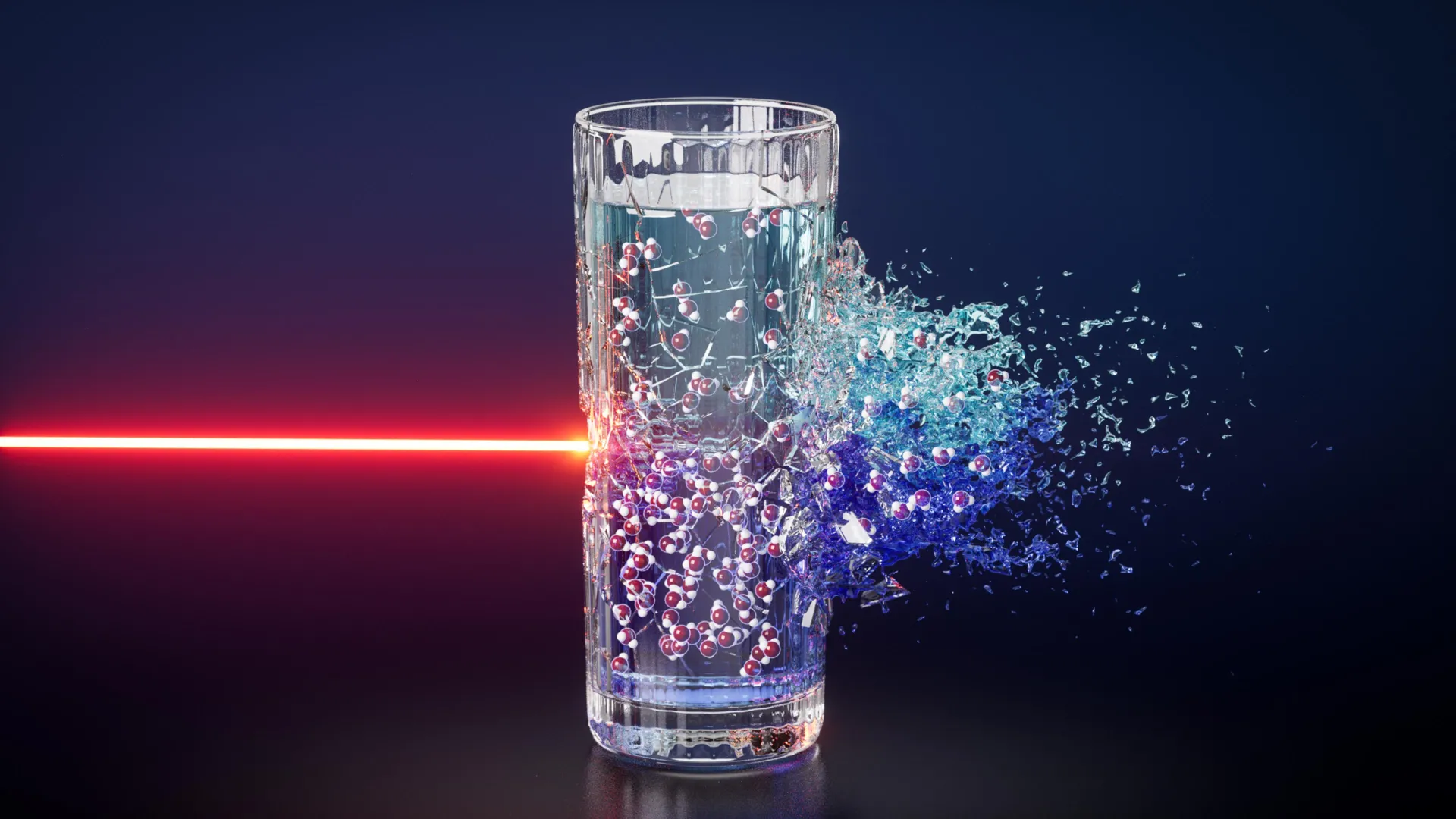
Researchers at Stockholm University have used advanced X-ray lasers to reveal a long-suspected feature of water: a critical point that appears when water is deeply supercooled. This occurs at approximately -63 °C and 1000 atm. Even under everyday conditions, this hidden spot influences the behavior of water and helps explain many of its unusual properties. The results were published in a magazine science.
Water is ubiquitous and essential to life, but it is unlike most other liquids. Properties such as density, heat capacity, viscosity, and compressibility respond to temperature and pressure in ways opposite to what scientists observe in common materials.
Most materials shrink and become denser when cooled. Based on this pattern, water should reach its highest density when frozen. Instead, ice floats, and liquid water is actually most dense at 4 degrees Celsius. This is why cold water remains beneath warmer water in lakes and oceans.
When water cools below 4 degrees, it begins to expand again. When pure water is cooled below 0 degrees Celsius (crystallization occurs slowly), this expansion continues and accelerates as the temperature is further reduced. Other properties such as compressibility and heat capacity also exhibit anomalous behavior as the temperature decreases.
Capturing the hidden state of water with an X-ray laser
To investigate these strange behaviors, scientists used extremely fast X-ray pulses produced by a powerful laser in South Korea. These pulses made it possible to observe the supercooled state of water just before it turns into ice.
“What was special was that we were able to take X-ray images at unimaginable speeds before the ice froze, and observe how the liquid-liquid transition disappears and a new critical state emerges,” says Anders Nilsson, professor of chemical physics at Stockholm University’s Department of Physics. “For decades there has been speculation and various theories to explain these surprising properties, and one theory was the existence of a tipping point. Now we know that such a point exists.”
Two liquid waters and important transitions
At low temperatures and high pressures, water can exist as two distinct liquid phases with different molecular bond structures. When conditions change, these two forms merge into a single phase at a critical point.
Around this point, the system becomes very unstable and the water changes rapidly between the two liquid states or a mixture thereof. These variations span a wide range of temperatures and pressures, and even normal environmental conditions. Scientists believe that these constant changes give water its unusual properties.
Beyond the critical point, water enters a supercritical state, and under everyday conditions it already exists in this state.
“Black hole-like” effects in hydraulics
The researchers also discovered that as water approaches a critical point, molecular motion slows down dramatically.
“Once you hit the critical point, it seems almost impossible to escape the black hole,” said Robin Tybulski, a chemical physicist at Stockholm University.
Achieving breakthroughs over decades
“It’s amazing how amorphous ice, a state of water that has been studied so extensively, happened to be the gateway to a critical region,” said Aigerim Karina, a postdoctoral researcher in chemical physics at Stockholm University.
“Being able to measure water at such low temperatures without freezing it is a dream come true,” says Iason Andronis, a PhD student in chemical physics at Stockholm University. “Many people have dreamed of finding this critical point, but the means to do so were not available until the development of the X-ray laser.”
“I think it’s very interesting that water is the only supercritical liquid in the ambient conditions where life exists. We also know that without water there is no life. Is this pure coincidence, or is there important knowledge that we should acquire in the future?” says Phibos Perakis, associate professor of chemical physics at Stockholm University.
Solving a century-old water mystery
“The origins of water’s strange properties have been hotly debated for more than a century, ever since Wolfgang Roentgen’s early studies,” explains Anders Nilsson. “Researchers studying the physics of water have now settled on a model in which water has a critical point at a supercooled state. The next step is to find the implications of these findings regarding the importance of water in physical, chemical, biological, geological and climate-related processes. This is a major challenge in the coming years.”
International cooperation behind the discovery
The research includes a collaboration between Stockholm University, POSTECH University, South Korea’s PAL-XFEL, the Max Planck Society, Germany’s Johannes Gutenberg University and St. Francis Xavier University in Candada. Contributors include Aigerim Karina, Robin Tyburski, Iason Andronis, and Fivos Perakis, as well as former members of the Chemical Physics Group at Stockholm University.
