


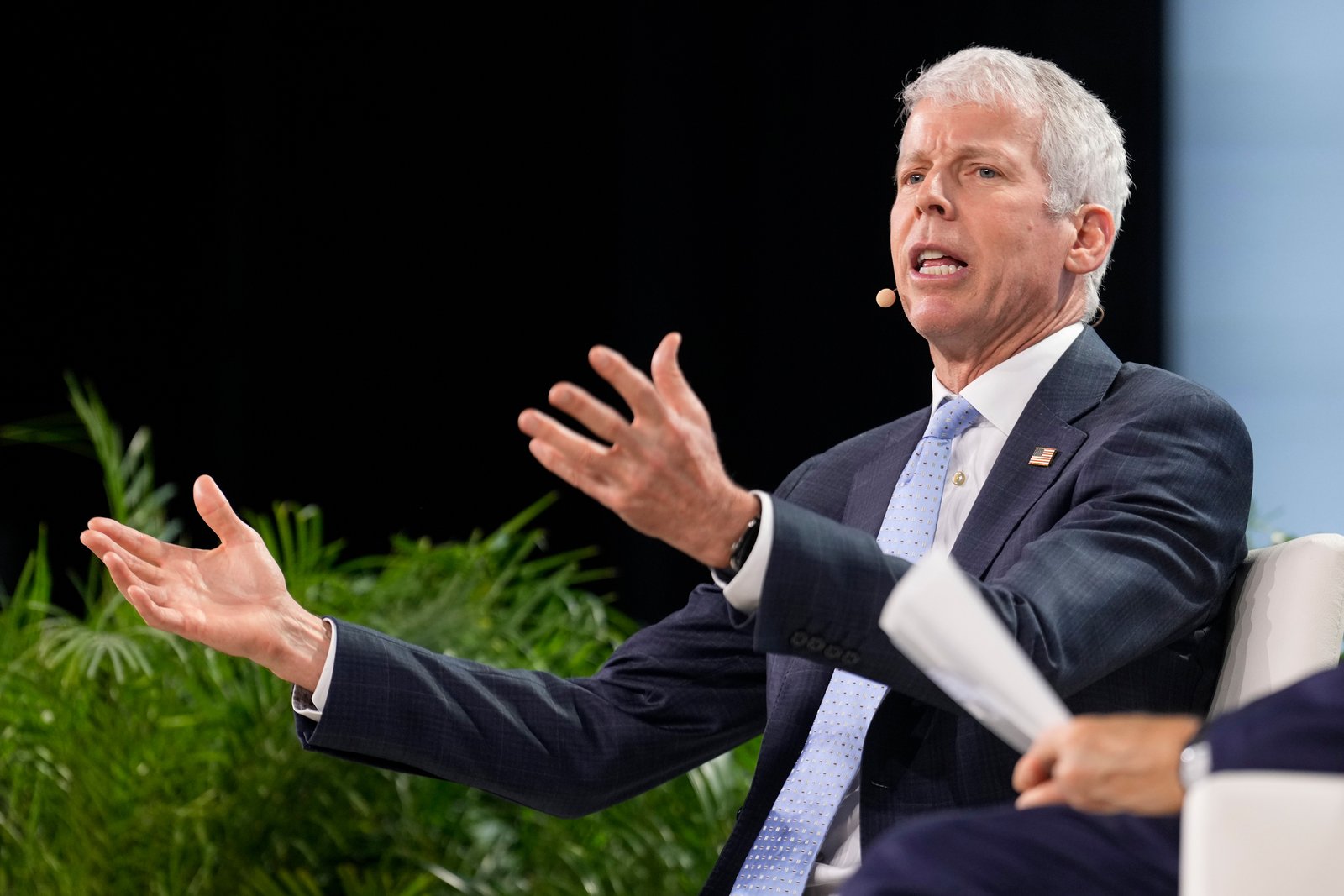
Energy Secretary Chris Wright, a longtime believer in fossil fuel expansion, on Monday issued a blunt directive to the world’s largest oil and gas producers to produce more and do it now.
The call was made at S&P Global’s CERAWeek, the “Super Bowl” of energy conferences, held in Houston. Smoke has risen thousands of miles away in the Persian Gulf following weeks of U.S. and Israeli airstrikes on Iranian infrastructure.
The conflict has caused one of the largest energy supply shocks in modern history, with Brent crude trading between $101 and $103 per barrel on Tuesday morning and the average gasoline price across the country just under $4 per gallon, according to AAA.
But the White House’s push to increase production has met resistance from major oil companies. Industry CEOs have warned that geopolitical instability has decoupled energy prices from physical supply and demand fundamentals, making them wary of long-term investments in the “fog of war.”
Speaking at CERAWeek, Chevron CEO Mike Wirth warned that global energy trade was operating on the basis of rather “poor information and awareness”.
“They’re uncertain, they’re unpredictable. They’re volatile,” Wirth said, explaining the market’s dizzying reaction to the latest headlines.
He added that the physical supply disruption caused by the closure of the Strait of Hormuz has not yet been fully reflected in current oil futures prices, suggesting the true economic pain is yet to come.
Oil prices rose more than $112 a barrel on Friday before falling more than 10% on Monday following President Donald Trump’s announcement that the United States and Iran had held productive talks to end the war. Iran has denied talks with the White House.
The war closed the Strait of Hormuz, through which a fifth of the world’s oil and gas supplies pass, destroyed Iranian gas fields and caused long-term damage to the Middle East’s key energy infrastructure. The death toll exceeds 2,000.
On Saturday, President Trump further escalated the stakes, giving Iran a 48-hour ultimatum to reopen the strait or face attacks on its domestic power plants. Environmental advocates have warned that the move could cause an unprecedented ecological disaster in the region. But the president on Monday extended that deadline until Friday.
Jarrod Agen, executive director of President Trump’s National Energy Control Council, defended the administration’s decision to attack Iran on Monday night and touted steps the White House has taken to address the energy crisis. That includes a five-day extension of President Trump’s threat to attack Iranian power plants, a waiver of shipping laws to allow more oil imports, and the release of millions of barrels of oil from strategic stockpiles.
Asked by a Politico reporter if anyone had told President Trump that attacking Iran would ensure the closure of the Strait of Hormuz, Ajan dodged the question and called Trump a master negotiator.
Ajan said “drill baby drill” is the weekly watchword when the government meets with oil executives about increasing production. “I haven’t heard any backlash from wanting to produce more.”
Ajan pointed to two main routes to increasing production. The first is on the northern slopes of Alaska, from which crude oil is shipped to Asian markets, including Japan, an ally of the United States. The second is Venezuela.
“Chevron has oil production there,” Ajan said. “They’re already at record levels. There’s still a lot they can do even better.”
This story is funded by readers like you.
Our nonprofit newsroom provides free advertising for our award-winning climate coverage. We rely on donations from readers like you to continue our work. Donate now to support our work.
donate now
But Wirth wasn’t the only executive to express concerns. Sultan Al Jaber, CEO of Abu Dhabi National Oil Company, warned via video that the “systemic” nature of the crisis will inevitably slow global growth and punish the world’s most vulnerable people. Patrick Pouyanne, CEO of Total Energy, also bluntly stated that if the Strait remains closed for more than three or four months, the world will face a crisis that will dwarf the 2022 energy shock caused by Russia’s invasion of Ukraine.
“We can’t have 20% of the oil exported around the world sitting in the Gulf,” Pouyanne said.
Philippe Benoit, Managing Director of Global Infrastructure Advisory Services 2050, emphasized that predictability is the lifeblood of the oil industry.
“Peace tends to serve corporate goals better than the uncertainty of war,” Benoit said.
He noted that major U.S. companies, including ExxonMobil, are gambling billions of dollars in the Middle East, and their assets are becoming increasingly vulnerable. These risks became a reality last week when an Iranian missile attack severely damaged Qatar’s Ras Laffan liquid natural gas plant, in which ExxonMobil has invested tens of billions of dollars.
The president’s comments are adding to the industry’s hesitation. Executives said Trump’s insistence that prices would “quickly go down” once the war ends is undermining incentives to pour capital into today’s expensive new drilling projects.
President Trump is also moving to restore subsidies for renewable energy and block wind power projects in the pipeline. Experts say this energy source could protect the United States from oil and gas shocks. The Trump administration announced Monday that it has agreed to pay Total Energy nearly $1 billion to shut down a proposed wind farm in the Atlantic Ocean in exchange for the company to invest money in new oil and gas projects in the United States.
“The president has made it pretty clear that he doesn’t want new wind projects,” Ajan said, pointing to nuclear power as the ultimate “solution” to America’s growing energy consumption.
While the administration pivots toward fossil fuels, the economic pressures of rising gasoline prices are increasing for ordinary people. Benoit pointed out that electric car owners are currently weathering fluctuations much better than owners who rely on internal combustion engines.
“People who drive EVs have not felt the recent rise in oil prices as much as people who drive gasoline-powered cars,” he said.
The financial sector is preparing for the worst. Goldman Sachs issued a stark warning on Monday, nearly doubling its forecast for oil prices as the Strait of Hormuz remains closed. The bank now expects Brent crude to average $110 through April, 62% above last year’s average.
Analysts warned that if shipments remain at just 5% of normal shipping capacity for 10 weeks, prices could surpass the 2008 record of $147 a barrel.
About this story
As you may have noticed, this article, like all news we publish, is free to read. That’s because Inside Climate News is a 501c3 nonprofit organization. We don’t charge subscription fees, keep our news behind paywalls, or fill our website with ads. We provide climate and environmental news free to you and anyone who wants it.
That’s not all. We also share our news for free with dozens of other news organizations across the country. Many of them cannot afford to do their own environmental journalism. We’ve established bureaus across the country to report on local news, partner with local newsrooms and co-publish stories to ensure this important work is shared as widely as possible.
The two of us started ICN in 2007. Six years later, we won the Pulitzer Prize for national reporting and now run the nation’s oldest and largest dedicated climate newsroom. We tell the story in its entirety. We hold polluters accountable. We expose environmental injustice. We debunk misinformation. We explore solutions and inspire action.
Donations from readers like you fund all aspects of our work. If you haven’t already, will you support our ongoing work, our coverage of the biggest crises facing our planet, and help us reach more readers in more places?
Please make a tax-deductible donation. Each one makes a difference.
thank you,

Katie Sarma
pittsburgh reporter
Katie Sarma is a reporter for Inside Climate News covering the natural rights movement and international environmental justice. Her work focuses on the intersection of human rights and the environment. Prior to joining ICN, he worked as an attorney specializing in commercial litigation. Her journalistic work has been recognized by the Overseas Press Club, the International Association of Journalists, and the Business Editors and Writers of America, among others. Katie holds a master’s degree in investigative reporting from Arizona State University’s Walter Cronkite School of Journalism, an LLM in international rule of law and security from ASU’s Sandra Day O’Connor School of Law, a J.D. from Duquesne University, and a major in art and architectural history from the University of Pittsburgh. Katie lives in Pittsburgh, Pennsylvania.
