


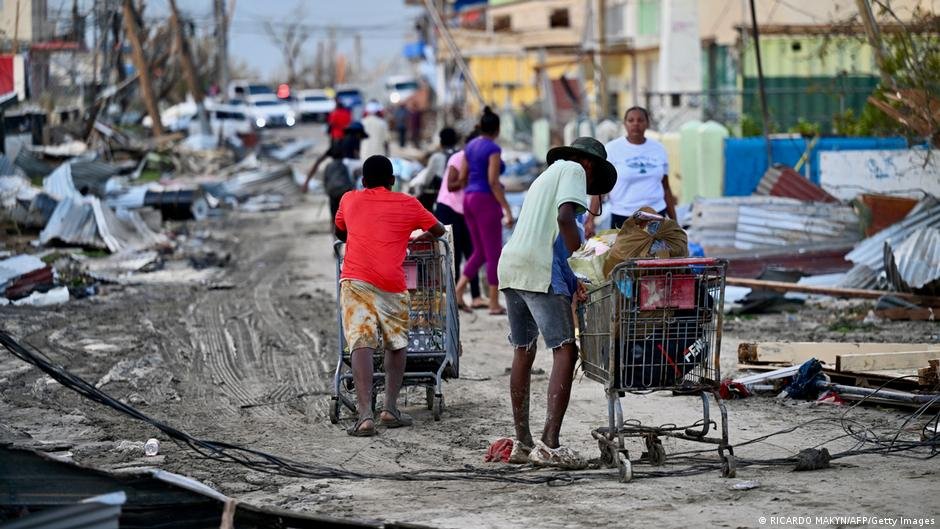
Everyone alive today has grown up in a world of increasingly extreme weather conditions. Last year, the worst floods in 50 years hit Texas, glaciers in Iceland melted at record speed, a hurricane hit Jamaica with near-unprecedented force, and the world experienced record heat. Scientists warn that the window for change in direction is rapidly shrinking.
A report released by the World Meteorological Organization (WMO) on Monday confirms that the Earth’s climate is more out of balance than at any point in recorded history, with effects that will last for centuries and even millennia.
Image of Iceland’s melting glaciers experiencing an unprecedented retreat in 2025: Michael Piepgras/CHROMORANGE/picture Alliance
The main findings of the WMO annual report, Global Climate Situation Report 2025, are as follows:
- 2015-2025 was the hottest decade on record
- Oceans hit unprecedented heat for 9th year in a row
- Glaciers and sea ice continue to retreat
- Extreme weather, cascading health risks, and rising human costs
- Earth’s energy imbalance is at an all-time high, meaning more energy is flowing into the Earth system than solar energy is leaving Earth.
- Global average sea levels have been rising faster since 2012 than in the past 20 years.
“All the major climate indicators are flashing red,” said UN Secretary-General António Guterres. “Humanity has just endured the 11th hottest year on record. When history repeats itself 11 times, it is no longer a coincidence. We are called to action.”
Rising heat, extreme weather, and global instability
Depending on the dataset used, last year’s temperatures were about 1.43 degrees Celsius (2.57 degrees Fahrenheit) above pre-industrial levels, making it the second or third warmest on record. This was just below the 2024 high of 1.55 degrees. This drop in temperature was due to the temporary cooling effect of the global weather phenomenon La Niña.
Under the 2015 Paris Agreement, countries agreed to limit global warming to 2°C, ideally 1.5°C, to avoid the worst effects of global warming.
The main driver of temperature rise is a sharp increase in the concentration of greenhouse gases in the atmosphere, mainly caused by the combustion of oil, coal, and gas. Carbon dioxide (CO2) will reach its highest level in the atmosphere in at least two million years in 2024, and will continue to rise in 2025, according to the report.
The findings have particular urgency for the year ahead. El Niño, a warming weather pattern, could return later this year, scientists say, causing an even sharper rise in temperatures and potentially more extreme weather events.
In 2025, heat waves, wildfires, floods, droughts, and tropical cyclones killed thousands of people and caused billions of dollars in economic losses. The January 2025 California wildfires alone caused more than $60 billion (€52.4 billion) in damage, making them the costliest fires of their kind ever recorded.
The report highlighted the growing health risks of climate change, including dengue fever, which is currently the world’s fastest growing mosquito-borne disease. Meanwhile, 1.2 billion workers, more than a third of the world’s workforce, are exposed to dangerous heat every year.
Climate change is also causing hunger, migration, water scarcity, and increasing competition for dwindling resources. Over the past decade, 250 million people have been displaced by weather-related disasters.
The United Nations draws a direct line between the climate crisis and global instability. At the same time, war and the military are themselves significant contributors to global warming emissions.
“Reliance on fossil fuels destabilizes both the climate and global security,” UN Secretary-General António Guterres said in a statement.
Guterres added that countries need to act quickly to decarbonize to halt further warming and accelerate the transition to renewable energy. “Renewable energy provides climate security, energy security and national security,” he said.
How this small German village achieved such low energy prices
To view this video, please enable JavaScript and consider upgrading to a web browser that supports HTML5 video.
So, the energy of the earth is abnormal. What does this actually mean?
Earth’s energy imbalance (the difference between solar energy entering the atmosphere and heat escaping into space), which first appeared as an indicator in the WMO report, will reach an all-time high in 2025. In a stable climate, the energy coming in from the sun is equal to the energy going out.
In today’s climate, much more energy is flowing in than is flowing out because greenhouse gases act like a blanket around the Earth, trapping excess heat throughout the system. About 91% is absorbed by the ocean, 5% by land, 3% by ice sheets and glaciers, and 1% heats the atmosphere.
“Human activities are increasingly disrupting natural equilibrium, and we will live with these impacts for hundreds and thousands of years,” said WMO Secretary-General Celeste Sauro.
Burning fossil fuels like oil, coal and gas releases heat-trapping greenhouse gases, warming the planet and changing the energy balance Image: Gerald Herbert/AP Photo/Photo Alliance
Accelerating global warming: Impact on the oceans
The oceans are Earth’s main source of thermal energy, protecting life on Earth from the worst effects of climate change. However, ocean heating broke records again in 2025 for the ninth year in a row, with 90% of the ocean experiencing at least one ocean heatwave, despite cooling La Niña conditions.
The report’s authors said there was no sign that the heat sink was weakening, but that all ocean layers, including the deep ocean, were warming. Changes in ocean temperatures are now irreversible on timescales of centuries to millennia. Even with significant emissions cuts now, the energy imbalance in the Earth system means that ocean warming will not be halted this century, the report says.
The human costs of ocean warming are enormous. Approximately 3 billion people rely on seafood for protein, but rising temperatures are bleaching corals, reducing fish populations and weakening the ocean’s ability to absorb carbon dioxide. Rising ocean temperatures are also creating more powerful storms, accelerating ice loss at the poles and driving sea level rise, with cities and coastal regions at the forefront.
Houses in the eastern Australian coastal town of Wamberal are at risk of being washed away by storm surge. Image: Peter Parks/AFP
Sea ice in the Arctic and Antarctic is at one of its lowest levels on record, and glacier mass loss ranks among the worst five years since records began in 1979. Glaciers are important for providing water to 2 billion people.
The WMO report does not make any policy recommendations. But the group said its findings should help governments and organizations prepare for and adapt to the intensification of extreme weather events related to climate change. For example, incorporating weather and climate data into medical information systems could enable more proactive responses to save lives.
Celeste Sauro from WMO said, “Today’s observations are not just about predicting the weather, they are about protecting tomorrow. We are protecting tomorrow’s people and tomorrow’s planet.”
Editor: Tamsin Walker
