


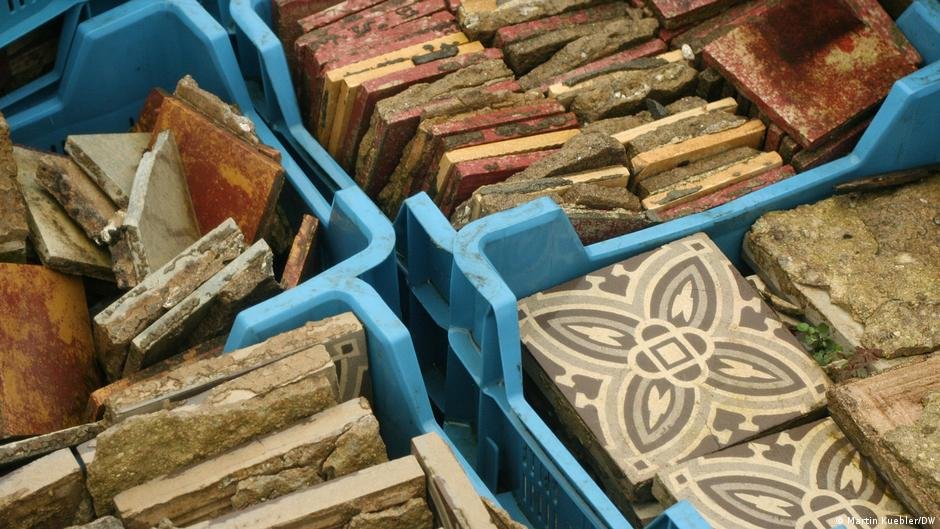
Michael Guillot extracts a model painted with Art Nouveau motifs in blue, gray and white from a wooden box of reclaimed floor tiles.
“It’s easy to fall in love with it because it has this floral pattern,” said Guyot, a researcher specializing in architectural reuse, holding up a square cement tile that was once common in many homes built in Belgium in the early 20th century. “And in the ’30s and ’40s, more modern patterns started being produced, which is also very interesting.”
The crate is just one of dozens of tiles of various styles, sizes and colors waiting to be cleaned and sorted for resale at Lauter DC, a Brussels-based cooperative specializing in salvaged building materials.
Incoming shipments containing these hand-painted tiles, recovered from Belgian artist Agnes Emery’s workshop, are sorted and cleaned before being sold for reuse at Rotor DC. Image: Martin Kuebler/DW
In a nearby warehouse, tall solid wood doors with original handles line the walls, flanked by several large golden windows rescued from mid-20th century office buildings. Outside on the lawn, a photographer has placed a sink on the wet grass to photograph for his online store.
Rotor DC has been promoting the urban mining concept in Brussels since opening its store in a former office building at the end of 2016. Material surveyors search for buildings slated for demolition, and experts carefully salvage anything that can be reused elsewhere, from Murano glass light fixtures to solid oak floors and handmade decorative bricks.
It is not the only such organization in Belgium; similar stores exist in Europe, North America, and elsewhere. However, Rotor’s design practice provides guidance to projects considering the use of recycled components and publishes research on sustainability, circularity, and materials economics.
The construction sector has a huge environmental burden
Reusing construction materials is not a new concept. For example, medieval architects made use of some ancient Roman structures to save time and money. Some of those buildings still stand, especially in Rome. However, especially with 20th century industrialization and modern manufacturing methods, the focus has shifted from reuse.
The structure built in Sibylla, in what is now southern Turkey, used elements of Roman buildings in its construction. Image: Rainer Hackenberg/picture Alliance
“The entire construction system – procurement, liability, regulations, schedules, insurance, standards – has been built around new materials,” said Areti Markopoulou, academic director of the Catalan Institute for Advanced Architecture. “Direct reuse of components such as windows, doors, beams, facade elements, sanitary fixtures and floors in their original form is not as widespread as low-grade recycling or downcycling.”
While reusing building components may seem simple, Markopoulou said it involves many challenges, including careful dismantling, storage, certification and matching supplies to new projects.
Urban mining: reusing old materials in new construction
To view this video, please enable JavaScript and consider upgrading to a web browser that supports HTML5 video.
“We know how to crush buildings very efficiently, but we have not yet learned how to demolish them intelligently,” she said.
As a result, most of that waste ends up being reused as backfill for new projects or as ground cover if reused. Construction and demolition waste currently accounts for more than a third of the European Union’s total waste.
Focusing on new materials comes with significant environmental costs. In the EU alone, around 50% of all extracted materials are consumed in the building sector, and associated greenhouse gas emissions are estimated to be between 5% and 12% of the country’s total emissions.
“Reuse is important not only because it repurposes waste, but because it completely avoids the emissions associated with manufacturing new materials,” Markopoulou said.
A 2019 report by the Ellen MacArthur Foundation, a UK-based charity, noted that reusing materials made from steel, aluminum, concrete and plastic reduces demand for new products. This shift to circular economy strategies could help the global building sector reduce emissions by up to 40% by 2050.
Reuse is becoming more popular, but it remains a niche
Guillot said convincing contractors and architects to use second-hand building materials is not easy. Changes can take time, increase construction costs, and when using salvaged components, a steady supply of the same product is not guaranteed. Materials sourced from old buildings may be degraded, contain toxic elements, or be difficult to decompose.
“We need to rethink how we design, how we organize our workflows, and how we work with contractors,” said Ghyoot, who is also a project manager at Rotor. “We are doing our best to promote it, but it remains a niche practice in the construction industry as a whole.”
Sustainable buildings using concrete waste
To view this video, please enable JavaScript and consider upgrading to a web browser that supports HTML5 video.
In the early days, Rotor DC was all about recovering and preparing building materials for reuse. But things changed when we launched a system to buy back reclaimed architectural elements from individuals, especially general contractors and demolition teams.
“What we learned is that it wasn’t a question of skill on their part. They usually know how to do it properly,” Gyot said. “But if you bring a little money into the mix, they’re ready to put in the effort because they have something for themselves.”
AI, digital tools can assist in material recovery
Markopoulou and her team are also looking at how digital tools and artificial intelligence can be leveraged to facilitate the recovery of valuable reusable components such as solid wood, stone, steel and brick from demolition projects.
“Cities are huge material repositories,” she explained. “The idea is to use Google Street View, aerial photography, scans, cadastral data and permits to estimate what materials and components are likely to be present in a building, when they will be available and in what quantities.”
The study has already been tested in cities such as Barcelona, New Delhi, Helsinki and Singapore.
“Although we cannot yet predict all the windows and beams that will be reusable, we can already estimate enough urban material stock to plan for reuse on a city scale,” she said. “Although AI cannot tell you everything inside a building, it can fundamentally improve the way we predict a city’s material stock before demolition or renovation begins.”
Mr Markopoulou said these incentives and digital tools need to be backed up by policy changes, highlighting that mandatory energy certificates are shifting focus to more sustainable construction methods. For example, materials and architectural passports with detailed information about everything that makes up a structure can help you plan for eventual reuse and change the way you think about buildings.
“This is a change in thinking because buildings were always thought of as permanent,” Markopoulou said. “We also need to consider where the materials will go after the building’s useful life is over when designing.”
Editor: Tamsin Walker
