


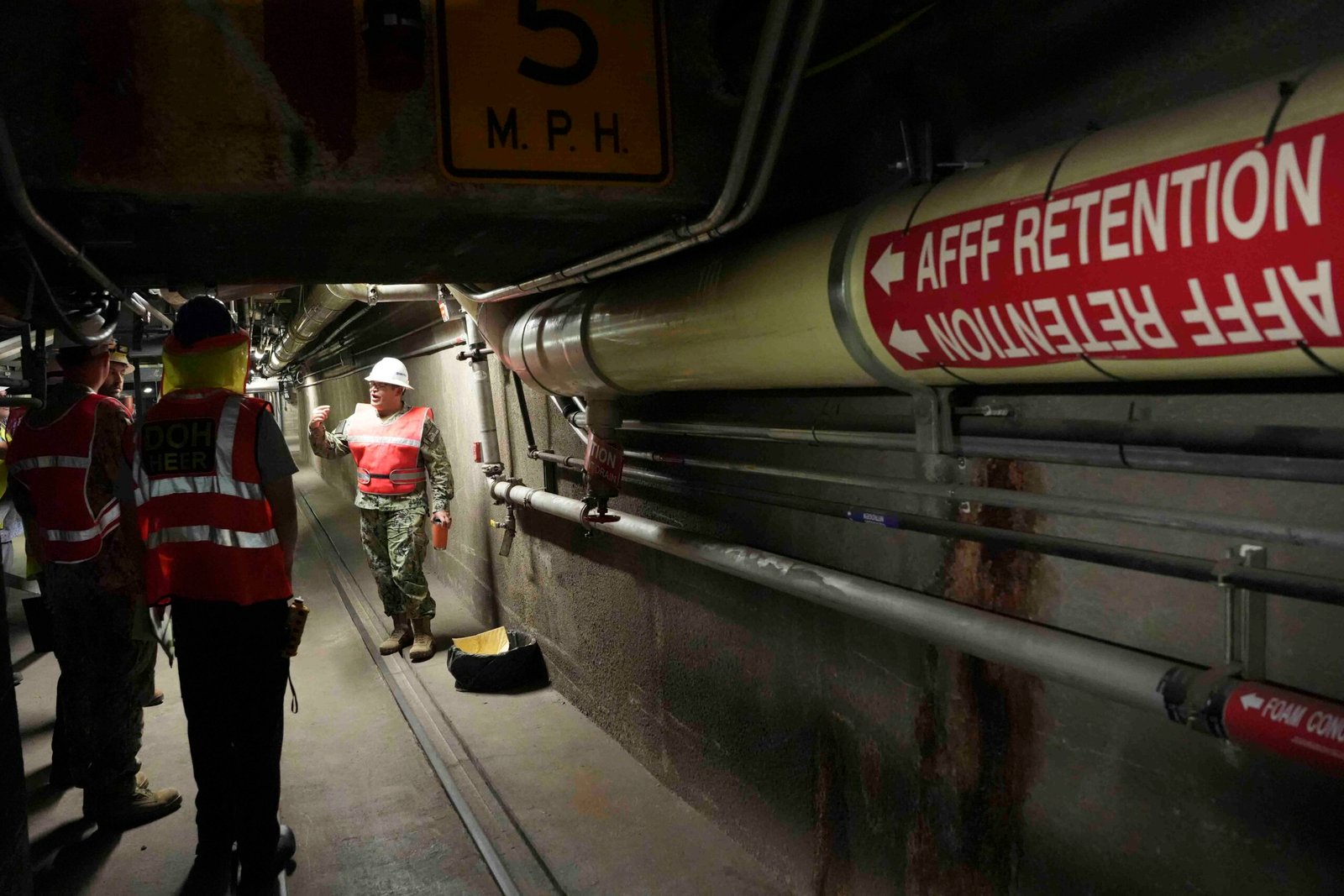
Nearly 630 plaintiffs affected by naval water contamination in central Oahu will receive payments totaling $17 million in the latest Red Hill court settlement announced Wednesday by the U.S. Department of Justice.
Justice Department leaders touted the move as a good-faith step toward solving a problem in which tens of thousands of gallons of jet fuel spilled in 2021 sickened scores of service members, their families, and civilians. However, some victims called the deal a “slap in the face” and said it was not enough to compensate them for all their losses.
The settlement, which applies to families of sick soldiers rather than service members themselves, stems from two recent Federal Tort Claims Act (FTCA) lawsuits filed against the Navy over Red Hill contamination.
Together, these cases (Feint v. United States and Hughes v. United States) amount to more than 6,500 claims.
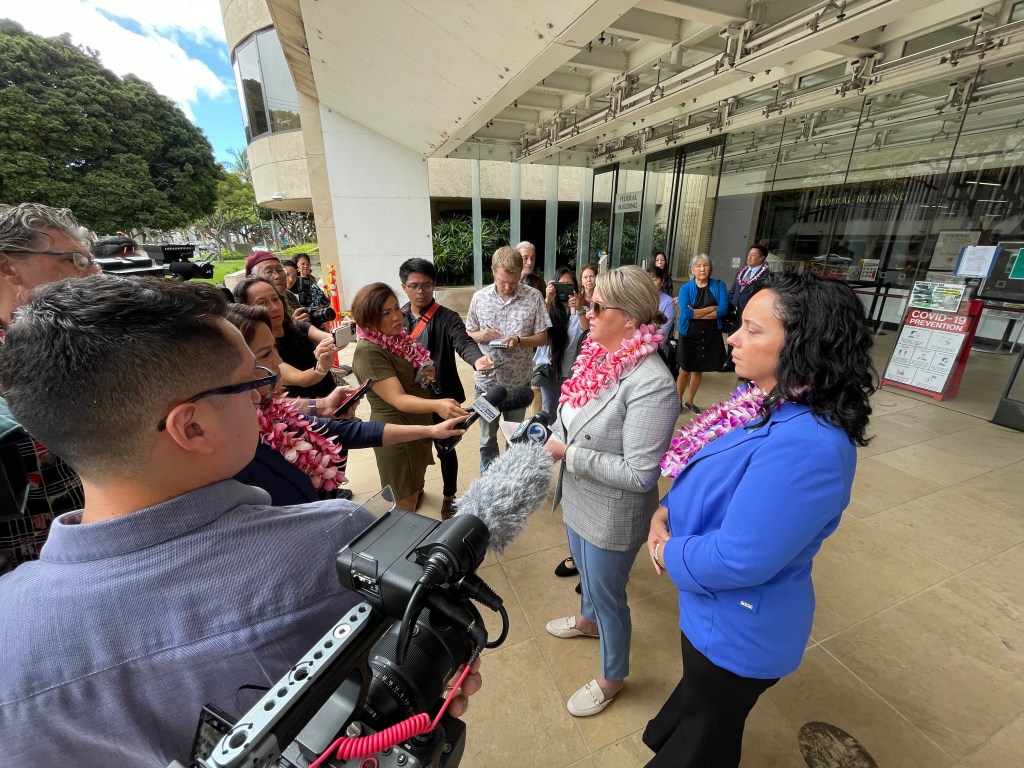 Maj. Mandy Feindt and Nastasia Freeman stand in front of news cameras after the conclusion of the first Red Hill trial on May 13, 2024. The families of Feint and Freeman reported serious illness in the wake of the fuel leak at Red Hill. (Christina Jedora/Civil Beat/2024)
Out of more than 6,500 claims, about 3,600 Red Hill plaintiffs have now reached settlements with the federal government over their health ordeals, according to the Justice Department.
Assistant Attorney General Brett Shumate called the settlement a “fair and equitable resolution.”
“We look forward to paying the additional charges as soon as they are approved,” he said in a statement Wednesday.
Plaintiffs’ attorney Christina Beyer said the roughly $27,000 paid to each of the 629 plaintiffs in the deal was far below the minimum amount set in U.S. District Judge Leslie Kobayashi’s order. Baer said Kobayashi’s order called for the federal government to pay between $38,500 and $76,000.
Army Maj. Mandy Feindt, whose husband Patrick served as lead plaintiff in one of the lawsuits, said $27,000 doesn’t come close to covering the health damage, property loss and other challenges her family faced in the Red Hill spill that year.
“This may seem like a lot to some people, but our family alone has been to over 800 medical appointments,” said Feindt, whose family now lives in Virginia.
Feindt’s 8-year-old daughter still suffers from neurological problems, and her son, now 6, suffered permanent damage to his lungs after the Navy’s water supply was contaminated, she said.
“Many of us spent thousands of dollars on medical treatment and relocation for our family members,” Feindt said. “Our family alone has had two compassionate reassignments, but we will never get all that money back. We lost everything.”
The court’s ruling found that previous legal actions by the government served to limit the criteria considered in issuing awards and determining settlements. The plaintiff’s award is further reduced by attorney’s fees (which can account for up to 25% of the total amount) and related costs.
Feint said the family accepted a $37,500 settlement as part of the tort lawsuit, but rejected the $15,000 settlement for the daughter and $5,000 settlement for the son, and continues to fight in court on the family’s behalf.
“Our case basically kind of set a precedent, which is why we refused to pay the kids,” she said Wednesday. “We carry a great weight on our shoulders, because our acceptance will pave the way for thousands of others who will come after us.”
Beyer said the government has approved two new settlements in the past two weeks, one for $45,000 and one for $55,000, within the range of amounts called for in the Kobayashi ruling. She said she hopes this will set a precedent for higher awards in the remaining cases.
The Justice Department’s Civil Division said in a statement that it continues to move forward with more settlements to approve more transactions.
Meanwhile, a legal battle over whether Feint and other service members should be compensated for water contamination continues in the Ninth Circuit Court of Appeals. Baer said the federal government argued that military personnel should not be compensated for their exposure to pollution because it was “incidental to military service.”
The stance further upset Mr. Feint, who on Wednesday objected to Mr. Shumate’s statement that the Justice Department is “committed to securing justice for our nation’s heroes who repeatedly put themselves at great risk to protect our freedoms.”
“For those of us who are putting our lives at risk in this country, it’s very serious for families, especially families with young children, to be poisoned,” Feindt said.
Civil Beat’s climate change and environment reporting is supported by the Healey Foundation, the Marisula Fund of the Hawaii Community Foundation, and the Frost Family Foundation.

Sign up for our free morning newsletter and stay informed every day.
sign up
sorry. That’s an invalid email.
thank you! We will send you a confirmation email shortly.
