


In this interview, PFAS expert Dr. Kunal Kureja reveals how ultrapure water impacts laboratory accuracy.
What are PFAS and why are they attracting attention?
PFAS (per- and polyfluoroalkyl substances) are a large group of more than 4,700 synthetic chemicals that have been widely used in industrial and consumer products such as nonstick cookware, waterproof textiles, food packaging, and firefighting foam since the mid-20th century. Its popularity is due to its unique properties such as resistance to heat, water and chemical degradation.
PFAS have received increased attention due to growing concerns about their environmental persistence and potential adverse health effects. Because PFAS have strong carbon and fluorine bonds, they do not break down easily in nature and can accumulate in soil, water, wildlife, and humans over long periods of time. These have been detected in drinking water sources around the world, raising public health concerns.
Human exposure to PFAS can occur through contaminated food or water, inhalation of dust or air, or contact with PFAS-containing products. The growing body of evidence linking PFAS exposure to health risks, as well as the widespread environmental distribution and difficulty of removal of PFAS, has led to increased scientific, regulatory, and public attention, making PFAS a major environmental problem today.
Image credit: zimmytws/Shutterstock.com
Why is PFAS so difficult to remove from the environment?
What makes PFAS particularly difficult to remove from the environment is the combination of their chemical stability, environmental mobility, and widespread use. The carbon-fluorine bond, one of the strongest bonds in organic chemistry, makes PFAS highly resistant to chemical, biological, and thermal degradation. As a result, they persist for decades in water, soil, and living organisms.
Additionally, many PFAS are highly water-soluble and easily disperse into rivers, groundwater, oceans, and the atmosphere. This mobility allows them to circulate globally, as evidenced by their inhabiting remote oceanic and arctic environments. Once released, PFAS are not confined to a single location, making them extremely difficult to contain and remove.
Another problem arises from the large number of PFAS compounds, which vary in chain length, structure, and behavior. For example, short-chain PFAS are more difficult to remove from water using traditional treatment methods. Additionally, PFAS often occur at very low concentrations, complicating detection, monitoring, and remediation efforts.
PFAS are extremely difficult to remove from the environment due to their chemical persistence, global transport, and resistance to traditional treatment techniques.
Why is ASTM Type I ultrapure water essential for PFAS-sensitive analyses?
When we work with PFAS, we often measure concentrations at single-digit parts per trillion (ppt) or sub-ppt levels. At that level, even trace contamination from laboratory water or other equipment and reagents can have a significant impact on chromatographic results. ASTM Type I ultrapure water provides the highest level of purity with extremely low organic and ionic background. This is essential to achieve reliable detection limits, avoid false positives, and ensure the reliability of PFAS measurements, especially LCMS-based analyses.
How do reverse osmosis, activated carbon, and ion exchange work together to reduce PFAS?
Removal of PFAS requires a multi-barrier approach as no single technology is sufficient.
- Reverse osmosis (RO) acts as the first major barrier, physically eliminating a wide range of PFAS molecules based on size and charge, significantly reducing overall PFAS loading.
- Activated carbon adsorbs PFAS through hydrophobic and electrostatic interactions and is particularly effective against long-chain PFAS.
- Ion-exchange resins provide targeted removal, especially for short-chain, highly mobile PFAS that are not effectively captured by activated carbon.
These technologies complement each other to achieve much higher and more consistent PFAS reductions than a single processing step.
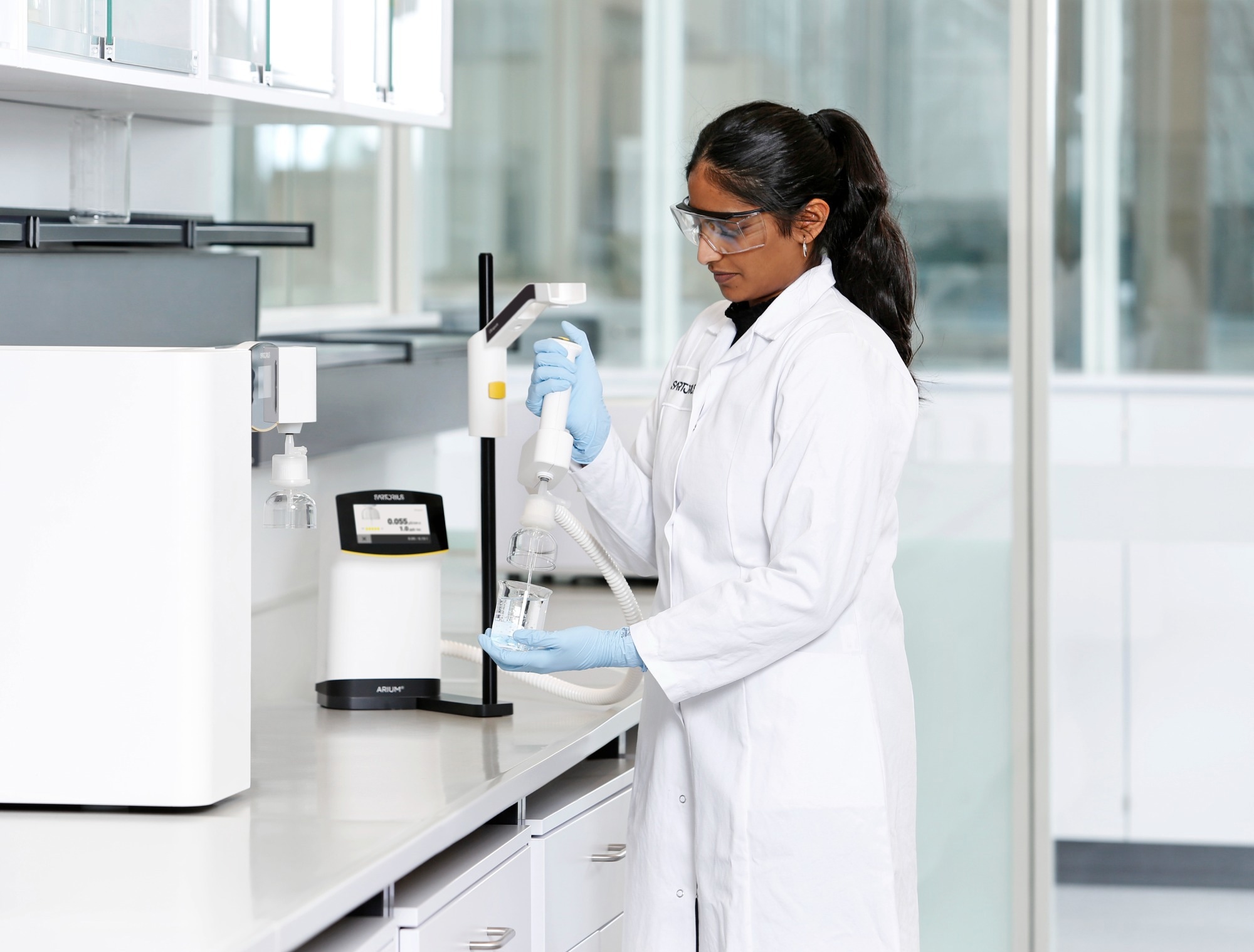
Image credit: Sartorius Lab Instruments
Why did you use both LCMS and total organic fluorine by combustion ion chromatography (CIC-TOF) analysis in this study?
We used both techniques to combine ultra-high sensitivity with comprehensive coverage. LCMS is essential for targeted PFAS analysis because it can detect and quantify individual PFAS compounds at single-digit ppt and even sub-ppt levels. This is important for regulatory compliance and reliable quantification.
However, LCMS is inherently limited to the PFAS compounds included in the analytical method. To address this, we complemented LCMS with CIC-TOF analysis. CIC‑TOF typically operates at ppb-level sensitivity but captures the entire pool of organofluorine compounds, including unknown or emerging PFAS, that are not part of the targeted LCMS method.
Combining the extreme sensitivity of LCMS with the broader fluorine mass balance perspective provided by CIC-TOF provided a more robust understanding of the presence of PFAS. This dual technology approach increases confidence in PFAS removal performance and ensures that critical fluorine contamination is not overlooked.
How important are ultrapure water storage conditions in preventing cross-contamination with PFAS?
Water storage conditions are critical to preventing cross-contamination with PFAS. Even water that initially meets the highest standards of purity can become contaminated during storage through contact with inappropriate materials such as plastics, tubes, caps, and seals, or through long-term storage.
PFAS analysis is often performed at single-digit ppt or sub-ppt levels, which can lead to elevated background levels and false-positive results if even trace amounts of PFAS are introduced during storage. In reality, contamination often occurs downstream of the purification process rather than during water production.
For this reason, we strongly recommend that you avoid storing ultrapure water whenever possible. Instead, laboratories must produce ultrapure water on demand and use it immediately at the point of use. On-demand fresh water generation minimizes material contact time, reduces contamination risk, and provides the highest level of reliability for PFAS-sensitive analyses. Therefore, proper control of storage conditions is a key element for reliable and reproducible PFAS analysis.
How does an in-house lab water system compare to bottled LCMS-grade water for PFAS?
An in-house water purification system gives your laboratory greater control, consistency, and reliability. Producing ultrapure water on demand eliminates risks associated with bottling, transportation, and long-term storage that can lead to PFAS contamination. Additionally, our in-house systems allow for continuous quality monitoring and traceability. This is a key advantage for laboratories operating under increasing regulations and quality expectations. For routine PFAS analysis, in-house systems provide both performance and operational efficiency.
What should labs look for in a future-proof PFAS water purification system?
Laboratories should look for multi-stage purification solutions that are tailored to their daily ultrapure water needs and feed water quality and proven to deliver water suitable for PFAS analysis. Importantly, this performance must be supported by a water analysis or certificate demonstrating that the PFAS concentration in the product water is below the analytical detection threshold, as ultra-trace analysis can produce false-positive results for even trace amounts of PFAS contamination.
Sartorius’ Arium® laboratory water system is designed to meet exactly these requirements. Utilizing advanced multi-stage treatment technology, the Arium® system reduces PFAS to undetectable levels, ensuring water quality that meets the stringent demands of PFAS-sensitive applications. Independent water analysis according to DIN 38407-42 or EPA 1633 confirms that Arium® product water is PFAS-free and suitable for PFAS analysis, and the laboratory is confident in its results.
Sartorius also emphasizes the importance of real-time water quality and data monitoring and simple, contamination-free point-of-use preparation. As detection limits continue to decrease and PFAS regulations evolve, laboratory water systems that can consistently produce PFAS-free water are essential. Such systems ensure that your laboratory is protected from background contamination and prepared for today’s analytical challenges as well as future regulatory and sensitivity requirements.
About Dr. Kunal Kureja 
Dr. Kunal Kureja is a scientist and product manager at Sartorius AG, specializing in laboratory water technology and analytical applications. He holds a PhD in analytical and preparative chemistry from the University of Kassel and has worked in academic, start-up and industrial settings. His expertise includes application development, technical communications, and cross-functional project leadership, with a particular focus on PFAS-related analytical challenges and contamination risks in laboratory workflows.
About Sartorius Lab Instruments GmbH & Co. KG
The Sartorius Group is a leading international partner for life science research and the biopharmaceutical industry.
Our Laboratory Products & Services division is focused on meeting the needs of research and quality control laboratories in pharmaceutical and biopharmaceutical companies, as well as academic research institutions, by providing innovative laboratory equipment and consumables.
The Bioprocess Solutions division has a broad product portfolio with a focus on single-use solutions, helping customers safely and efficiently manufacture biotechnology medicines and vaccines. The Group has averaged double-digit growth every year and has regularly expanded its portfolio through the acquisition of complementary technologies.
