


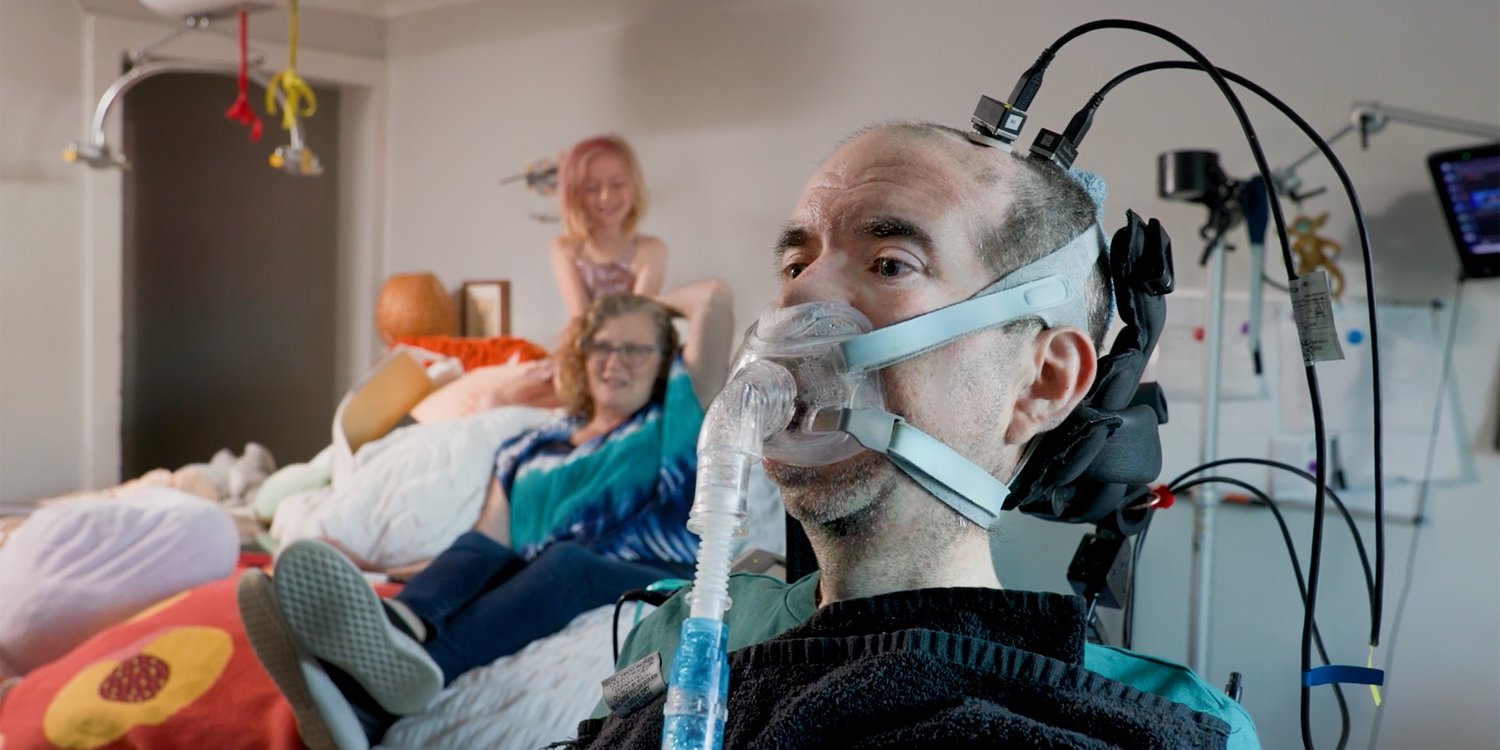
Recent research published in natural medicine Evidence shows that special brain implants can enable people with severe paralysis to communicate and operate computers independently at home. The system translated brain signals into text and computer cursor movements, allowing participants to talk and work without the need for daily supervision from scientists. These discoveries represent an important step toward developing practical assistive devices for people who have lost the ability to speak or move.
Amyotrophic lateral sclerosis is a progressive neurological disease that gradually impairs a person’s ability to control their muscles. This condition often results in complete loss of speech and physical mobility. To help people suffering from this condition, scientists have developed brain-computer interfaces. These are systems that record electrical activity directly from the brain and convert it into digital commands.
In previous laboratory experiments, these interfaces have shown promise in allowing paralyzed people to use their thoughts to type and control a cursor. However, these experimental systems typically required a team of engineers to set up the equipment and manually tune the software to keep it working accurately. Neural signals recorded from the brain tend to change slightly from day to day and require frequent readjustment.
“For many years, BCIs have been proof-of-concept devices used in highly controlled laboratories,” said David Brandman, co-senior author of the study and associate professor of neurosurgery at the University of California, Davis. “This study shows that we may have crossed the threshold by allowing people with paralysis to speak in their own language.” Brandman is also co-director of the Neuroprosthetics Institute at the University of California, Davis.
The transition from supervised laboratory demonstrations to actual communication devices requires a system that patients and their families can operate themselves. A joint team of scientists from the University of California, Davis, Brown University, and Brigham University in Massachusetts has developed an improved interface specifically designed to overcome these barriers. The new system avoids the need for continuous expert supervision. They programmed the software to update automatically in the background, creating a user-friendly process for independent home use.
The study involved one participant, 47-year-old Casey Harrell, who enrolled in the ongoing clinical trial. Harrell has amyotrophic lateral sclerosis, which causes severe weakness in his arms and legs, a condition known as quadriplegia. The disease also makes his speech very difficult to understand, a condition known as dysarthria.
In 2023, surgeons implanted four small sensor arrays, each containing 64 microscopic electrodes, on the surface of Harrell’s brain. These sensors were placed in the precentral gyrus, a specific area of the motor cortex responsible for regulating language. The 256 microscopic electrodes recorded the electrical firing of individual brain cells. This raw neural data was transmitted to a nearby computing system via a physical wired connection implanted in his skull.
The computing setup consisted of multiple networked computers mounted on a mobile cart in Harrell’s home. The software relied on advanced artificial intelligence models to decipher his intentions in real time. In audio decoding, the system continuously analyzed brain signals while he silently tried to say the words. The software predicted corresponding sounds, known as phonemes, and formed complete sentences on the screen.
This system utilized a huge vocabulary of 125,000 words. “Our previous study showed 97% accurate word decoding, but Harel was only able to use the neuroprosthesis when someone from our research team was there to set it up,” said Sergei Stavisky, co-senior author of the study and assistant professor of neurosurgery at the University of California, Davis. Mr. Staviski also serves as co-director of the University of California, Davis Neuroprosthetics Institute.
“We are now making improvements that bring this medical technology closer to clinical utility. It can now be used at home without the support of researchers,” Stavisky explained. “It’s even more accurate (99%), keeps up with him trying to speak faster, and has worked very well for almost two years.”
In the case of computer control, the system translated Harrell’s thoughts as he moved his hand into directional movements of the computer’s mouse pointer. The simple idea of holding his hand translated into the click of a digital mouse. The researchers also integrated a commercially available eye-tracking device. This allows you to select buttons on the screen with just a second glance.
After an initial testing phase, the research team allowed Harrell and his family to use the system on their own. Caregivers were taught how to connect the wires and turn on the software. This daily setup process took approximately 20 minutes. Once the system was up and running, it could be used continuously for up to 19 hours without assistance from a scientific team.
“Casey can use this system to communicate his thoughts whenever he wants, not just while we are in a controlled environment,” said Nicholas Card, lead author of the study and a postdoctoral fellow in the Department of Neurosurgery at the University of California, Davis. “Sometimes we did it for 12 hours straight. The system worked well, was reliable, stable, and gave consistent results.”
Card added that the successful home setup is a major milestone for assistive technology. “This is one of the strongest demonstrations that BCI is practical and useful,” he said. Over nearly two years, Harrell spent more than 3,800 hours using the interface. He operated this device independently almost every day.
During that time, Harrell delivered more than 183,000 sentences and nearly 2 million words. In controlled tests, he rated 92% of his sentences as accurate or nearly correct. His average speaking speed reached 56 words per minute, and his speed improved significantly as he became more familiar with the system.
“This is a more dynamic, action-filled life with friends, family, and co-workers, and one that allows us to communicate more in a natural way than any technology I’ve ever experienced,” Harrell said through a brain-computer interface system. The software also included an optional text-to-speech feature that was trained to match his pre-diagnosis voice. “It’s such a joy to be able to look into my wife’s eyes when she heard my voice and bring back sweet memories, and to be able to explain things to my daughter, who doesn’t remember anything from when I was still talking, and remind her of what my voice used to be,” he added.
 (Director of the University of California, Davis)
Harrell also used the interface to take full control of his personal computer. Using a combination of Brain-to-Text functionality and a mind-controlled computer cursor, he browsed the Internet and sent emails and text messages. He also participated in video calls and was able to maintain continuous communication and employment despite his paralysis.
The vast amount of personal use time has provided researchers with an unprecedented amount of data. “In addition to testing ways to restore communication, this clinical trial is generating a wealth of unique data that we are studying to better understand how the human brain produces speech,” Stavisky said.
“To our knowledge, these 3,800 hours of brain recordings that Cayce used the system with are the largest individual brain recording dataset with single-neuron resolution ever,” Stavisky added. “This will help us develop even better treatments.”Future analysis of this data could provide new insights into the neurological mechanisms of language.
Although the results are very promising, there are limitations to this study that should be noted. Because this study included only one participant, the results may not automatically apply to other individuals with different neurological conditions. This system also relies on physical wires passing through the skin. This setup has some risk of infection and requires daily maintenance.
Today’s computer equipment is very bulky and must fit into large moving carts. This physical hardware requirement limits user mobility and prevents the system from being used outside of the home environment. Readers should also be aware that several authors hold patents related to audio decoding technology, so there may be financial conflicts of interest between the research teams. Some team members serve as advisors to neurotechnology companies that could benefit from related scientific advances.
“This fundamental advance in BCI technology would not have been possible without the tireless dedication of clinical trial participants,” Brandman said. “Together with them, we have accomplished so much. Thanks to them, the future will be brighter for people living with ALS, spinal cord injuries, and other neurological conditions.”
The study, “Long-Term Independent Use of Intracortical Brain-Computer Interfaces for Speech and Cursor Control,” was authored by Nicholas S. Card, Tyler Singer-Clark, Hamza Peracha, Carrina Iacobacci, Xianda Hou, Maitreyee Wairagkar, Zachery Fogg, Elena C. Offenberg, Leigh R. Hochberg, Sergey D. Stavisky, and David M. Brandman.
