


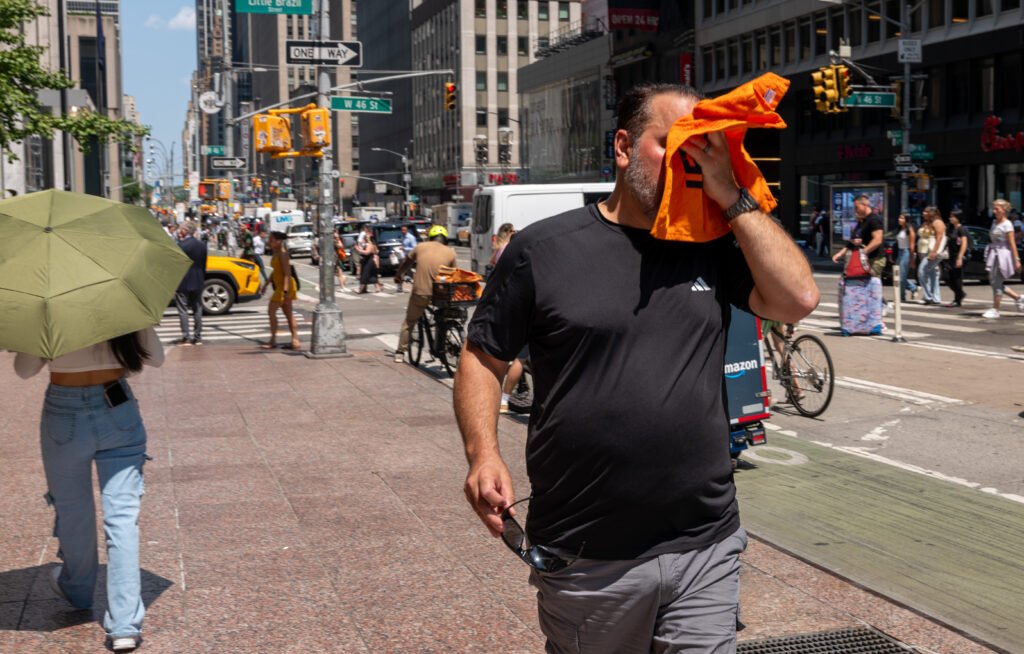
It’s getting hotter in our country’s cities. How hot it gets depends not only on the weather, but also on infrastructure, working conditions, and postal code.
When that heat falls on cities with steel and concrete infrastructure, it can create what scientists call “urban heat islands.”
Under this phenomenon, concrete structures and roads essentially act like “thermal batteries,” with man-made surfaces absorbing and releasing more heat than natural landscapes such as grass and trees, potentially leading to higher temperatures, said Luis Ortiz, an assistant professor in George Mason University’s School of Atmospheric, Oceanic, and Earth Sciences and a member of the New York City Climate Change Panel, an advisory group that helps inform policy on climate issues.
Other factors also contribute. Machines such as air conditioners pump heat into the atmosphere, and tall buildings protect against cold gusts of wind.
In large cities like New York and Houston, temperatures can vary depending on the area’s landscape and amount of green space and trees. Local scientists and community organizations have been working to understand the effects of the urban heat island over the past several decades. But the average city resident doesn’t always know that the area where he or she lives can feel hotter than the weather forecast indicates.
scorching city
In 2024, approximately 150 Houston residents attached temperature sensors to their car windows and drove around the city, recording the effects of the urban heat island in real time. This was the second study of its kind for the Houston Center for Advanced Research. The first event happened in 2020.
As expected, the results showed that areas with denser development and fewer trees were hotter. For many volunteers, it provided a snapshot of an issue whose impact can be felt but not necessarily proven. Meredith Jennings, director of local government and community initiatives at the Houston Center for Advanced Research, who worked on both experiments, said it wasn’t just about science.
“For people to get involved in this campaign, talk about it on the news and see how the heat affects people,” she said. “It can tell you how people behave.”
From 2016 to 2024, the National Oceanic and Atmospheric Administration, in collaboration with other federal agencies, funded the mapping of the urban heat island effect in American cities, including Houston. The U.S. Department of Agriculture funded the second study through its Increasing Tree Canopy in Underserved Areas program. With recent cuts to federal climate research, the future of mapping urban heat and cold may rest squarely on the shoulders of local leaders.
In many cities across the country, people who are low-income or people of color are more likely to live in hotter areas.
Communities in areas with little green space also often suffer due to their proximity to industries such as power plants and highways that emit heat while driving. A recent study found that highway expansion can significantly worsen the urban heat island effect.
In hot regions, air conditioners are used more frequently. Research shows a link between increased building cooling energy demand and urban overheating. This is if the resident owns an air conditioner and can afford to use it as electricity costs rise.
Black people in New York are twice as likely to die from heatstroke, and the death rate is twice that of white residents, according to New York City data. They are also less likely to use air conditioning. The city’s Commission on Climate Change predicts the number of hot days and nights will increase from 15 to 52 days by mid-century.
Illnesses that involve overheating or exposure to heat, such as sunstroke, can take a toll on the human body, Ortiz said. He said it was important to inform the public, especially outdoor workers, about heat-related health risks. My colleagues Keerti Gopal and Martha Psowski have written about the threat heat exposure poses to construction workers in Texas.
However, cities are not always more dangerous than rural areas during periods of extreme heat. Ortiz noted that in New York, for example, where buildings are densely packed, assistance in the form of cooling centers – air-conditioned rooms that local authorities open to vulnerable people on extremely hot days – may be more readily available than in suburban or rural settings.
cool down
Summers are getting warmer due to climate change, and that trend looks set to continue this summer.
Municipalities looking to cool hot areas can take practical steps, such as adding green space and street trees, and using roofs and paving materials designed to absorb less heat.
Planting trees has proven to be a way to cool neighborhoods by providing shade and lowering temperatures, but maintaining street trees can be expensive, especially if they’re dying from drought.
In New York City, an upcoming urban forest plan will be designed to cover 30 percent of the city with tree canopy to reduce the heat in certain areas. I reported in December that the city had received state funding to plant and care for trees in the diseased forest. But the cash-strapped Parks and Recreation Department may struggle to maintain it.
Since 2020, Houston leaders have been tracking tree planting across the city in line with a city plan that sets a framework for achieving carbon neutrality and increasing resilience to climate change by 2050. The plan predicts that by 2050, city residents will experience 74 days a year on the heat index (a measure of how a mix of heat and humidity feels to the human body). Currently, they experience an average of just 10 days on the heat index.
“Climate projections and historical trends all point to summers becoming increasingly unbearable and longer,” Jennings said. “So this really becomes a quality of life issue.”
More top climate news
Wildfires have destroyed grasslands across Nebraska. As a result, more than 1 million acres of land have been lost, reports Gabriel Cannon of the Guardian. The warm, dry winter created ideal conditions for fires, one of which became the largest fire ever recorded in the state. My colleague Jake Bolster recently wrote about how this weather is causing concerns of massive wildfires in neighboring Wyoming.
Environmental Protection Agency Administrator Lee Zeldin fundamentally changed the mission of government agenciesaccording to a recent analysis of EPA staff public communications by Lisa Friedman and Harry Stevens of the New York Times. As leader of the Environmental Protection Agency, Mr. Zeldin frequently discussed the need for corporate red tape and rarely mentioned environmental harm to children, according to the analysis.
Sen. Sheldon Whitehouse (DR.I.), ranking member of the Senate Environment and Public Works Committee, sent a letter to the CEO of French company Total Energy, questioning the legality of most of the issues. $1 billion settlement with Trump administration Kelsey Tamborino is abandoning her offshore wind lease, Politico’s E&E News reported.
About this story
As you may have noticed, this article, like all news we publish, is free to read. That’s because Inside Climate News is a 501c3 nonprofit organization. We don’t charge subscription fees, keep our news behind paywalls, or fill our website with ads. We provide climate and environmental news free to you and anyone who wants it.
That’s not all. We also share our news for free with dozens of other news organizations across the country. Many of them cannot afford to do their own environmental journalism. We’ve established bureaus across the country to report on local news, partner with local newsrooms and co-publish stories to ensure this important work is shared as widely as possible.
The two of us started ICN in 2007. Six years later, we won the Pulitzer Prize for national reporting and now run the nation’s oldest and largest dedicated climate newsroom. We tell the story in its entirety. We hold polluters accountable. We expose environmental injustice. We debunk misinformation. We explore solutions and inspire action.
Donations from readers like you fund all aspects of our work. If you haven’t already, will you support our ongoing work, our coverage of the biggest crises facing our planet, and help us reach more readers in more places?
Please make a tax-deductible donation. Each one makes a difference.
thank you,

Lauren Dalban
new york city reporter
Lauren Dalban is a New York City-based reporter with a background in local journalism. A former ICN Fellow, she is currently responsible for environmental issues for all five boroughs. A native of London, she earned a bachelor’s degree in history and English from the University of Virginia and a master’s degree from the Columbia University Graduate School of Journalism.
