


The movements of electrons and protons often work together in both living systems and artificial materials. The most well-known example is proton-coupled electron transfer (PCET). This is a process that plays a central role in bioenergetics, cellular respiration, photosynthesis, and nitrogen fixation. PCET has also influenced the design of many engineered materials used for energy conversion and storage. More recently, scientists have identified another related process known as proton-coupled singlet energy transfer (PCEnT).
A team led by Professor Kaifeng Wu of the Dalian Institute of Chemical Physics, Chinese Academy of Sciences, built on earlier work on PCET and PCEnT to investigate another important but poorly understood process: triplet energy transfer associated with proton transfer.
Triplet energy transfer is the primary pathway for transferring energy in both natural and synthetic systems, but it behaves differently than singlet energy transfer. Understanding how proton motion affects this process could open new ways to control energy flow in advanced materials.
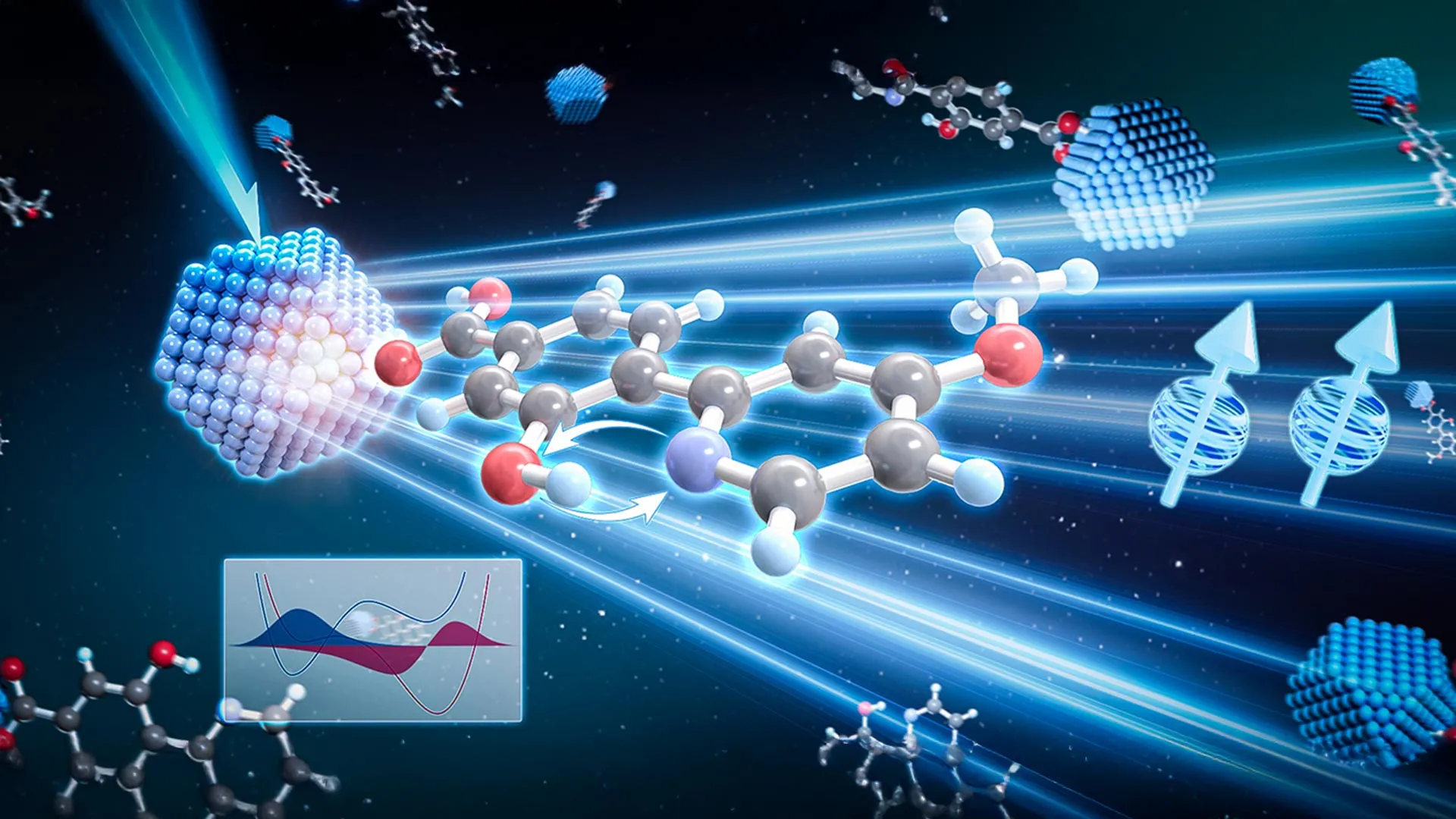
In a study published in natural materialsresearchers reported a previously unknown mechanism called proton shuttle-assisted triplet energy transfer (PS-TET). This process was observed when energy was transferred from a ZnSe-based colloidal quantum dot (QD) to a phenol-pyridine divalent acceptor attached to its surface.
How the proton shuttle transfers energy
When ZnSe QDs absorb light, they enter an excited state. Next, a hole is transferred from ZnSe to phenol, and at the same time a proton is transferred from phenol to pyridine.
Next, electrons are transferred from ZnSe to the phenoxyl radical. At the same time, the proton returns from the pyridinium to its original position. Together, these linked steps generate an overall transfer of spin triplet energy from the ZnSe QDs to the phenol-pyridine dyad.
Although the protons eventually end up where they started, their temporary movement has significant effects. This shuttle significantly increases both the speed and efficiency of triplet energy transfer compared to methylated analogs that do not contain a proton shuttle.
The researchers also discovered that adding a strongly electron-withdrawing trifluoromethyl substituent to pyridine can change the order in which the proton conjugation electron and hole transfer steps occur.
Quantum tunneling at room temperature
The speed of PS-TET changed little with temperature. This suggests that protons do not move in traditional thermally driven processes. Instead, it appears to be traveling through a quantum mechanical tunnel.
Calculations involving overlap integrals of the vibrational wave functions of the proton supported this interpretation. These integrals help determine which excited state relaxation path is preferred and guide the system toward efficient triplet energy transfer.
The findings show that quantum effects can be used to control charge and energy transfer in complex materials even at room temperature.
Potential applications in solar cells, lasers and catalysts
“The discovery of the PS-TET mechanism has significant implications for many modern molecular techniques involving the spin triplet excited state of molecules,” Professor Wu said.
Increasing triplet production efficiency could improve photoredox and environmental catalysis. However, other techniques may require limiting triplet formation. Organic optoelectronic devices such as solar cells and lasers exhibit better performance when unwanted triplet states are suppressed.
This study suggests that scientists may be able to tune triplet formation to suit their needs. Creating a proton shuttle may enhance the process, whereas removing the shuttle may reduce or prevent the process.
