


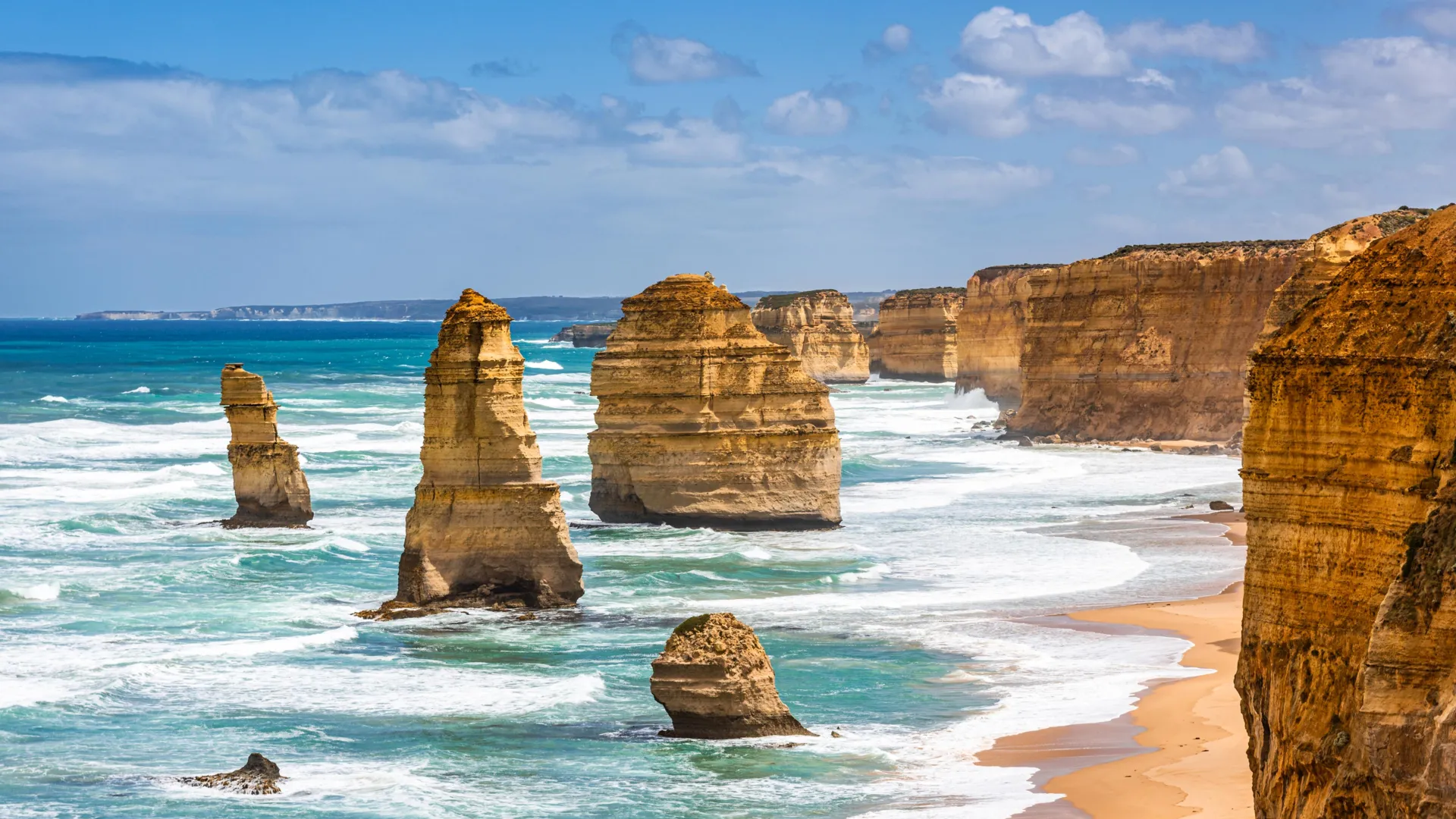
Researchers from the University of Melbourne have explained for the first time how Australia’s famous Twelve Apostles were created. Their findings show that millions of years of tectonic plate movement gradually lifted these giant rock formations and tilted them away from the ocean.
Until now, scientists had only a limited understanding of how the Twelve Apostles developed into the landmarks we see today.
Natural record of ancient climate and sea level
Research lead researcher Associate Professor Stephen Gallagher, from the University of Melbourne’s School of Geography, Earth and Atmospheric Sciences, said this tectonic activity gave the Apostles one of the most complete and accessible records of past environmental conditions.
“Like environmental time capsules, each layer of these gigantic structures stores information about millions of years of Earth’s climate, tectonic activity, flora and fauna, including a key period around 13.8 million years ago when the climate was much warmer than today,” explained Associate Professor Gallagher.
He added: “We are using this ‘window back in time’ to understand where temperatures and sea levels are headed on the current climate change trajectory. There are only eight of the Twelve Apostles left and we need to learn from them while we still can.”
New evidence shows she’s getting younger
Rock layers that resemble tree rings have allowed scientists to estimate the age of geological formations more accurately than ever before. This result suggests that the apostles were younger than previous studies had indicated.
“Early preliminary research had indicated that the age of the ancient limestone layer was between 7 million and 15 million years ago, but we have discovered microscopic fossils that more precisely pinpoint the age of this layer as 8.6 million to 14 million years ago,” Associate Professor Gallagher said.
This study Australian Geoscience Journal.
From the ocean floor to coastal landmarks
According to the study, tectonic movements have slowly pushed up layers of rock over millions of years, but the dramatic columns visible today only formed much more recently. After the last Ice Age, rising sea levels and coastal erosion carved away and exposed towering structures along the coastline.
Tilted layers reveal ancient earthquakes
The researchers also found that the bumps were not uniform. Instead of rising uniformly, the rock layers were bent and cracked in the process.
“We also found that tectonic movements did not push the Apostles up completely straight; instead, they forced the strata to tilt and break along the way. If we look closely at the cliffs around the Twelve Apostles today, we can see that the limestone layers are not flat, but are actually tilted several degrees. We can also see small fault lines, which are records of ancient earthquakes,” Associate Professor Gallagher said.
Continuing research into past and future changes
Scientists are now studying individual layers in more detail to reconstruct past climate, ocean conditions, and sea levels. This research may help explain how ancient geological processes continue to shape modern coastlines and influence ongoing erosion.
