


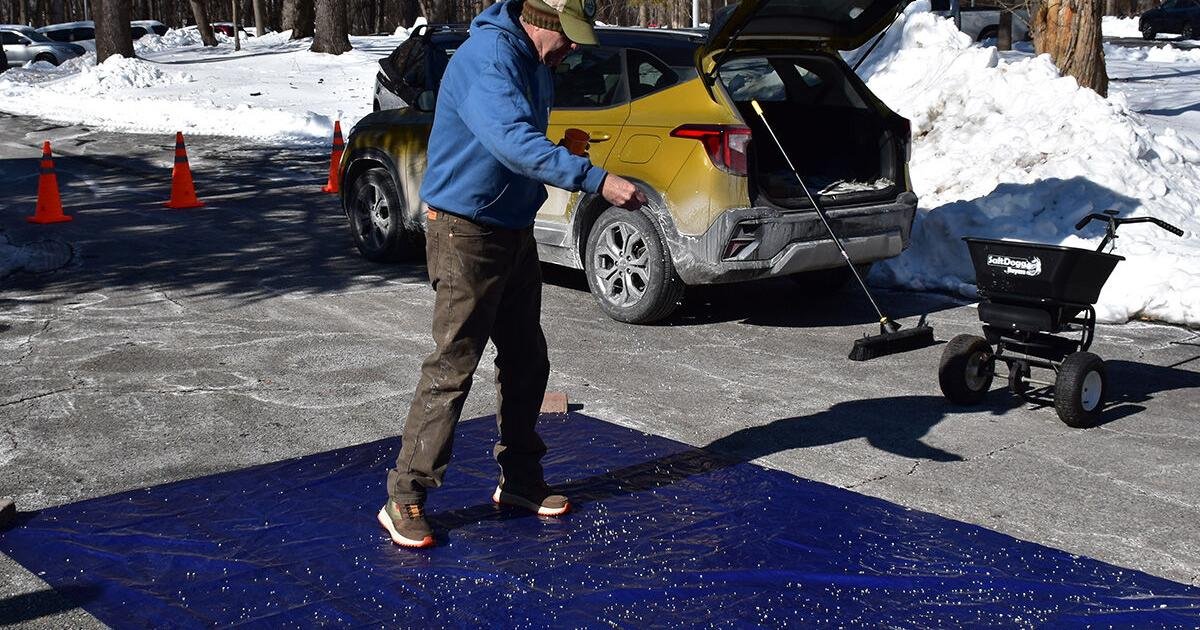

Chesapeake Bay Landscape Specialist Jason Swope demonstrates road salting techniques in Gaithersburg, Maryland, on January 31, 2026. (S. Monsion/Potomac River Basin Interstate Commission)
With the arrival of spring, salinity levels in many freshwater rivers in the Chesapeake Bay region will skyrocket. The salinity comes primarily from salt used to treat roads in the winter, which continues to flow toward rivers during the spring rains.
And while efforts are underway across the region to reduce harmful salinity in freshwater streams, research shows that salinity continues to rise.
John Jackson, principal investigator at Stroud Water Research Center in Pennsylvania, said rock salt is now part of the water cycle. And even in places where it doesn’t flow directly into rivers, it percolates underground and reaches groundwater and aquifers.
Plants and animals near the Chesapeake Bay, especially those to the south, have evolved to tolerate saltier waters, but plants and animals in freshwater rivers and streams have not. Increased salinity can make it difficult for fish to regulate the amount of salt in their bodies. For humans, salt can reach drinking water sources and cause heart and kidney disease. This compound also corrodes infrastructure and increases the toxicity of other pollutants.
To address the problem, states and local governments in the Bay Area are trying to reduce their use of road salt, and community groups are encouraging private landowners to do the same.
But it’s a challenge. It is already difficult to remove salt from soups. Removing salt from drinking water on a large scale is much more difficult and much more expensive. The Fairfax County Water District in Northern Virginia estimates it would cost more than $1 billion to desalinate the drinking water it processes.
“Everything that we put on the sidewalk that we don’t remove ends up in our waterways, so everything has an impact,” said Lenny Bourassa, communications director for the Potomac River Basin Interstate Commission.

In January 2026, salt piles up at Lehigh Valley Health Network in Allentown, Pennsylvania.
The general advice is to simply use less. Adding salt to a particular spot won’t make the snow melt faster. Bourassa said people only need one mug of salt for every 10 squares of sidewalk.
The Highways Agency is working to reduce salt usage while keeping roads safe. Maryland, Virginia and Pennsylvania now pre-treat roads with brine, a mixture of salt and mostly water. The salt water helps the subsequently added rock salt stick more to the road.
Charlie Gischler, a spokesman for the Maryland Highway Administration, said the use of brine can reduce salt application by up to 30 percent. The ministry’s goal is to reduce salt use by 50%, but a particularly snowy winter could hinder that, he said.
Virginia uses many of the same tactics, releasing a Salt Management Strategy Toolkit in 2020 as guidance for private organizations and communities. Pennsylvania has a Strategic Environmental Management Program that provides guidance for reducing winter salt use. About 1.5 million tons of salt were used this winter in Virginia, Maryland, and Pennsylvania.
Despite these efforts, salinity in freshwater rivers continues to rise. A study by U.S. Geological Survey hydrologist Rosemary Fanelli found that from 2014 to 2016, 68 percent of Chesapeake Bay freshwater streams had conductance levels, a measure of salinity, 1.5 times higher than naturally occurring levels.
Levels of chloride (sodium chloride) from salt have increased by 84% and 155% in the Potomac and Patuxent rivers, respectively, over the past 30 years.
The Washington Metropolitan Area Council of Governments is managing a project to study something called “freshwater salinization syndrome.” This project aims to analyze current salinity trends and identify solutions for the Washington area and surrounding counties, cities, and towns.

A snow blower clears the landing area at Thurgood Marshall Baltimore Washington International Airport on January 24, 2016. (Maryland Department of Transportation)
Sujay Kaushal, a professor at the University of Maryland, is also participating in the project. Researchers found that even though snowfall in the region has decreased by 40% over the past 100 years, salt spikes still occur in waterways.
Professor Stanley Grant of Virginia Tech, another of the project’s lead scientists, studied the salinity of Occoquan Reservoir as a microcosm of the region. Grant found that peak salinity levels have increased even though snowfall has decreased in surrounding areas. Grant found that development and extreme weather are the main factors.
Fanelli’s USGS study also found that, besides geological features, the biggest predictor of high conductance was impermeable surfaces.
Kaushal and others plan to meet with the Chesapeake Bay Project’s Science, Technology and Advisory Committee by the end of May to find solutions and risks.
“I think this is a solvable problem,” Kaushal said. “As we see what these possibilities are (as a result of monitoring), I think it will decrease, and I think it’s possible. And it just becomes the political and social will at some point.”
The state’s efforts may be ineffective because state highways are only a small portion of the areas where salt is sprayed. Private properties such as shopping centers and business campuses over-salt their premises to avoid liability for injuries.

Penny Pantano, a volunteer with the Pennsylvania Road Salt Control Working Group, measures salinity levels in a Pennsylvania river in October 2025.
Jason Swope, lead instructor for Maryland’s Smart Salting Program, teaches property managers about salt best practices and encourages them to consider contract modifications to curb excessive salt use. For example, customers pay a fixed price instead of paying per bag of salt.
Anthony Bishop, a partner at Deicing Depot, is a salt wholesaler. Bishop helps train Swope’s contractors. But he said the key to this change is getting customer buy-in.
“Once[customers]understand the benefits, we find that they can reduce the amount of salt they apply on their property and get it where it’s needed, rather than in the lawn or in the pond,” Bishop said.
