


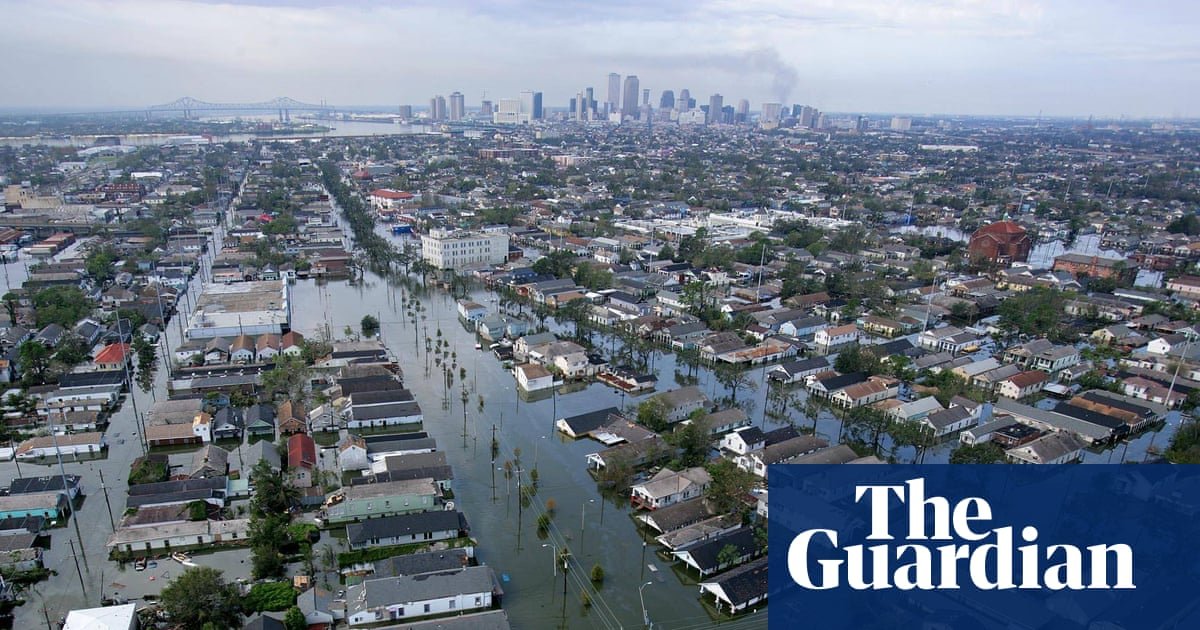
TThe process of relocating people from New Orleans should begin immediately, a brand new study concludes, as the climate crisis puts the city at a “point of no return” where the city will be surrounded by ocean within decades.
Ongoing sea level rise and severe wetland erosion in southern Louisiana will engulf the New Orleans area within a few generations, with a new paper estimating that the city “could be surrounded by the Gulf of Mexico by the end of the century.”
South Louisiana’s lowlands face multiple threats, including rising sea levels due to global warming, the increasingly powerful hurricanes that characterize the climate crisis, and the gradual sinking of coastlines carved out by the oil and gas industry.
South Louisiana faces 10 to 20 feet of sea level rise and the loss of three-quarters of its remaining coastal wetlands, according to the study, which would cause the coastline to “shift 100 kilometers inland,” stranding New Orleans and Baton Rouge. The study compared today’s rising global temperatures to a similar period of heat 125,000 years ago that caused sea levels to rise.
Researchers say this scenario would make the region “the most physically vulnerable coastal region in the world” and require immediate action to prepare people from New Orleans, a population of about 360,000, to move smoothly to safer areas.
Louisiana has already experienced population decline in recent years, and the newspaper warns that this trend will accelerate in a chaotic manner unless steps are taken to address the crisis facing its largest cities and surrounding communities.
A perspective paper published in the journal Nature Sustainability added: “Climate mitigation should be the first step to preventing the worst outcomes, but coastal Louisiana is clearly already past the point of no return.” A perspective paper is an academic paper that provides an evaluation rather than new data.
Billions of dollars have been spent to shore up New Orleans with a vast network of levees, flood gates and pumps installed after 2005’s devastating Hurricane Katrina. But growing threats to cities mean that the levees already require major renovations to remain fully functional and will not save cities in the long term, a new paper warns.
Animated map showing land at depths of 3 meters and 7 meters along Louisiana’s south coast.
“From a paleoclimate perspective, New Orleans is gone. The question is how long that lasts,” said Jesse Keenan, a climate adaptation expert at Tulane University and one of the paper’s five co-authors.
“We don’t know for sure how long, but it’s probably decades, not centuries. Even if we stopped climate change today, New Orleans still has a finite lifespan. It’s going to be surrounded by open ocean, and you can’t keep an island afloat when it’s underwater. There’s no amount of money to make that happen.”
Keenan said city, state and federal leaders should begin efforts to support people moving out of the New Orleans area in a coordinated way, starting with the most vulnerable communities, such as those living outside the levees in Plaquemines Parish.
“New Orleans is terminally ill and we need to make it clear to patients that it is terminally ill,” he said. “There is an opportunity for palliative care to help transition people and economies. We can get ahead of this.”
But, he added, “no politician wants to be the first to say this terminal diagnosis. They will talk about it behind closed doors, but never in public.”
New Orleans faces clear challenges. Located in a bowl-shaped basin below sea level, it already puts 99% of its population at great risk of severe flooding, making it the worst-hit of any U.S. city, according to a separate study released last week.
“Compared to other cities in the United States, New Orleans really stands out, which is concerning,” said study co-author Wangyun Hsiao, a geographer at the University of Alabama.
“While there is no specific timetable for how long New Orleans will remain, we know that New Orleans is in big trouble. New Orleans faces one of the highest sea level rises in the world, and we don’t know how long human efforts can combat the tide. This is a ticking time bomb.”
Hsiao said he agrees that people will need to relocate. “We know this is a political and emotional issue. There are people who have a deep attachment to New Orleans,” she said. “But managed withdrawal, no matter how unattractive it may be, is the ultimate solution at some point.”
A major pressure on this southern cultural hotspot is the rapid retreat of the surrounding land. Since the 1930s, Louisiana has lost 2,000 square miles of land to coastal erosion, an area the size of Delaware, and is expected to lose another 3,000 square miles over the next 50 years. The rate of land loss is so rapid that an area the size of a soccer field disappears every 100 minutes.
To combat this, Louisiana has settled on a new kind of plan over the past decade that seeks to avoid building more flood defenses and instead take advantage of the Mississippi River’s natural ability to rebuild land. Until now, levees and other infrastructure have enclosed the naturally winding Mississippi and instead of replenishing coastal wetlands, it has pushed sediment carried by the Mississippi directly into the Gulf of Mexico.
The so-called Mid-Barataria Sediment Diversion Project, which broke ground in 2023, will help restore more natural flow in the Mississippi Delta and allow sediment to build up in lost coastal areas. The project estimates that more than 20 square miles of new land will be created over the next 50 years.
But Louisiana’s Republican governor, Jeff Landry, canceled the plan last year, arguing that the $3 billion cost was too high and threatened the state’s fisheries. “This level of spending is unsustainable,” Landry said at the time, adding that the project was putting the livelihoods of “the people who have supported our state for generations” at risk.
Proponents of the project, which was funded by BP’s settlement over the 2010 Deepwater Horizon disaster, denounced the decision as disastrous for the state, noting that fishing villages would have to be relocated anyway due to worsening erosion.
Former Republican Rep. Garrett Graves, who once led the state’s Coastal Restoration Agency, said Landry made a “gut-wrenching decision” that “results in one of the biggest setbacks for the protection of our nation’s coasts and communities in decades.”
Losing the sediment diversion plan “effectively means abandoning large swaths of coastal Louisiana, including the New Orleans area,” according to a new research paper.
Meanwhile, a legal proposal to force oil and gas companies to pay for damage to Louisiana’s coastline is also questionable. This month, the U.S. Supreme Court allowed the fossil fuel industry to file a federal challenge to a state jury’s decision to award Chevron $740 million to remedy damage caused to wetlands by dredging canals, drilling wells and dumping wastewater.
“The combination of these decisions is pushing a scenario where the state stops building on the land,” Keenan said. “It would only accelerate the schedule. They could be buying time, but that option is currently prohibited. That means New Orleans’ levees are sure to fail again and again. The floodwaters will have nowhere else to go.”
Although the United States has never relocated large cities on a large scale, many communities have relocated for economic reasons, and now some are relocating because of the climate crisis. In Louisiana, Keenan said the government could begin planning and building appropriate infrastructure in safer areas across Lake Pontchartrain, a large estuary north of New Orleans.
“This could be an opportunity for New Orleans to move people further north, invest in long-term infrastructure and make it sustainable,” Keenan said.
“That leak has already started, so if we don’t do something, we’re going to see a trickle of people over time and chaos. The market is going to say people can’t get insurance. Louisiana has to stop the bleeding and acknowledge that this is happening. But there’s no plan at this point.”
Timothy Dixon, a coastal environmental expert at the University of South Florida who was not involved in the new paper, said the study “does an excellent job” highlighting the challenges facing Louisiana from the combination of land subsidence and rising sea levels.
“New Orleans isn’t going to disappear in 10 years, but policymakers really should have been thinking about relocation plans a century ago,” said Dixon, whose research recommends a cautious retreat from coastal Louisiana.
“Governments may not have the capacity to just tell people to leave, but people will move voluntarily, and we’re already seeing that. I’m not optimistic that our political system will be able to deal with this problem. It’s going to take leadership and unpopular decisions. And many people don’t want to move. They love where they were born.”
Landry’s office did not respond to requests for comment.
