


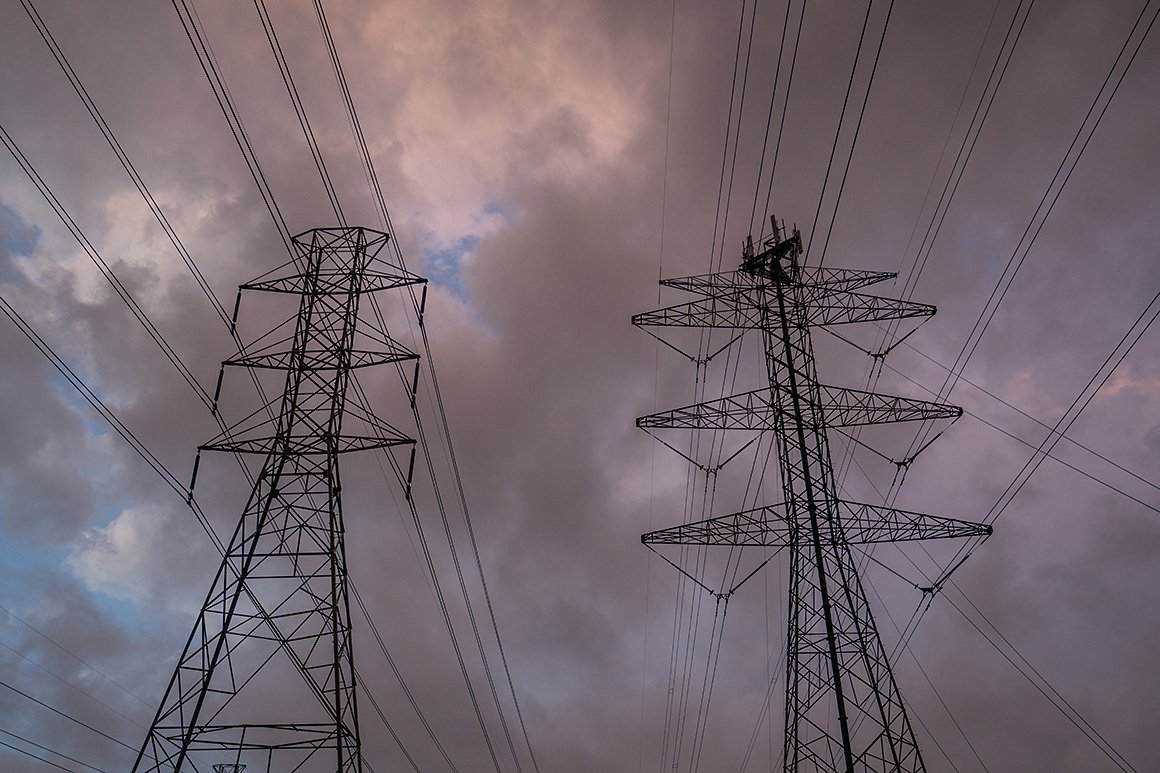
Texas is considering where to install power lines in a $33 billion expansion of its power grid, but landowners are complaining about changes to how lines are approved.
The debate is unfolding at the state Public Utilities Commission, which is considering where to route more than 3,400 miles of extra-high-voltage power lines that crisscross the state. Ranchers and homeowners also objected in half the time.
Texas is among a growing list of regions across the country, from Maryland to Maine, where opposition to power projects is growing. At issue are both the physical impact of massive towers and miles of power lines, as well as questions about compensation and due process.
Dave Clark, director of the nonprofit Friends of the San Saba River, said the one-two punch of the PUC’s 2025 approval of the mega-transmission project and the 2023 law shortening the review process was difficult for Texas property owners to accept.
“Okay, we have to have it, that’s what I hear,” Clark said of the power lines. “But let’s have a fair process that landowners can really follow and a reasonable timeline to get through it.”
Unlike other states, the driving force behind Texas’ transmission overhaul was not data centers, but the state’s massive oil and gas industry, where power demand has soared since the fracking revolution of the 2010s. Since then, Texas has become a data center hotspot, further increasing pressure to build lines.
A map of planned power grid improvements shows three major transmission lines from central Texas to the Permian Basin and two major projects in the central and eastern parts of the state. Many power companies are involved in power transmission expansion.
Under the state’s current rules, residential and small business ratepayers will primarily be hit with a $33 billion transmission tab. But PUC commissioners should consider changes to these rules later this year to further ease the burden on residents and non-industrial power users.
State lawmakers and regulators have heard a lot from constituents dissatisfied with the transmission planning process, and Republican Lt. Gov. Dan Patrick directed the Texas Senate to consider whether a shortened regulatory timeline would give landowners enough time to submit their comments.
PUC Chairman Thomas Gleason, the state’s top electricity regulator, told a state Senate committee last month that “private property rights are as important an issue in Texas as economic development is.” “We’re trying to thread that needle and get the balance right.”
Gleason did not respond to requests for an interview. The PUC said in a statement that the transmission planning process complies with the letter of the law.
Texas could soon face another battle with infections.
The Electric Reliability Council of Texas, the transmission utility that handles about 90 percent of Texas’ electricity needs, said power demand could rise to 367.8 gigawatts by 2032, thanks in large part to data centers, up from a record demand of 85.5 gigawatts in 2023.
But the current oil and gas-driven transmission expansion highlights problems with how states approve infrastructure plans for large electricity users.
The oil field’s thirst for more reliable power has been growing for more than a decade.
Oil production in Texas has skyrocketed since hydraulic fracturing (fracking) took off in the 2010s. Hydraulic fracturing requires far more energy than just running a generator to drill a conventional well, said Hugh Daigle, a professor of petroleum engineering at the University of Texas at Austin.
Creating the water pressure needed to crack underground rock and release oil requires more horsepower than a traditional well, he said.
“The traditional method (of hydraulic fracturing) used diesel power and fracking trucks, which required 40 trucks lined up to provide the necessary pressure,” Daigle said.
“It’s shameful.”
Starting around 2020, many major exploration and production companies made climate change pledges and planned to start electrifying their operations rather than using diesel generators as part of reducing greenhouse gas emissions.
Daigle said carriers also realized they could save money by using power from the grid.
But electrifying oil fields has proven difficult, especially in the Permian Basin, the epicenter of Texas oil production. The basin, which includes parts of southern New Mexico, accounted for 44% of total U.S. oil production in December 2025.
The Permian Basin is essentially a remote part of West Texas.
There are only a handful of population centers nearby, and the areas with the most oil production don’t have many power lines, but they also have very few people.
Six oil and gas companies commissioned a study in 2022 that showed electricity demand in the Permian could increase from 4.2 million kW in 2022 to 17.2 million kW by 2032.
The following year, the Texas Legislature passed HB 5066, requiring the PUC to develop what became known as the Permian Basin Reliability Plan, which required addressing the expansion of electrical transmission service to “regions” where resources such as oil and gas were discovered.
Texas Oil and Gas Association President Todd Staples said in a statement that transmission is desperately needed after “a decade of significant delays in power connectivity” in the Permian.
“For too long, electric grid expansion has been unable to keep up with the tremendous growth in oil and natural gas production that powers our state,” Staples said. “The Permian Basin Reliability Plan is a critical component of the state’s infrastructure modernization efforts, laying a critical foundation for the state’s future power transmission needs and ensuring Texas can continue to responsibly produce the oil and natural gas that power our state, nation and world.”
The Texas Legislature approved another transmission review in 2023.
Lawmakers that year also passed SB 1076, shortening the deadline by which the PUC must approve or deny transmission projects from one year to 180 days.
And after those laws were passed, Texas’ major transmission utilities released a study highlighting the need for more transmission, this time in East Texas.
Collectively, the PUC and Texas’ electric transmission operator, known as ERCOT, have approved building more than 3,400 miles of new high-voltage transmission lines across the state by 2032 at a cost of $33 billion. Approximately 2,468 miles of the line will be 765 kilovolt transmission lines, the highest voltage level in North America.
ERCOT officials did not respond to specific questions from POLITICO’s E&E News, but they did share some resources on how grid operators identify transmission needs.
In the papers, ERCOT officials said researchers used demand forecast data submitted by transmission companies and a 2022 study funded by the oil industry to develop an extensive transmission plan.
But the combination of rolling out large-scale transmission expansions and shortening transmission approval periods sparked outrage across the state, especially in rural areas.
Kevin Kennedy, a retired engineer, estimates he has spent 40 to 60 hours a week for months fighting power transmission company Oncor Electric over a plan to build part of a $33 billion power transmission project through his central Texas ranch in Burnett County. He has put in so much time that his friends and family now call him “Kilowatt Kevin.”
In reality, the time he has to stop mowing crews across miles of land is short.
Kennedy and other landowners have 30 days to submit documentation that is considered part of the legal decision-making process about where to install power lines, regardless of when they receive formal notification that their land is part of the project.
That’s just the first hurdle.
All told, protesters now have just 85 days and multiple state-mandated deadlines to file dozens of legal documents to oppose the route of a proposed transmission project, down from nearly six months before SB 1076.
Kennedy said the process of filing and submitting applications is so technical, complex and time-consuming that many neighbors have given up on defending their rights.
“This whole thing is completely working against the people,” Kennedy said. “There’s a lot of people who are wealthy but are actually poor. They’re now paying an $8,000 fee to hire a lawyer, and the cost is turning them off.” “The whole thing is a disgrace.”
Oncor spokeswoman Kelly Dunn said in an interview that the company is trying to build the transmission line as straight as possible from the substation, taking into account community concerns and the ecological environment. Oncor is a regulated electric utility company.
“We also have to look at the community impacts, the recreational impacts, the environmental impacts,” Dunn said. “While our route doesn’t go through anyone’s homes, we know people who are near (the power lines) are concerned and we understand that.”
“Quite a few calls.”
The public can submit comments opposing the submission project on the PUC’s website without hurdles.
But the PUC relies primarily on final orders from administrative law judges to inform decisions about where the power lines will be routed.
Republican state Sen. Kevin Sparks said he and others receive calls almost daily from landowners frustrated with the transmission planning process and concerned about their properties. The main problem for property owners is to take initial action.
“If they don’t respond within 30 days, assuming they were properly notified, they have lost the ability to protest something that could significantly reduce the value of their land,” Sparks said in an interview. “More and more landowners are starting to realize that these lines could potentially cross[their]property, and they’re starting to reach out to their legislators, and we’re getting a significant number of calls.”
More than a dozen state lawmakers, including the authors of the bill that created the Permian Basin Reliability Plan, sent a letter to PUC members asking them to reconsider where some of these power lines will go and slow down the protests.
A letter from the lawmakers said that while they initially supported SB1076, some of ERCOT’s new transmission projects “need a more careful review than the current schedule allows.”
Republican state Sen. Phil King, who authored SB 1076 regarding the timing of PUC reviews, did not respond to requests for interview or comment. But the Texas Legislature won’t convene its next session until January 2027, so there are limits to what lawmakers can do now.
“I think we’ve talked to literally everyone except the governor, and he’s the only one who can do anything about this right now until the Legislature comes back,” Clark said with the San Saba River Friends Association.
Texas Republican Gov. Greg Abbott has appointed members of the PUC, and despite SB 1076’s order, landowners and some lawmakers are asking regulators to pause the transmission approval process.
In a statement, Abbott state spokesperson Andrew Maharelis said the state needs to invest more in transmission to keep power reliable and affordable for Texans.
“The needs and concerns of Texans are the Governor’s top priority, and he encourages the public to provide feedback to the PUC,” Mahalelis wrote.
The PUC declined E&E News’ request for an interview, but officials said in a statement that the commission “strongly encourages resident participation” in the transmission planning process and highlighted legal steps that can be taken to make residents’ voices heard.
PUC spokeswoman Ellie Breed wrote that the commission’s public engagement office attended community meetings, met with lawmakers and responded to more than 300 phone calls and emails regarding the transmission project.
“Once again, the (PUC) strongly encourages Texans to fully participate in the decision-making and planning process for transmission line route selection,” Breed said. “The public’s opinion is very important.”
But Clark said writing public comments to the PUC won’t fix flaws in the transmission approval system and won’t give landowners enough say.
“Let’s approach it in the right way and understand it, rather than forcing it on everyone in too short a period of time,” Clark said.
