


People in three states who live near large livestock operations have higher rates of cancer, a new analysis finds.
The study, published in the journal Environment Research, focused on California, Iowa, and Texas because of the availability of cancer incidence data, the number of feeding operations in those states, and the variety of animals kept in feedlots.
While the results are alarming, the study authors note that they do not prove that concentrated animal feeding operations (CAFOs) cause cancer. Meanwhile, industry representatives dispute that finding, pointing to other studies showing lower rates of many cancers near facilities.
Researchers at Yale University mapped operational CAFOs and overlaid those maps with county-level cancer data. The study also took into account other factors such as facility type, management practices, and regulatory enforcement. Their findings raised concerns from environmental health activists about how the facility would affect the surrounding air and water, and ultimately human health.
“There are many ways CAFOs could affect cancer, including changes in air quality, water quality, noise, and odor,” Nicole Desir, a Yale University researcher and co-author of the study, told Inside Climate News in an email on Friday.
Deziel said more research is needed, but the study “raises important public health concerns given the consistency of the results” in all three states.
Compared to counties with a lower density of CAFOs, the study found that the incidence of all types of cancer was 4 percent higher in high-exposure counties in California and 8 percent higher in high-exposure counties in Iowa and Texas. Researchers defined “high exposure” counties as those in the top 25 percent of CAFO densities in the state.
They also correlated CAFO density with higher associations with bladder cancer in California, colorectal cancer in Iowa, and lung and bronchial cancers in Texas.
The Yale study is “groundbreaking,” said Amanda Claire Starbuck, director of research at the nonprofit Food & Water Watch.
“I don’t think this topic of CAFOs and cancer is really emphasized enough and considered enough,” Starbuck said.
Instead, she said, the study focuses on pollutants from factory farms, including those recorded in the air and water, and the impact that fertilizers released from these facilities have on local communities.
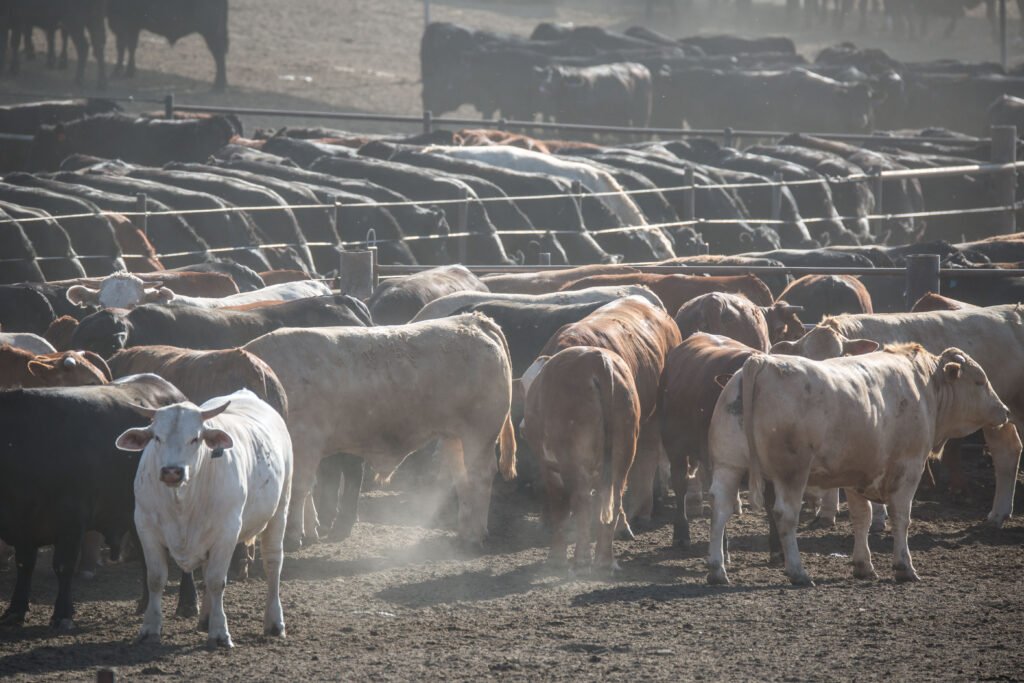
CAFOs are large industrial agricultural facilities that house large numbers of livestock, usually confined in small spaces to maximize meat, milk, and egg production.
Agriculture emits more methane, a powerful climate pollutant, than oil and gas production, according to national estimates. Cows will account for about 35 percent of U.S. agricultural greenhouse gas emissions in 2024, more than any other livestock, according to the Congressional Budget Office.
Iowa has the highest number of CAFOs in the nation, with federal estimates suggesting there may be nearly 4,000 facilities in the state. California ranks fifth with an estimated 1,000 deaths, while Texas ranks sixth with about the same number, according to Environmental Protection Agency statistics.
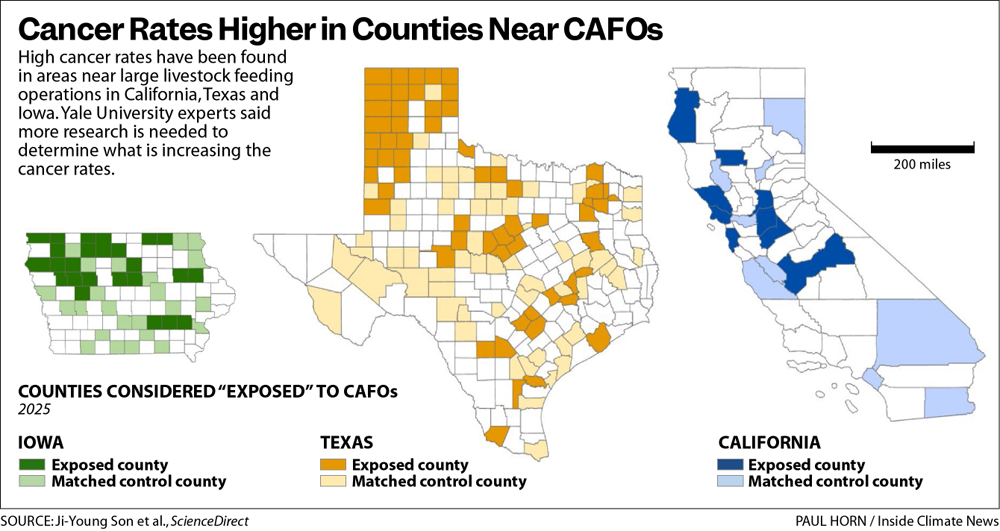
Researchers at Yale University, led by Ji-young Song, examined cancer data from 2000 to 2021. Researchers cited a range of harmful pollutants emitted by animal farming operations as potential contributors to increased cancer rates: gaseous emissions such as ammonia and hydrogen sulfide, particulate matter, volatile organic compounds, and bioaerosols containing endotoxins and antibiotic-resistant bacteria.
“Chronic exposure to these pollutants is associated with inflammation, oxidative stress, and immunosuppression,” which may contribute to cancer development, the study authors wrote.
In addition to their impact on the atmosphere, CAFOs can be a major source of water pollution. This operation produces large amounts of fertilizer, which is often distributed as fertilizer and can contaminate water with nitrates.
Michelle Bell, lead author of the Yale study, said further research, including testing people living near CAFOs, is needed to understand how different cancer types are affected by things like air and water quality from these feeding operations.
Yale researchers said the study did not examine individual exposure levels to pollutants from CAFOs and did not prove that CAFOs cause cancer. Additionally, some cancers (such as breast cancer in Iowa and Texas) did not correlate with the abundance of CAFOs in relatively small geographic areas.
Industry representatives have questioned the report’s findings.
“In addition to not adequately accessing factors such as actual contaminant measurements, duration of exposure, facility size, management, and emissions, this study is missing other important cancer-related exposures, including occupational exposures, health access/screening rates, diet, obesity, alcohol use, and regional baseline cancer risk differences,” Livestock Agriculture Alliance President Hannah Thompson-Wieman said Friday after reviewing the study.
Additionally, CAFO managers must follow “significant environmental regulations,” added Thompson Wieman, a group representing farmers, ranchers and food companies.
This story is funded by readers like you.
Our nonprofit newsroom provides free advertising for our award-winning climate coverage. We rely on donations from readers like you to continue our work. Donate now to support our work.
donate now
The Yale study is not as thorough as other analyzes of the same industry, said Wendy Brannen, vice president of communications and marketing for the National Pork Producers Council, which represents more than 60,000 pork operations.
“There was a rigorous, long-term study that followed real farmers for 30 years and found that Iowa farmers were significantly less likely, if not more likely, to develop cancer than the general population,” Brannen said in a statement, referring to a study published in March by the Iowa Cancer Registry.
Brannen said Yale’s county-level comparisons, which study authors described as “exploratory,” “do not negate” Iowa’s long-term data.
A report from the Iowa Cancer Registry found that farmers in the state have 13 percent less cancer than the general population.
“The incidence of cancers of the colon and rectum, lung, bladder, oral cavity, pharynx, pancreas, esophagus, larynx, liver, and tongue was lower than expected,” Iowa officials said in a summary of their findings. “But they were diagnosed with more prostate and lip cancers than expected.”
The mixed findings from the Iowa study show how complex the problem is, Food & Water Watch’s Starbuck said.
“You have to take the full weight of the evidence, and I think that’s kind of the issue here,” Starbuck said. “It’s very easy for industry to cherry-pick and think this research is bad. But if you look at the research here, so everything is fine. That’s not how science works.”
Lori Pesante, director of the Sierra Club’s Kern Kaweah chapter in California, called the Yale study alarming but not surprising, and agreed that more research is needed to understand the relationship between cancer and large-scale livestock operations.
When she looks through methane satellite data, the largest plumes are often clearly visible over CAFO feedlots.
“We know that major sources of air and water pollution, such as oil and gas wells and large-scale feedlots, are often built in low-income areas, leading to disproportionately negative health impacts,” Pesante said.
She called for stronger regulations to monitor and prevent contamination related to feeding operations. “Agricultural reform is a key part of solving the climate crisis, but it also makes our communities healthier.”
About this story
As you may have noticed, this article, like all news we publish, is free to read. That’s because Inside Climate News is a 501c3 nonprofit organization. We don’t charge subscription fees, keep our news behind paywalls, or fill our website with ads. We provide climate and environmental news free to you and anyone who wants it.
That’s not all. We also share our news for free with dozens of other news organizations across the country. Many of them cannot afford to do environmental journalism themselves. We’ve established bureaus across the country to report on local news, partner with local newsrooms and co-publish stories to ensure this important work is shared as widely as possible.
The two of us started ICN in 2007. Six years later, we won the Pulitzer Prize for national reporting and now run the nation’s oldest and largest dedicated climate newsroom. We tell the story in its entirety. We hold polluters accountable. We expose environmental injustice. We debunk misinformation. We explore solutions and inspire action.
Donations from readers like you fund all aspects of our work. If you haven’t already, will you support our ongoing work, our coverage of the biggest crises facing our planet, and help us reach more readers in more places?
Please make a tax-deductible donation. Each one makes a difference.
thank you,

stephen rose
california reporter
Stephen Rodas is an environment and climate reporter for Inside Climate News based in Southern California. He previously reported on New Jersey’s environment covering energy, pollution, wildlife and development. Steven’s work has appeared in several publications, including NJ.com/The Star Ledger, hMAG, The Jersey Journal, and The Hudson Reporter. He worked as a copywriter at Google. Stephen holds a master’s degree from Syracuse University’s SI Newhouse School Of Public Communications. He is fluent in English and Spanish (any advice would be greatly appreciated).
