



Italy’s elderly population is growing unevenly, and new regional data shows how disease burden, diet, obesity and a southern longevity hotspot could shape the future of healthy aging.

Research: Beyond the Blue Zone: Healthy Aging and Ultralongevity in Italy (1982-2025) – Ecological Analysis of Demographic, Metabolic and Nutritional Interrelations. Image credit: ChatGPT / OpenAI
In a recent study published in the journal nutrientsresearchers used an ecological population-level design to analyze temporal trends in hyperlongevity and population aging in Italy.
Population aging represents a challenge to global public health and economic sustainability. Europe has some of the highest proportions of the population aged 65 and over, with Italy, France and Spain leading the way in prevalence among centenarians. Improving survival into old age is accompanied by a burden of non-communicable diseases (NCDs). Despite considerable research interest, comprehensive studies on regional longevity patterns and NCD mortality rates in Italy remain limited.
About research
In this study, researchers investigated the temporal trends and regional patterns of hyperlongevity and population aging in Italy. Age-standardized mortality ratios (ASMR) for five NCDs, chronic lower respiratory tract diseases, diabetes, ischemic heart disease, neoplasms, and cerebrovascular diseases, were obtained from the European Health for All (HFA) database for the years 1990, 2001, 2011, and 2023.
Population numbers for 1982, 2001, 2019, and 2025 were obtained from the Italian National Institute of Statistics. The HFA-Italy database was used to obtain 2024 data on nutritional and behavioral indicators for individuals aged 65 years and older. In addition, longevity indicators included the ratio of 85 and above to 90 and above, aging trend, longevity index (LI%), male to female ratio (F/M), and centenarian index (CI%).
The 85 and over and 90 and over ratios are the proportion of people 85 and over and 90 and over, respectively, as a percentage of the total population. LI% was the ratio of people 90 and older to people 65 and older. CI% was the ratio of people over 100 years old to people over 90 years old. Aging trends reflect the proportion of people aged 65 and over in the total population.
F/M was the ratio of women to men aged 100 and older and 90 and older. Choropleth maps were used to assess the spatial distribution of ASMR in NCDs. We used macro-regional line charts to examine temporal trends. Spearman rank correlations were used to examine ecological associations between longevity indicators and NCD mortality, and between nutritional and behavioral indicators, rather than causal relationships at the individual level.
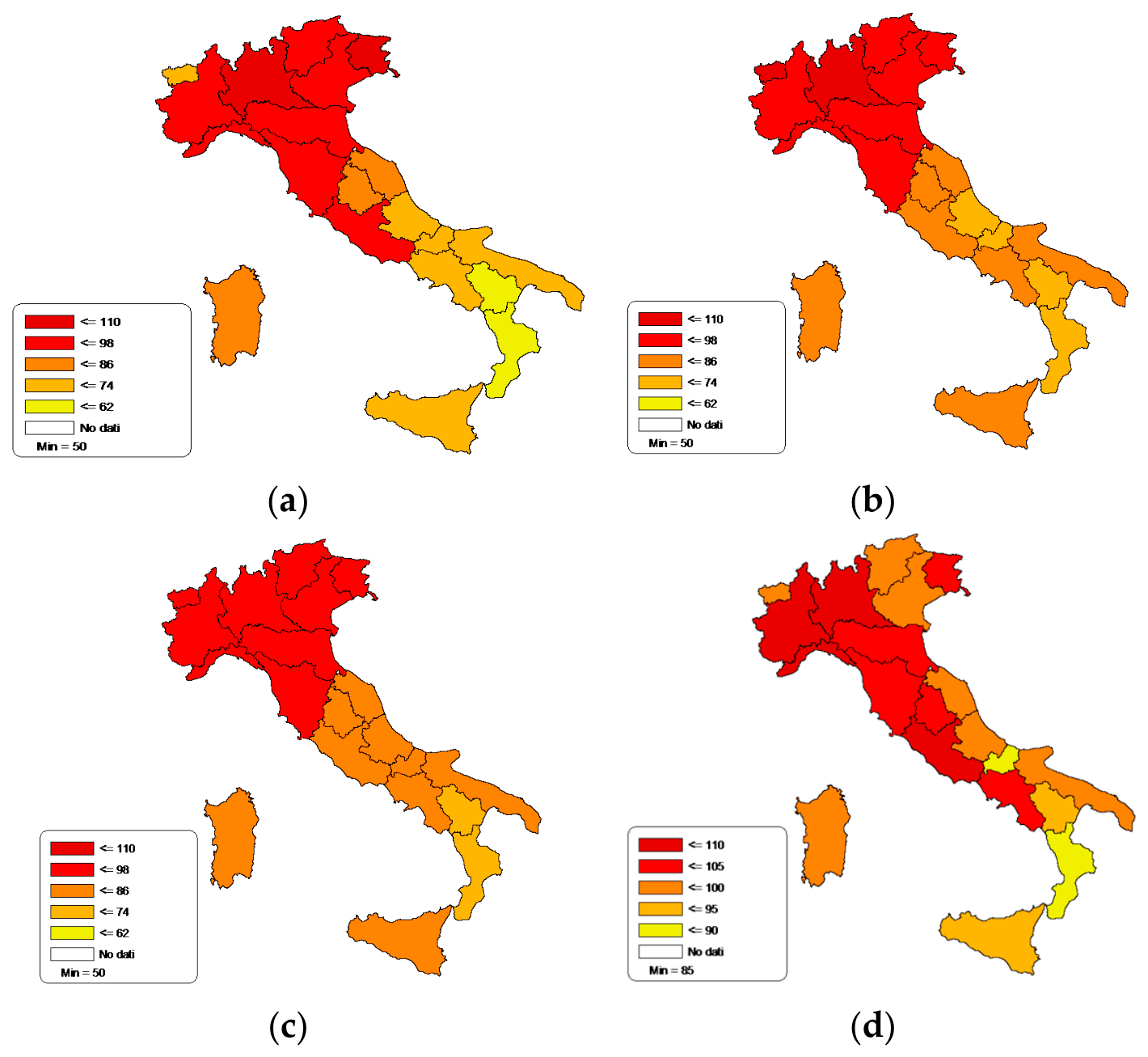
Choropleth map of age-standardized mortality rates from neoplasms in individuals aged 65 years and older in Italian regions: (be) 1990. (b) 2001. (c) 2011. (d) 2023. Maps were generated directly from the WHO European Health for All Database (HFA-DB)/HFA-Italy online platform. “No data” indicates regions where no data is available.
Survey results
Demographic analysis of four time points: 1982, 2001, 2019 and 2025 showed a continuous and regionally variable aging process in Italy. The proportion of people aged 65 and older has steadily increased. Aging trends and the ratio of people aged 85 and over to 90 and over show an upward trend over time, with the central and northern regions experiencing the highest aging. The region with the highest aging trend in 2025 was Liguria, followed by Emilia-Romagna and Tuscany.
In contrast, the aging trends were lower in Calabria and Campania. Liguria, Marche and Molise had the highest growth in the population aged 85 and over, while Liguria, Tuscany, Emilia-Romagna and Trentino-Alto Adige had the highest proportion of the population aged 90 and over in 2025. Molise, Calabria and Friuli Venezia Giulia had the highest CI% in 2025, while Liguria recorded the highest LI%. Northern and central regions generally exhibit high longevity profiles, with some smaller regions also exhibiting high values. At all time points and regions, females had a significant survival advantage.
In 2025, F/M was highest in Valle d’Aosta, Lombardy and Friuli Venezia Giulia, and lowest in Basilicata and Calabria. There was considerable regional heterogeneity in the overall mortality rate for people aged 65 years and over in 2025, with the lowest and highest mortality rates at 4,026 and 67,672 per 100,000, respectively. Lombardy and Basilicata respectively. The study notes that crude mortality rates in smaller, older populations may be more variable due to denominator effects. Additionally, the NCD showed an overall decline in ASMR from 1990 to 2023, although there were regional differences.
In general, ischemic heart disease and neoplasms had higher rates in the central and northern regions at early time points, whereas cerebrovascular disease and diabetes mellitus maintained higher rates in the archipelago and southern regions throughout each time point. Reductions in long-term mortality from diabetes and cerebrovascular disease showed the strongest regional correlations with increases in LI% and CI%. Additionally, most behavioral and nutritional indicators had a north-south gradient. The central and northern regions had a higher proportion of vegetable consumers than the southern region.
Similarly, more people in the central and northern regions reported consuming enough breakfast. Fish intake was higher in the southern and central regions. Southern regions had higher prevalence of overweight and obesity than northern regions. LI% was positively associated with vegetable intake and negatively associated with the prevalence of overweight and obesity at the community level. CI% showed a similar positive association with vegetable intake and a negative association with obesity. However, these contemporary behavioral and nutritional indicators do not represent the lifetime exposure of the centenarian cohort and should not be interpreted as evidence of individual-level causation.
conclusion
Taken together, our findings demonstrate a major demographic shift in Italy towards a superlongevity society, characterized by regional heterogeneity and changes in the burden of vascular and metabolic diseases. The central and northern regions were generally older and had the highest LI% values. On the other hand, certain southern regions, including Cilento, show that survival can be expected until extreme old age, with aggregated comparisons reporting indicators comparable to Sardinia and above the Campania regional average. Overall, these findings may inform regionally tailored healthy aging strategies, while remaining hypothesis generation rather than proof of individual-level causality.
Reference magazines:
- Aliberti SM, Nurzyńska D, Capunzo M (2026). Beyond the Blue Zone: Healthy Aging and Ultralongevity in Italy (1982-2025): An Ecological Analysis of Demographic, Metabolic, and Nutritional Interrelations. Nutrients, 18(12), 1952. Doi: 10.3390/nu18121952, https://www.mdpi.com/2072-6643/18/12/1952
