


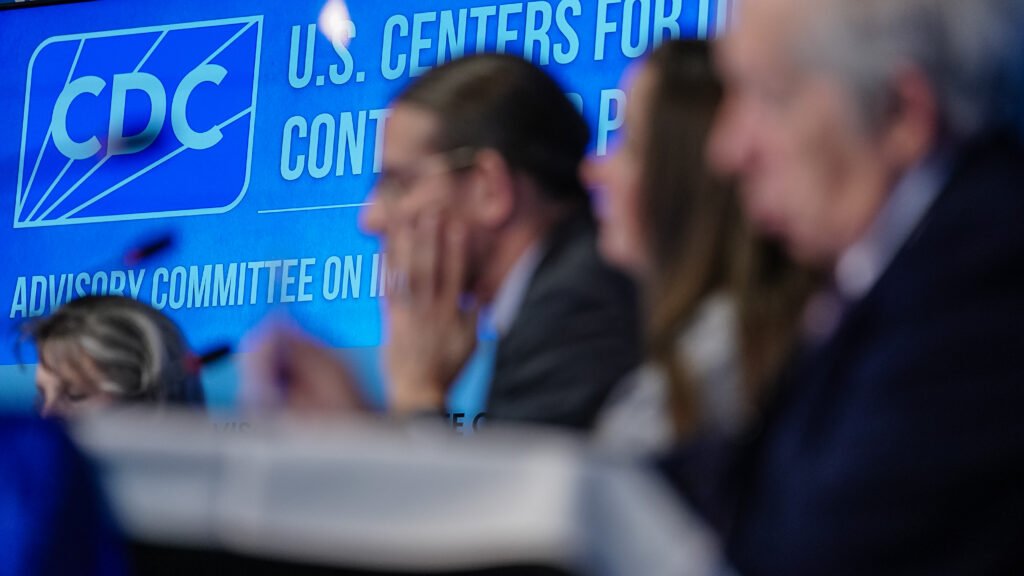
Following the court defeat, Trump administration health officials revised the governing documents of a key federal vaccine commission to expand its membership, sharpen its focus on the potential harms of vaccines and empower allies of Health Secretary Robert F. Kennedy Jr.
The new charter for the committee that advises the Centers for Disease Control and Prevention on the use of vaccines appears aimed at avoiding the kinds of legal challenges that currently bog down the appointed agency. Additionally, the document places greater emphasis on the role of the Advisory Committee on Immunization Practices in researching injuries that may be associated with vaccination, although the Committee has always paid close attention to new evidence that calls into question the safety of individual vaccines.
In a preliminary ruling last month, a federal court said most ACIP members appointed by President Kennedy, a longtime vaccine critic, were “clearly unqualified” to serve on the commission.
The revised charter announced Thursday expands the list of membership qualifications to include additional expertise such as knowledge in toxicology, pediatric neurodevelopment and “recovery from serious vaccine injuries.” It also states that people with expertise in medical fields should be eligible, which is a very broad scope.

Federal judge blocks Health Secretary RFK Jr.’s vaccine policy review
“Weakening the expertise requirement and simply making members ‘informed’ will likely make it harder for judges to require expertise, but expertise is talked about in different terms,” said Dorit Rees, a law professor at UC Law San Francisco who focuses on vaccine policy.
“Updating the ACIP Charter and its publication is a routine legal requirement and does not represent a broader policy shift,” said Andrew Nixon, a spokesperson for the Department of Health and Human Services.
ACIP advises the Centers for Disease Control and Prevention about which vaccines should be routinely recommended and to whom. This recommendation has traditionally been incorporated into state attendance requirements. Under Kennedy, the commission became a battleground for health policy, as the secretary pushed to limit the number of vaccines recommended for all infants and children.
This charter must be updated every two years, but in the past changes have typically been minimal. The move risks pushing vaccine policy issues to the forefront at a time when President Trump is trying to draw public attention to politically popular initiatives such as food reform and affordability.
At the same time, creating a new role to advise ACIP may satisfy some of Kennedy’s MAHA allies.
The new charter expands the list of liaison organizations that do not have voting rights in ACIP processes. In the past, about 30 organizations were allowed to attend ACIP meetings in this capacity, including groups such as the American Medical Association, the Council of States, and territorial epidemiologists.


STAT Plus: The White House said the vaccine is “done.” Maha seems different
The new charter adds the American College of Physicians and Surgeons, the Independent Medical Alliance, the Academy of Pediatrics and Special Needs Medicine, and physicians requiring informed consent. AAPS is a conservative physician group that has expressed skepticism about some vaccines. Physicians seeking informed consent oppose making vaccines mandatory and question the benefits of some routine vaccinations. The Medical Academy of Pediatrics and Special Needs advocates for children with autism and other complex chronic conditions.
The Independent Medical Alliance was formed in 2020 and has been advocating for treatments for COVID-19 that are at odds with mainstream medicine, and has supported President Kennedy’s vaccine policy. Kirk Milhoan and Robert Malone, chairman and former vice chairman of ACIP, which was reorganized by the Kennedy administration, also belonged to the group.
Mr. Malone recently announced that he was resigning from ACIP in protest of the Department of Health and Human Services’ failure to push back against a federal judge’s criticism of the panel’s lack of expertise.

Indirect and sometimes surprising benefits of vaccines
“The new charter moves ACIP into a more risk-focused organization and has provided a platform for organizations that have historically opposed vaccination,” Demetre Daskalakis, former director of the CDC’s National Center for Immunization and Respiratory Diseases, told STAT.
“This is consistent with the same rhetoric that guided the ACIP commission, which has since been held up in court. Vaccine policy is turning into a chess game rather than a service to human health,” said Daskalakis, who resigned last August in protest of President Kennedy’s firing of CDC Director Susan Monares and his refusal to commit to accepting all recommendations from the newly formed ACIP.
The new charter reflects language frequently used by anti-vaccine advocates, suggesting, for example, that ACIP should study “the cumulative effects of vaccines and their components.” Anti-vaccine groups have long argued that the number of vaccines administered during childhood increases the risk of neurodevelopmental diseases such as autism.
Researchers have been studying this issue for decades and have found no link between vaccines and symptoms.
“Vaccine safety is always an important consideration, but what we are witnessing is a manipulation of the committee’s objectives for the sole goal of upending vaccine confidence and use in the United States,” said Richard H. Hughes, an attorney with Epstein, Becker, and Greene, lead attorney in the case against President Kennedy’s ACIP restructuring and vaccine policy changes.
The new commission’s budget is more than double the budget set out in the previous ACIP charter, which was signed in 2024 and expired on April 1. The new charter increases ACIP’s operating budget from $410,000 to $1.08 million. There are no details to explain the sudden increase in costs.
The new revised version of the Charter, like the version it replaced, provides that the committee can have up to 19 members serving four-year terms. At the time of dissolution, the former ACIP had 17 members. The ACIP appointed by Kennedy had 15 members.

The United States is now an outlier when it comes to vaccine timelines.
ACIP’s status has been called into question since the preliminary ruling was issued last month. Following the ruling, a meeting scheduled for mid-March was canceled. Additionally, whereas the previous ACIP charter provided that the committee meet at least three times a year, the new charter provides that meetings may be convened at the discretion of the designated federal official in charge of the committee, in consultation with the committee chair.
The revised charter is also expected to address the controversial rewrite of the childhood vaccination schedule earlier this year. The new charter gives ACIP the responsibility to “review global efforts and review vaccination schedules by other countries and international organizations.”
In early January, HHS announced that, in accordance with President Trump’s memorandum, the list of vaccines recommended for children has been revised to reflect Denmark’s list, which recommends significantly fewer vaccines for all children. The rationale was that the shortened schedule would put the U.S. on par with its peers, but in reality, the new schedule, which is part of a lawsuit filed by the American Academy of Pediatrics, makes the U.S. an outlier.
Ironically, ACIP was not consulted on its revision. It was based on evidence collected by two federal health officials and approved by then-acting CDC Director Jim O’Neill.
