


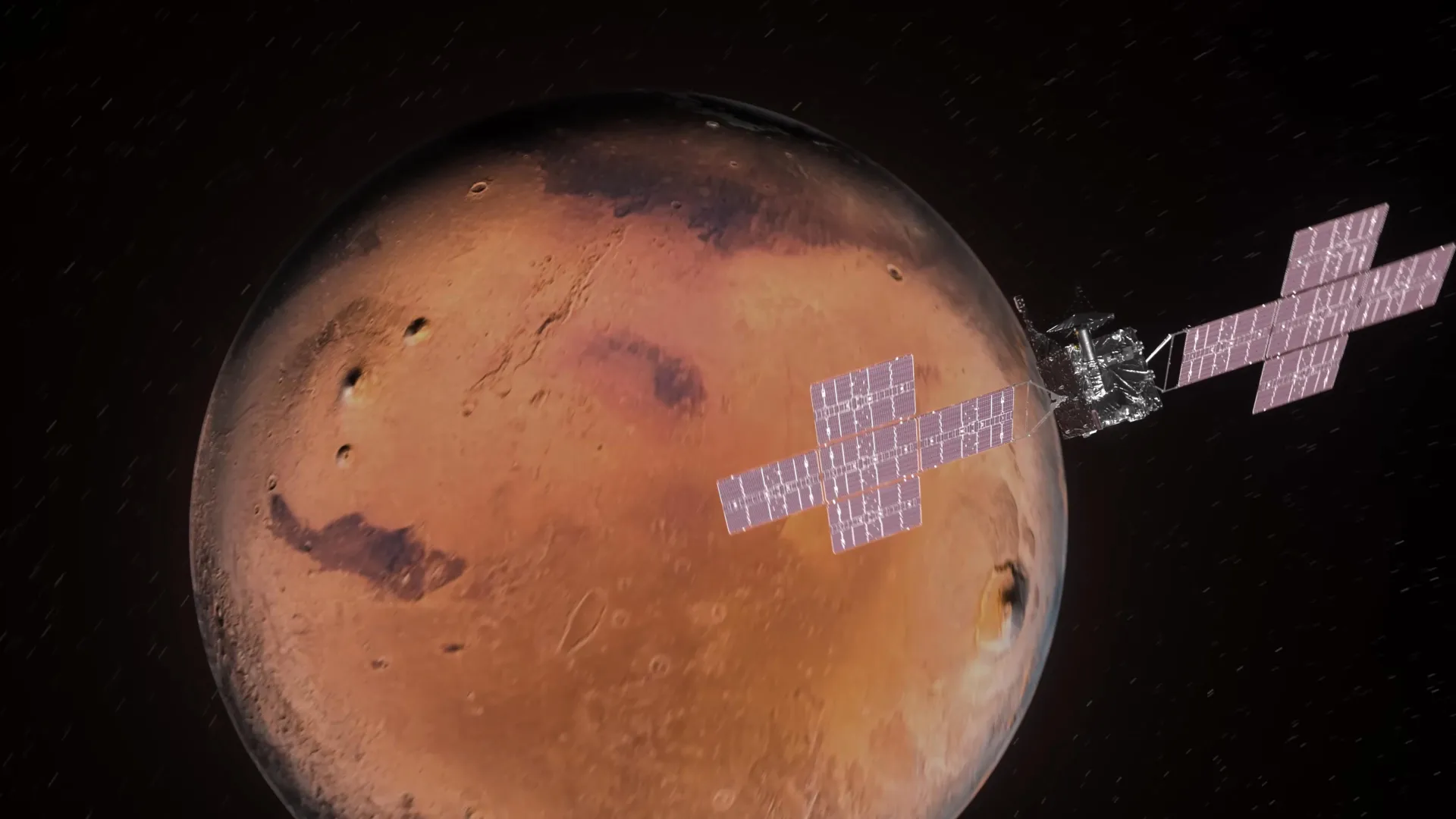
NASA’s Psyche spacecraft is preparing for a close encounter with Mars that will help propel it deep into the solar system on its way to the metal-rich asteroid Psyche. On Friday, May 15, the rover will pass just 2,800 miles (4,500 kilometers) above the surface of Mars, traveling at about 12,333 miles per hour (19,848 kilometers per hour). During the flyby, Mars’ gravity will change Psyche’s course and increase its speed, reducing the amount of propellant needed for future long missions.
Launching on October 13, 2023, Psyche will use a solar-powered propulsion system powered by xenon gas. Rather than relying entirely on thrusters, mission planners are using Mars’ gravity to guide the spacecraft towards its final destination, the rare metallic asteroid Psyche. The flyby is also an important opportunity to test and calibrate the spacecraft’s scientific instruments before arriving at the asteroid in 2029.
Psyche spacecraft captures images of Mars
During the encounter, the mission team plans to collect thousands of observations of Mars using Psyche’s multispectral imager. This data will help scientists refine imaging techniques and practice maneuvers they will later use to orbit the asteroid Psyche.
The spacecraft has already begun returning images ahead of the flyby. Starting May 7, the mission’s website began showing the first unprocessed, or “raw” images showing a starry sky with Mars appearing as a tiny dot of light. Engineers will then process the flyby images by adjusting brightness and contrast, and plan to create a time-lapse sequence of the event in the coming weeks.
To ensure the spacecraft was accurately positioned for this maneuver, the operations team conducted a course correction maneuver on February 23. During its adjustment, Psyche fired its thrusters for 12 hours to fine-tune its course and slightly increase its speed by the time it reached Mars.
“We’re now exactly on target for the flyby, and we’ve programmed the flight computer with everything the spacecraft will do during the month of May,” said Sarah Bairstow, Psyche’s mission planner at NASA’s Jet Propulsion Laboratory in Southern California, which is managing the mission. “This is the first opportunity to calibrate Psyche’s imager in flight with something larger than a few pixels, and we will also make observations with the mission’s other scientific instruments.”
What Mars looks like during a flyby
Psyche’s view of Mars will look quite different from the familiar bright images often seen from spacecraft and telescopes. Because the spacecraft approaches the planet from the night side, Mars initially looks like a thin crescent moon, illuminated only by a narrow band of sunlight.
“We’re approaching Mars at a very high phase angle, which means we’re catching up to Mars from its night side with only a fraction of the sunlight creating a thin crescent,” said Jim Bell, Psych imaging instrument leader at Arizona State University in Tempe. “The thin crescent moon during approach and the almost ‘perfect Mars’ view after passing creates both great calibration observations and just beautiful photo opportunities for the imaging team. ”
Scientists are also interested in the possibility that there is a faint dust-like ring, sometimes called a torus, around Mars. Researchers believe that micrometeoroids colliding with Mars’ moons Phobos and Deimos could scatter dust particles into space. Depending on how sunlight lines up during the flight, some of that dust could become visible in Psyche’s observations.
The spacecraft’s imager will also perform “satellite hunting” observations around Mars. These tests are intended to prepare the mission team to explore possible satellites orbiting the asteroid Psyche later in the mission.
Other instruments on board the spacecraft may also collect valuable information during the flyby. Psyche’s magnetometer could observe Mars’ magnetic field interacting with charged particles from the Sun. Gamma-ray and neutron spectrometers, on the other hand, study changes in cosmic rays (high-energy elementary particles from interstellar space) as spacecraft pass by planets.
“Ultimately, the only reason for this flyby is to increase our speed and tilt our orbit toward the asteroid Psyche, with a little help from Mars,” said Lindy Elkins Tanton, Psyche’s principal investigator at the University of California, Berkeley. “But if we can power up all the equipment and do critical testing and calibration of the scientific equipment, that’s a bonus.”
NASA tracks spirits during gravity support on Mars
Mission controllers will closely monitor radio signals exchanged between Psyche and NASA’s Deep Space Network (DSN) to confirm a successful flyby. Changes in the spacecraft’s speed will show up in the Doppler shifts of these radio signals, allowing engineers to quickly determine Psyche’s latest speed and trajectory since it left Mars and headed toward the asteroid belt.
Several spacecraft already operating on Mars will also assist during the event. NASA’s Mars Reconnaissance Orbiter, Mars Odyssey Orbiter, Curiosity spacecraft, and Perseverance spacecraft will contribute observations and navigation support. ESA’s Mars Express and ExoMars Trace Gas Orbiters will also participate.
By comparing the data collected by Psyche with measurements from Mars missions, scientists will be able to improve the calibration of the rover’s instruments. Radio tracking coordinated through the DSN could also aid future spacecraft navigation efforts during later missions to Mars.
