


Updated April 23, 2026 at 7:11 a.m. ET
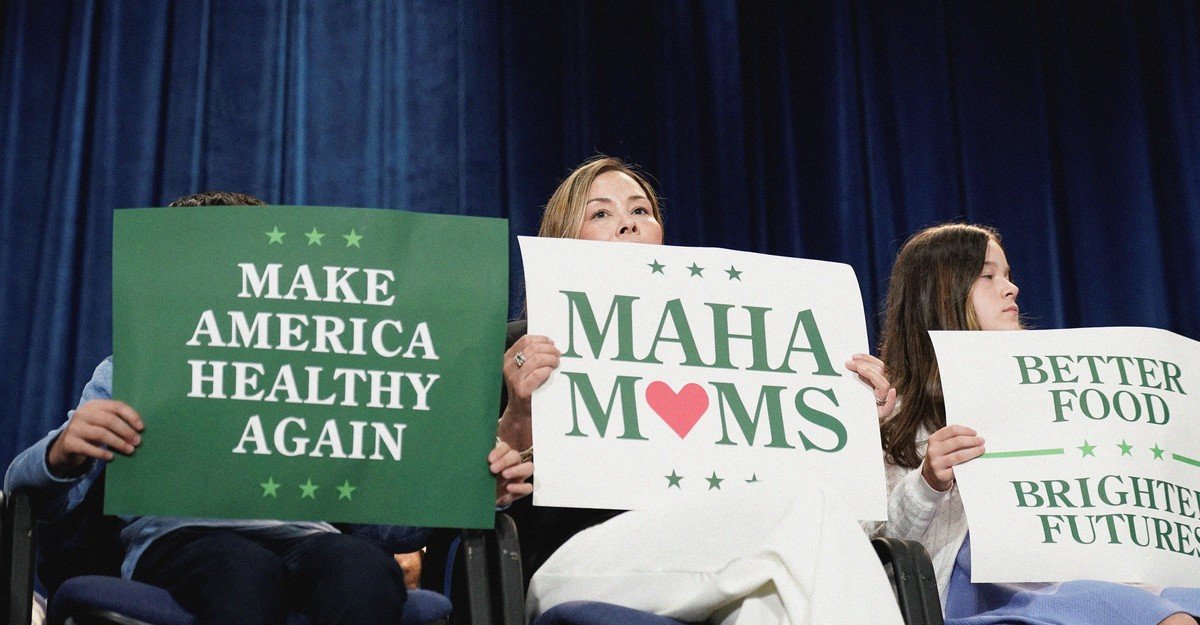
Earlier this month, MAHA moms visited the White House. Several key figures in the Make America Healthy Again movement gathered around a table in the Roosevelt Room to meet with Secretary of Health Robert F. Kennedy Jr. and other senior administration officials. The all-female guests included health activist Kelly Ryerson, wellness podcaster Alex Clark and nutritionist Courtney Swan. They are influential within a loose coalition of Kennedy supporters known as MAHA moms, many of whom are concerned about their children’s health. This was an opportunity for them to vent their frustrations with the Trump administration, which have grown in recent months. They were then escorted to the Oval Office and met with President Trump. According to Ryerson, President Trump welcomed them as “my MAHA leaders.”
The partnership between MAHA and MAGA was always an unlikely one. Kennedy was a Democrat until he ran for president as an independent in 2023, and many of his priorities, such as promoting healthy eating, have traditionally been on the left. Recently, the partnership has begun to fray. Core MAHA supporters were furious when President Trump signed an executive order in February that gave liability protection to manufacturers of glyphosate, the herbicide used in Roundup, which studies have linked to cancer. (Ryerson is so opposed to the chemical that she’s been dubbed the “glyphosate girl” on Instagram.) The movement has also been frustrated by the stalled nomination of perhaps the most famous MAHA mom, Casey Means, President Trump’s nominee for Surgeon General, who has yet to receive a Senate confirmation vote. Mr. Means also attended a recent White House rally, in what appears to be an attempt to smooth things over with MAHA before the midterm elections.
Like the “Silent Majority” that led Richard Nixon to victory in 1972 and the Tea Party movement that ushered in the Red Wave in the 2010 midterm elections, MAHA moms are being touted as a key factor in the upcoming election. Steve Bannon, the Trump administration’s former chief strategist, said MAHA is “the heart of our coalition.” He believes that without the movement’s support, Republicans have no chance of winning in November. President Trump seems to have the same idea. “I read today that they think Mr. Bobby would be a very good choice for the Republican Party in the midterm elections,” Trump said, referring to the health secretary during a January Cabinet meeting. “So we have to be very careful to make sure Bobby likes us.” White House senior deputy press secretary Khush Desai said in an email that the administration is committed to pursuing MAHA’s agenda. The White House gathering was “one of the many productive engagements the administration has had and continues to have with the MAHA community,” he wrote.
These voters are politically desirable across party lines. Some of MAHA’s priorities are widely known, such as eliminating petroleum-based food colors and limiting the use of pesticides. About a third of independent parents identify as supporters of the MAHA movement, along with one in six Democratic parents, according to a poll last year. Many Democrats are also trying to win support from disgruntled MAHA moms.
The most prominent MAHA moms tend to be swing voters, not Trump supporters. Activist Bani Hari, known as “Food Babe,” was a delegate to the 2012 Democratic National Convention and is now a prominent MAHA influencer (she was invited to the White House meeting but was unable to attend). Ryerson voted for Trump because of Kennedy. “I probably wouldn’t have voted otherwise,” she told us.
But Mr. Hari and Mr. Ryerson, both of whom were health activists long before MAHA, may not be representative of ordinary voters. For this story, we spoke with several MAHA supporters, including a documentarian who worked on an anti-vaccine film, a mother on a parenting podcast, and an Instagram influencer who shared her four-ingredient recipe for homemade goldfish crackers. One of us chatted with more than a dozen attendees at CPAC, the Republican Party’s annual conference. Many were MAGA before being MAHA and said their midterm vote would not be influenced by health issues. Virtually no one said they would realistically consider voting blue in November.
And then there’s the issue of numbers. Listening to the MAHA leaders, their supporters form a small army. Tony Lyons, who heads the movement’s political arm, MAHA PAC, said there are millions of MAHA moms and argued in a memo to Republican leaders that embracing the movement is the way to “win big in the midterm elections.” In January, Hari claimed in X that thousands of MAHA supporters have been calling state legislators in recent months over concerns about a bill that would give pesticide manufacturers immunity from lawsuits. (When we asked about it, she acknowledged that the number was probably in the hundreds. After this article was published, she said her response was too quick and that she had meant to say thousands. However, she declined to provide evidence of that number.)
In Tennessee, which debated a pesticide bill earlier this year, one lawmaker said he received “about 150 emails and about 50 phone calls to my office.” However, in our reporting, we were unable to track any evidence suggesting that mothers voting based on their MAHA beliefs existed in sufficient numbers to sway the midterm elections. MAHA “doesn’t have an overall effect, but it could affect different neighborhoods that are very close together,” said Bob Brendon, a Harvard professor who studies public opinion on health.
MAHA’s most famous contest to date is not even a seat where there is a realistic chance of flipping from red to blue. MAHA PAC pledged to spend $1 million to unseat Louisiana Sen. Bill Cassidy, who was a pivotal vote to advance RFK Jr.’s nomination for health secretary, but has occasionally publicly criticized him since then. The group supports another Republican, Julia Letlow, and health is not a deciding issue in her campaign. Instead, both candidates have competed to prove their loyalty to Trump. (Mr. Trump supports Mr. Letlow, not Mr. Cassidy.)
Of course, a lot can change between now and November. American elections have been upended before by elusive groups of voters who seemed to come out of nowhere. For example, the Tea Party was initially seen as a proliferation, similar to the modern-day MAHA movement, when in fact the effort was well-funded and well-planned, said Patrick LaFail, a professor at Tulane University who wrote a book on the movement. “I don’t see anything comparable to MAHA,” he said.
MAHA seems to be one of the few movements that unites people across the political spectrum. However, a wide range of appeals is not necessarily reflected at the voting booth.
