


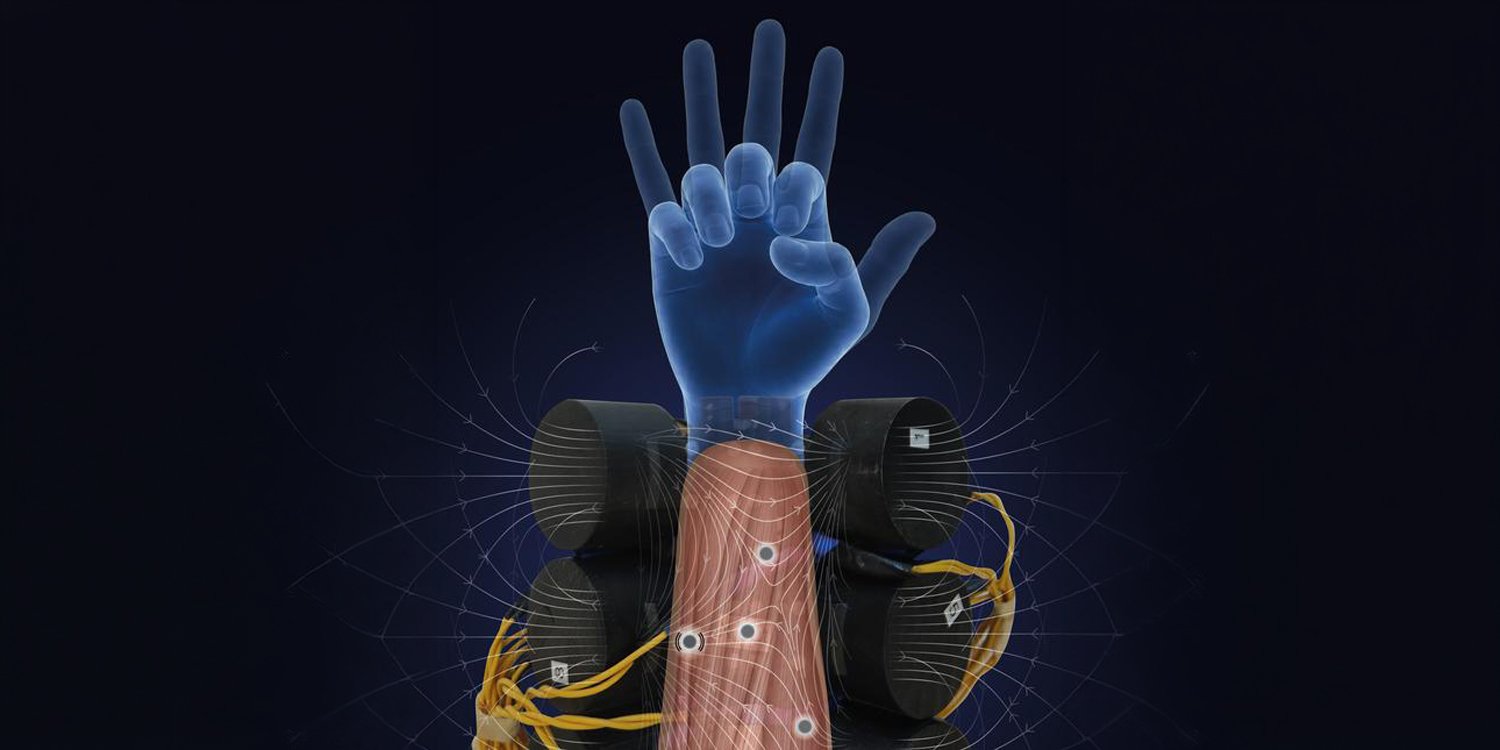
New research published in scientific progress Researchers suggest that vibrating small magnets implanted within the muscles of amputated limbs can restore a natural sense of hand coordination. These findings provide evidence that the brain perceives movements as synchronized whole-hand movements rather than isolated finger twitches. This research offers a promising path toward advanced prosthetic limbs that allow users to feel what they are doing without relying entirely on vision.
For amputees, operating a prosthesis often feels mechanical and disconnected. This happens because the surgery separates the muscles from the joints, disrupting the natural communication between the body and the brain. In a typical body, the nervous system relies on proprioception. Proprioception is the subconscious ability to sense where body parts are located in space. A related concept is kinaesthesia, which is a specific sense of real-time body movement.
Kinesthetic sensation is essential for natural motor control. It is lost after amputation, making it difficult to use the prosthesis intuitively. With a standard prosthetic arm, the remaining arm muscles send electrical signals by contracting. Because the muscles are not attached to the original bones or tendons, the user does not feel the physical movement of the mechanical hand.
To use standard robotic equipment, amputees must visually observe the mechanical fingers grasping objects to know whether their commands worked. Scientists have attempted to restore this lost sense of movement in the past, with varying degrees of success. Muscle vibrations can be used to generate the perception of movement. However, these vibrations typically stimulate both the skin and muscles at the same time, which can confuse the brain while using the prosthesis.
Previous methods for restoring kinesthetic sensation often required highly invasive surgery. The surgeon redirects the severed nerves to different muscle or skin areas, and when the robotic device vibrates those newly assigned areas, the patient can feel the missing hand. These nerve redirection surgeries are effective but require extensive anatomical changes.
A research team led by the Sant’Anna School of Advanced Studies in Italy, in collaboration with the Cleveland Clinic in the US, carried out the study to explore less invasive alternatives. The research team tested a new bidirectional interface for prosthetic hands called the myokinesthetic kinesthetic interface. This system uses vibrations generated by small magnets implanted in the remaining muscles of your forearm to restore your natural sense of movement. This interface was integrated with Mia Hand, a robotic hand developed by Sant’Anna spin-off company Prensilia.
To test a different approach, the scientists recruited a 34-year-old Italian man who had undergone a traumatic amputation of his forearm. The researchers surgically implanted small permanent magnets coated with biocompatible plastic into three specific muscles in his remaining arm. In the biological arm, these specific muscles are responsible for bending the wrist, extending the fingers, and moving the thumb. The main goal was to see if by making these magnets vibrate, they could trick the brain into thinking the missing hand was moving.
The implant was designed to last six weeks, and the team thought this was a long enough period to test the interface between the hand and the brain. During the experiment, participants placed their arms on a specially designed frame equipped with an electromagnetic coil. These coils allowed the researchers to generate a localized magnetic field directly around the arm. By adjusting the electrical current, the researchers were able to remotely vibrate individual implanted magnets at different speeds without touching the participants’ skin.
“The myokinesthetic interface is unique in that it uses a simple, minimally invasive implant to stimulate muscles without touching the skin,” said Federico Masiello, lead author of the study and postdoctoral researcher at the Technical University of Munich. “This approach could be key to better understanding how human motor control works, but also how to restore kinesthetic sensation after amputation.”
The scientists systematically applied vibrations with alternating waveform patterns, using both smooth and coarse pulses. They tested a wide range of frequencies from 1 to 130 hertz, keeping the intensity within a comfortable range to avoid pain. After each short burst of vibration, participants reported some specific details to the research team. He described the general nature of the sensation, where it was occurring in his limbs, and how vivid the sensation was.
The participants were completely new to this type of magnetic stimulation and did not know what to expect. Scientists initially thought that by vibrating a single muscle, participants would feel a single isolated finger move. Instead, he consistently reported that he felt synchronized movements in all the fingers of his missing hand. Every time the magnet vibrated, he felt his phantom hand open and close to grip it.
These sensations felt very natural to the participants. He realized that the hand opens and closes in a coordinated movement very similar to the real thing. He reported that the phantom fingers appeared to move within normal physical limits. The recognized fingers never cross each other or bend into impossible positions, suggesting that the brain maintains a structural map of the hand even after the physical limb is gone.
The researchers documented the exact threshold parameters at which participants felt these sensations most intensely. He experienced the most vivid sensations of movement when the magnet vibrated at an average frequency of 82.5 hertz, but was barely aware of very low vibrational frequencies. When researchers tested his reaction speed using an adaptive timing sequence, they found that he was highly sensitive to stimuli. He was able to reliably detect the presence of vibrations in about 40 milliseconds, which corresponds to just two to four cycles of magnetic waves.
The researchers also tested what happens when multiple magnets are vibrated at different intensities at exactly the same time. In these scenarios, participants had difficulty identifying the exact source of the vibrations. He did not experience more complex hand postures when multiple magnets were activated simultaneously. Instead, competing vibrations sometimes made it difficult to determine which specific muscles were being stimulated.
To understand whether these whole-hand movement sensations were unique to this individual, the scientists compared his results to previous studies. By combining data from the world’s only two neural-machine interfaces designed to restore kinesthetic sensation, researchers found that the brain appears to process this information not as isolated signals, but as patterns of coordinated hand grasping movements. The coordinated hand movements felt by the patients appeared similar to those felt by participants who used another kinesthetic feedback system built by researchers at the Cleveland Clinic.
The two prosthetic interface systems were structurally different. The one developed at Sant’Anna used implanted magnets, and the one at the Cleveland Clinic used surgical nerve redirection and robotics. Still, both kinesthetic interfaces yielded similar perceptual results. The evoked movement sensation was perceived as coordinated finger movements rather than individual signals.
“These findings are particularly compelling because they allow us to compare data generated independently from two very different interfaces,” said Paul Marasco, research coordinator at the Cleveland Clinic. “This provides a strong foundation for designing treatments and devices that interact with the nervous system in a more natural way, with the ultimate goal of improving patient outcomes.”
This shared experience between disparate types of artificial interfaces provides evidence of how the human brain organizes physical movement. This suggests that the central nervous system groups muscles to perform movements as a single cohesive unit, a physiological concept known as motor synergy. Motor synergy exists because the brain must manage an infinite number of possible joint combinations to perform simple everyday tasks. To do things efficiently, the brain relies on pre-programmed patterns, such as basic gripping and reaching movements.
The brain uses these coordinated patterns to give commands to the hand, so it appears to process the sensation of movement in exactly the same coordinated way. Together, the researchers’ findings suggest that the brain may organize kinesthetic sensations from muscles in a more coordinated and subliminal way than previously understood. This provides a natural basis for designing future treatments that directly match the body’s internal logic.
Although this study provides new insights into human perception, there are some limitations that should be considered. The most notable limitation is that this experiment included only one participant. Other people may experience these magnetic vibrations differently based on their unique biology or the special nature of their cutting. Future extensive testing with more participants will be needed to see if these results apply to a broader population.
“Our solution was implemented as a preliminary demonstrator. The implant was designed to last for six weeks, and this period was considered sufficient to initially validate the usability and effectiveness of the interface,” said Christian Cipriani, creator of the interface and research coordinator at the Sant’Anna School of Advanced Studies. “The results were very promising and led us to consider a permanent implantable solution, which would allow us to study the interface over a longer period of time and with a larger number of participants.”
Additionally, there can be misunderstandings about how the sensation actually feels to the user. Both research teams observed that some sensations conveyed through their respective interfaces were perceived by the patient without being immediately noticeable to the user. Participants said the sensation was not tactile in nature, meaning it did not feel like something was rubbing against the skin. He sometimes had to concentrate very hard to notice the sensation of movement itself, even though his physical ability to sense underlying vibrations was very fast.
This shows that the artificial sense of movement is working quietly in the background of a person’s consciousness, rather than being a distracting or overwhelming sensation. Looking ahead, the team’s next goal is to leverage previous work on controlling the prosthesis by reading the position of implanted magnets, while simultaneously using superimposed vibrations to restore natural sensation. The long-term goal is to develop a permanent implant that combines a natural grasping sensation with intuitive motor control.
These current projects, with international funding, lay the foundation for a new generation of more human-like prosthetic devices. This new result paves the way for more intuitive control of prostheses and could also have future applications in stroke rehabilitation, epilepsy, and pain treatment.
The study “Coordination of hand movements revealed through a kinesthetic interface of an implanted magnetic prosthesis” was co-authored by Federico Masiello, Mattia Gentile, Marta Gherardini, Eliana La Frazia, Chi Written by Charles H. Moore, B. Urgen Kilic, Valerio Iannisiello, Roberta Rejo, Tommaso Mori, Flavia Pagetti, Lorenzo Andreani, Simon A. Whitton, and Paul. D. Marasco and Christian Cipriani.
