


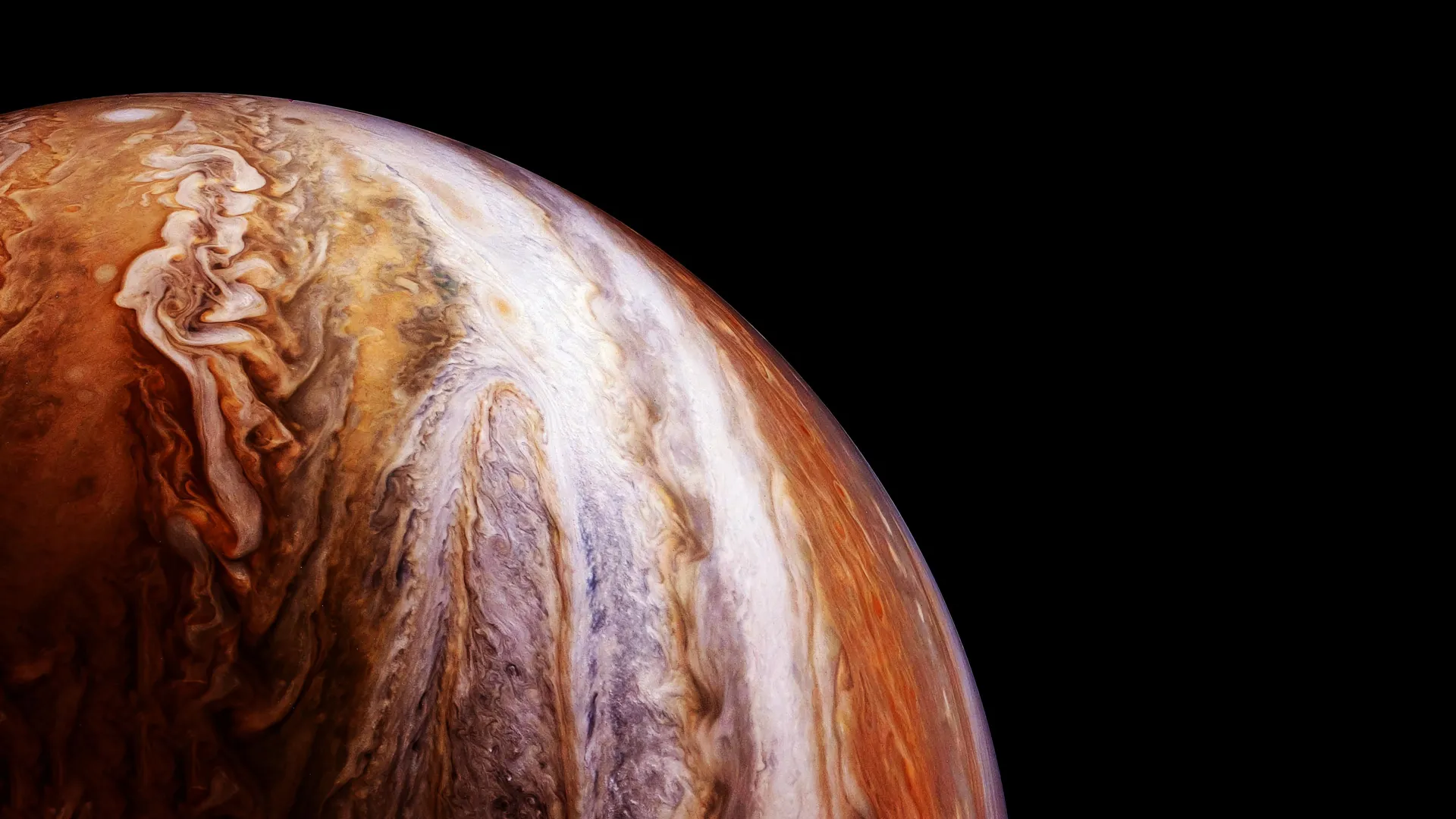
Astronomers have discovered something surprising on a distant gas giant: clouds of water ice. The discovery, made by a team led by Elizabeth Matthews at the Max Planck Institute for Astronomy (MPIA), calls into question many existing models of how exoplanet atmospheres behave. The planet, known as Epsilon Indi Abu, resembles Jupiter, but its atmosphere appears to be more complex than expected. The observational methods used in this study are also an important step toward the long-term goal of discovering and studying Earth-like planets.
The search for planets outside our solar system has evolved over several decades. Scientists eventually hope to detect signs of life on distant worlds, perhaps within the next few decades. Early efforts from 1995 to around 2022 focused primarily on discovering new exoplanets. Researchers relied on indirect methods that could reveal a planet’s mass, size, or both.
The launch of the James Webb Space Telescope (JWST) in 2022 marked the beginning of a new phase. For the first time, astronomers have been able to study the atmospheres of many exoplanets in detail and gain insight into their composition and structure. However, at this stage, we are not yet at the point where we can directly search for life, and more advanced telescopes will likely be needed in the future.
The latest research is pushing these techniques even further, but not yet for planets like Earth. Lead author of the study, Elizabeth Matthews of the Max Planck Institute for Astronomy, explains: “Thanks to JWST, we can finally study similar planets in our solar system in detail. If we were aliens a few light years away and looking back at the Sun, JWST is the first telescope that would allow us to study Jupiter in detail. However, to study Earth in detail, we would need a more advanced telescope.”
Why are exoplanets like Jupiter so difficult to study?
Despite JWST’s capabilities, studying Jupiter-like planets has been difficult. Most of the gas giants observed so far are much hotter than Jupiter. This is because the most common method of studying an exoplanet’s atmosphere requires the planet to pass in front of its star from Earth’s perspective. Planets closer to the star are more likely to align like this, but they are also very hot.
To get around this limitation, Matthews and her team used a different approach. Their study provides the closest look yet to a true Jupiter analog and reveals unexpected features.
The research team used JWST’s mid-infrared instrument MIRI to directly image Epsilon indiab. The planet orbits the star Epsilon Indi A in the constellation Indus (southern sky). “The planet’s mass is significantly larger than Jupiter,” said MPIA PhD student Bhavesh Rajput, who contributed to the study. “The new study pegs its mass at 7.6 times Jupiter’s mass, but its diameter is about the same as that of its solar system cousin.”
A cold giant with lingering heat
Epsilon Indi Ab orbits about four times farther from its host star than Jupiter is from the Sun. Its host star is slightly smaller and cooler than the Sun, which keeps the planet’s temperature relatively low. Its surface temperature is estimated to be between 200 and 300 Kelvin (-70 and +20 degrees Celsius).
Still, this planet is warmer than Jupiter, which has a temperature of about 140 degrees. Scientists believe this extra warmth is due to heat left over from the planet’s formation. Over billions of years, Epsilon Indi Ab is expected to cool, eventually becoming even colder than Jupiter.
To observe the planet, astronomers used the MIRI instrument’s coronagraph to block out the bright light from its host star. This allowed them to detect the faint glow of the planet itself. They captured the images using an 11.3 μm filter, just outside the wavelength associated with the ammonia molecule NH3. By comparing these observations with previous images taken at 10.6 μm in 2024, the researchers were able to estimate how much ammonia was present. (Incidentally, both the mechanical filter wheel that positions the coronagraph and the filter in front of the MIRI camera were built with MPIA, one of Germany’s contributions to JWST.)
Evidence of water ice clouds
Ammonia gas and ammonia clouds dominate the visible upper layers of Jupiter’s atmosphere. Based on its properties, Epsilon indi Ab was expected to also contain large amounts of ammonia gas, but it did not contain ammonia clouds. Instead, observations revealed less ammonia than expected.
The most likely explanation is the presence of thick, heterogeneous water ice clouds, similar to cirrus clouds, above the Earth’s atmosphere. This is an unexpected complication.
Astronomers typically interpret such data by comparing observations to computer models of planetary atmospheres. However, many existing models do not include clouds because they are difficult to simulate. This finding highlighted the need to improve these models. “This is a huge problem and speaks to the tremendous progress we are making thanks to JWST,” said study co-author James Mang of the University of Texas at Austin. Now within reach, we can examine the structure of these atmospheres, including the presence of clouds. This reveals new layers of complexity that our models are now beginning to capture, opening the door to even more detailed characterization of these cold and distant worlds. ”
Looking ahead to future telescopes
Future observations may reveal the appearance of these clouds even more clearly. NASA’s Nancy Grace Roman Space Telescope, of which MPIA is a partner, is scheduled to launch in 2026-2027 and should be suitable for directly detecting reflective water ice clouds.
In the meantime, Matthews and her colleagues are seeking additional JWST observation time to study cooler Jupiter-like planets. As researchers continue to hone their techniques, they are building the foundation for studying future Earth-like worlds and ultimately searching for signs of life beyond our solar system.
Background information
The results described here are published in EC Matthews et al. “JWST’s second visit to Eps Ind Ab: New photometric measurements confirm ammonia and suggest thick clouds in the nearest superJupiter’s exoplanet atmosphere.” Astrophysics Journal Letter.
MPIA researchers collaborate with Elizabeth Matthews and Bhavesh Rajput, James Mang and Caroline Morley (University of Texas at Austin), Arlyn Carter and Mathilde Marin (Space Telescope Science Institute), and others.
