


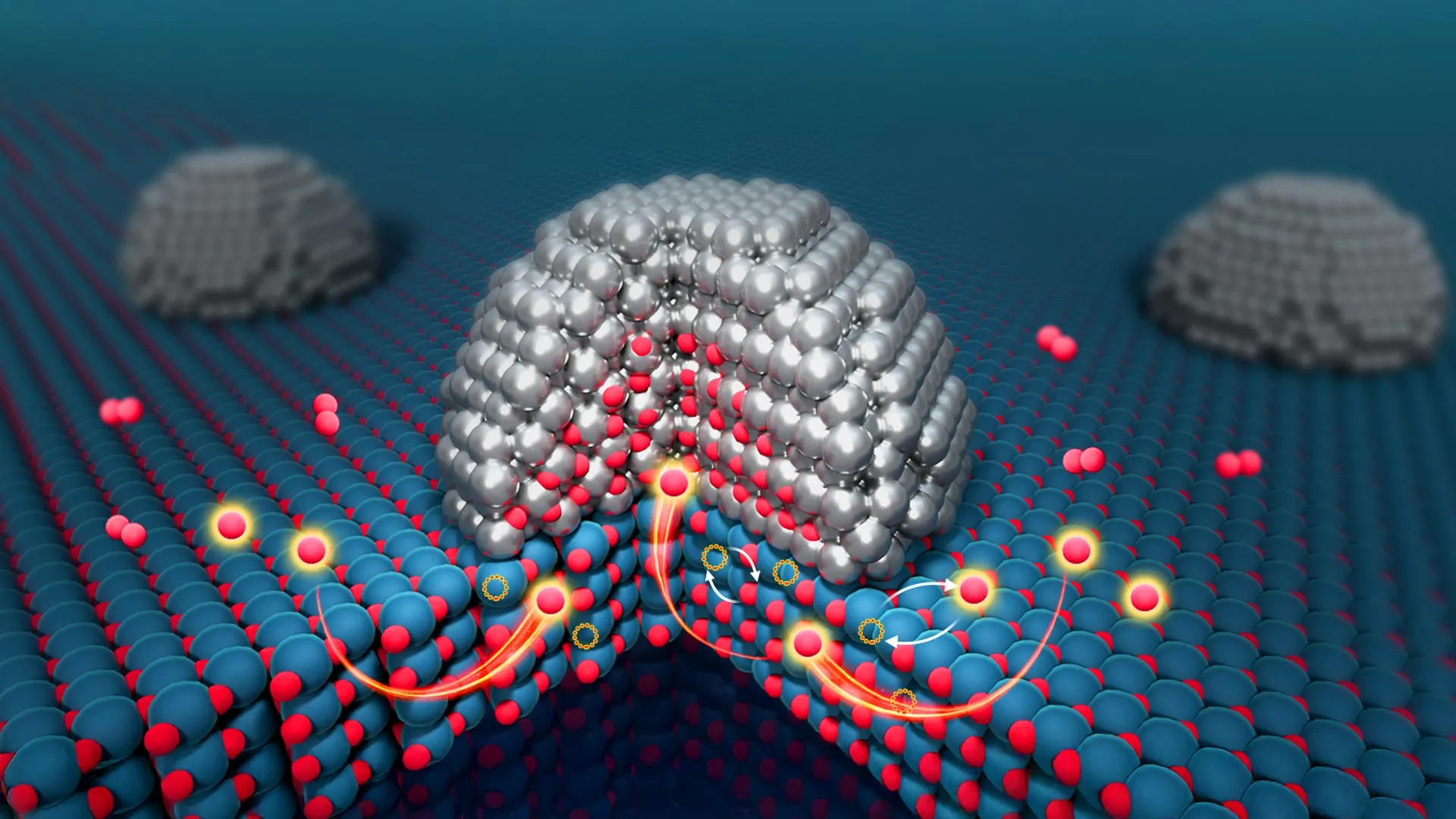
A team led by Professor Tao Zhang and Professor Yanqiang Huang from the Dalian Institute of Chemical Physics (DICP) of the Chinese Academy of Sciences (CAS), in collaboration with Professor Wei Liu from DICP and Professor Yanggang Wang from Southern University of Science and Technology, directly tracked the movement of oxygen in the catalyst. They used environmental transmission electron microscopy to observe bulk oxygen efflux in Ru/rutile-TiO2 catalysts for the first time. This discovery suggests a new way to utilize the interior of catalysts, which has often been overlooked until now.
The survey results are nature April 15, 2026.
What is the efflux of oxygen in a catalytic reaction
In catalytic reactions, spillover refers to the movement of atoms or molecules, such as hydrogen or oxygen, between a metal and its supporting material. Most of the past studies focused on the spillover that occurs along the surface of the catalyst. It remains unclear whether the interior or bulk of the catalyst also plays a role in these processes via non-surface routes.
Understanding spillover effects is important because they influence how different active sites interact. The availability of these sites varies and can affect catalyst performance. Previous studies have shown that reducible materials can improve surface spillover, depending on the distance and speed the atoms travel. However, traditional spectroscopic techniques have struggled to elucidate the precise pathways involved at the individual particle level. By gaining a clearer picture, scientists may be able to better control reactions that rely on spillover effects.
Why titanium dioxide was chosen
The researchers chose titanium dioxide (TiO2) because of its ability to efficiently store and release oxygen. The ability to change the oxidation state and its diverse crystal structure make it a useful model to study the behavior of oxygen. Using environmental transmission electron microscopy, the research team was able to directly observe the movement of oxygen on individual ruthenium particles on titanium dioxide (Ru/TiO2) particles.
First direct evidence of massive oxygen efflux
For decades, scientists believed that spillage occurred primarily at the catalyst surface. In this study, the researchers provided the first direct observation of oxygen moving within the bulk of a catalyst in ruthenium supported on rutile titanium dioxide (Ru/r-TiO2).
“We show that TiO2 supports have channels that facilitate oxygen efflux, while the metal-support interface acts like an atomic-scale guard, controlling whether oxygen efflux can pass through. This discovery inspires new strategies to exploit the catalyst bulk, which was traditionally thought to be useless for catalysis,” said Professor Wei Liu.
movement of oxygen beneath the surface
The researchers showed that oxygen atoms migrate through the (Ru/r-TiO2) interface to the metal from a layer located 3 to 5 atoms below the r-TiO2 surface. This movement is caused by differences in the chemical potential of oxygen.
“This unique oxygen spillover in our study allows a large portion of the catalyst otherwise inaccessible to the reactants to contribute to mass transfer during the catalytic reaction, highlighting the importance of interfacial engineering in controlling spillover behavior,” said Professor Yanqiang Huang.
Expanding the concept of metal-support interactions
Almost 50 years ago, scientists identified metal-support interactions in which metal particles become surrounded by oxide materials such as TiO2 under strongly reducing conditions. This process can reduce the metal’s ability to adsorb molecules such as H2 and CO. Traditionally, these interactions were thought to involve mass exchange only at the outer surfaces of the metal and its support, with the interface between them playing a key role in the reaction.
This new study extends that concept by showing that bulk oxygen efflux allows internal regions of the catalyst to participate in mass transfer during the reaction. These internal interfaces were previously considered inaccessible.
Aiming for more efficient catalyst design
This finding highlights how important interface engineering is to control spillover behavior. They also demonstrate the power of in situ microscopy imaging at the single particle level to reveal reaction pathways in catalytic systems.
Looking ahead, the researchers hope to build on this discovery. “We can take advantage of this great opportunity to improve the catalyst structure from two-dimensional surface reactions to three-dimensional ‘surface-interface-bulk’ synergies. This provides new insights into interfacial atom engineering in heterogeneous catalysis and dynamic catalytic behavior of supported metal catalysts. Our next goal is to develop practical catalysts that utilize the bulk to directly contribute to chemical reactions,” said Professor Tao Zhang.
