


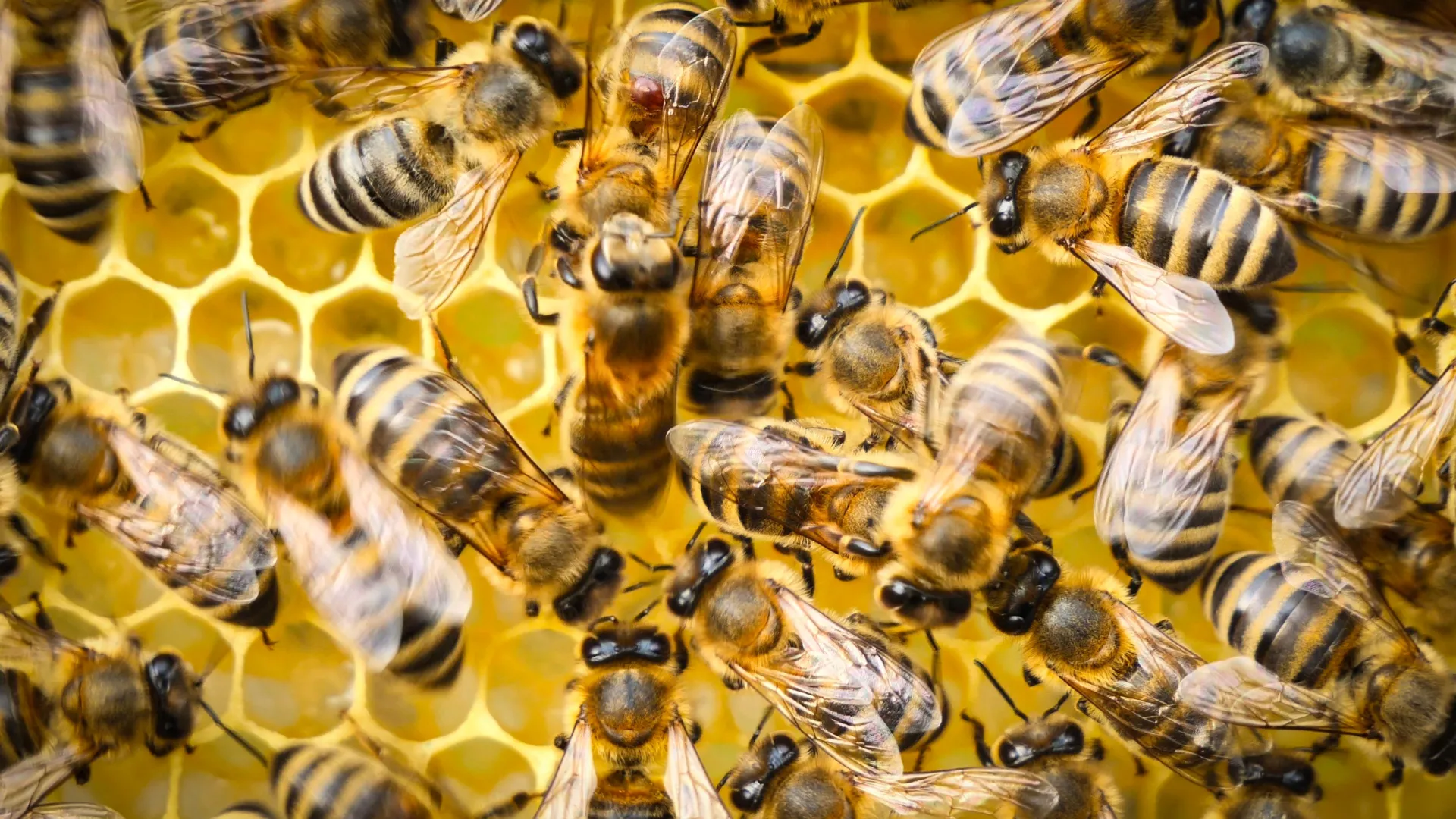
Southern California may have an unexpected ally in the fight to save honeybees. As commercial hives across the United States struggle to withstand attacks from deadly parasites, a unique hybrid honey bee found in the region is showing remarkable resilience.
Beekeepers across the country are reporting that they will lose up to 62% of the bee colonies they manage in 2025, raising serious concerns about food production. These losses are related to several pressures such as exposure to pesticides, climate stress, habitat shrinkage, and habitat loss. One of the most harmful threats is the Varroa mite.
Impact of Varroa mites on bees
Varroa mites weaken bees by feeding on fat body tissue, a critical organ that supports immune function, metabolism, and energy storage. In human biology, it plays a similar role to the liver, pancreas, and immune system. As a result of this damage, bees lose weight, become more susceptible to disease, and have shorter lifespans.
This mite also spreads dangerous viruses such as deformed wing virus and acute bee paralysis virus by injecting them directly into the bee’s bloodstream. To prevent infestations, beekeepers often rely on chemical treatments, but these solutions can become less effective over time.
Study reveals natural mite resistance in hybrid honey bees
A new study from the University of California, Riverside scientific reportoffers some rare good news. This study is the first to demonstrate that locally adapted groups of honeybees can consistently and naturally control mite populations.
“We kept hearing anecdotes about these California honey bees surviving with much less treatment. I wanted to test them rigorously and understand the driving forces behind what beekeepers were seeing,” said Genesis Chong-Echavez, a graduate student at UCR and lead author of the study.
Chong Echavez worked with entomologists at UCR’s Center for Integrated Honey Bee Research (CIBER) to track 236 honey bee colonies from 2019 to 2022.
Fewer mites, less need for treatment
The results showed that while these bees were not completely resistant, they performed much better than typical commercial colonies. Colonies led by locally bred hybrid queens had on average about 68% fewer mites than colonies led by commercial queens. They were also more than one-fifth less likely to reach a level that required chemical intervention.
These bees are not part of a commercial breeding program. Instead, they originate from naturally mixed populations in Southern California, often from wild arboreal colonies. Genetic studies have revealed that they combine traits from at least four honeybee lineages, including the African honeybee, Eastern European honeybee, Middle Eastern honeybee, and Western European honeybee.
Larval stage may hold the key
To understand why these bees perform better, the researchers conducted a laboratory experiment that focused on larval development. Because Varroa mites need to invade reproductive cells to reproduce, the researchers tested whether the mites were equally attracted to larvae from different types of colonies.
It wasn’t.
The mites were particularly uninterested in hybrid California honey bee larvae around seven days old, when the larvae are usually most vulnerable. This suggests that honey bee defenses may begin early in development, before adult behavior has an impact.
“What surprised me most was that there were differences even in the larval stage,” Chong-Echavez said. “This suggests that the resistance mechanism may be deeper than any behavior and may be genetically hardwired into the bees themselves.”
Impact on honey bee health around the world
The discovery could have implications far beyond Southern California. Bees are important pollinators that produce crops worth billions of dollars, yet they continue to face increasing environmental pressures. This study shows that natural biological traits can help strengthen bee populations.
Boris Baer, UCR entomology professor and co-author of the study, emphasized the importance of collaboration with beekeepers.
“This question didn’t start in the lab. It started in conversations with beekeepers,” Baer said. “More than just observers, they helped shape the questions behind this study.”
what happens next
The researchers stress that these hybrid honeybees are not completely free of mites and current management practices should not be abandoned. Instead, the goal is to identify specific traits that allow these bees to keep mite levels low, and to investigate how those traits can aid reproductive efforts or reduce dependence on chemicals.
Future research will focus on unraveling the genetic, behavioral and chemical signals that may make larvae less attractive to ticks.
“At a time when pollinators are facing a global decline, this study offers a hopeful message. Solutions may already be on the ground and we just need to understand them,” Chong-Echavez said.
