


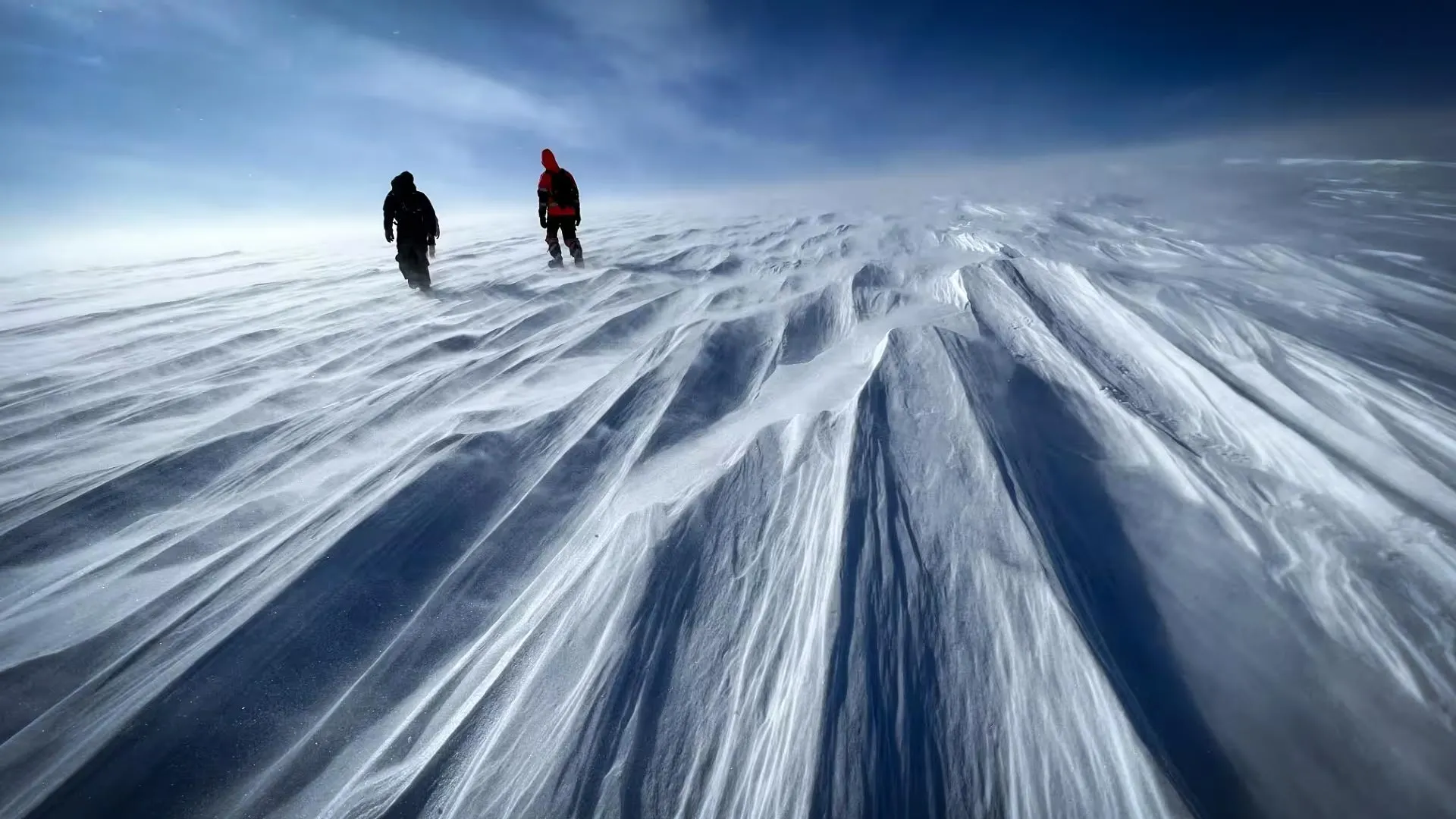
New research from Green Drill, a project co-led with the University at Buffalo to recover rocks and sediment buried beneath the Greenland Ice Sheet, reveals that the Prudhoe Dome ice sheet completely disappeared about 7,000 years ago. This is much more recent than scientists previously believed.
The survey results are natural earth scienceindicating that this high region in the northwestern part of the ice sheet is highly sensitive to even modest warming. The melting occurred during the Holocene, a relatively stable climatic period that began 11,000 years ago and continues today.
“This is an era known for climate stability, when humans first developed agricultural practices and began to move toward civilization. So if the natural, mild climate changes of that era continued to melt Prudhoe Dome and potentially cause it to recede for thousands of years, it may only be a matter of time before it begins to peel away again from today’s anthropogenic climate change,” said co-leader Dr. Jason Briner, professor and associate professor in the UB College of Arts and Sciences’ Department of Earth Sciences. Green Drill with Dr. Jorg Schäfer, Research Professor at Columbia University’s Lamont-Doherty Earth Observatory.
Drilling beneath Greenland’s ice to search for clues
GreenDrill is a unique initiative funded by the U.S. National Science Foundation that aims to drill through Greenland’s ice and collect ancient materials from below. In fact, scientists have collected fewer rock and soil samples from underground in Greenland than from the moon, but these materials contain important information. Their chemical signatures reveal when the surface was last exposed to sunlight and help pinpoint periods in the past when ice sheets disappeared.
For the study, researchers tested core samples taken from 1,669 feet below the surface during a multi-week expedition atop Prudhoe Dome in 2023.
To determine when the deposits were last exposed, the researchers used luminescence dating. This method measures the energy stored in mineral particles. Once buried, these particles capture electrons from natural radiation. When exposed to light, its energy is emitted as a faint glow that scientists can measure.
The strength of this signal indicated that the sediments were last exposed to sunlight between 6,000 and 8,200 years ago.
Evidence of past warming and future risks
“This means that Prudhoe Dome melted sometime before this time, perhaps in the early Holocene, when temperatures were about 3 to 5 degrees Celsius warmer than today. Some projections suggest that levels of warming at Prudhoe Dome could reach that level by 2100,” says the study’s lead author, Dr. Caleb Wolcott George, a former UB graduate student and now an assistant professor at the University of Kentucky.
These findings have important implications for sea level rise. By identifying weaknesses along the edge of the Greenland ice sheet, scientists will be able to more accurately predict where melting will begin and which coastal areas may face the greatest risk.
“The rocks and sediments beneath the ice sheet tell us directly which parts of the ice sheet’s edge are most vulnerable, which is critical for accurately predicting regional sea levels. This new field of science is a game-changer in providing this information through direct observations and predicting ice melt,” says Schaefer.
Life and challenges on ice
GreenDrill has installed two drilling sites at Prudhoe Dome. One at the top and one near the edge where the ice is thinner. (This study analyzed samples taken from the mountaintop.)
The scene was near Camp Century. Camp Century is a Cold War-era base where U.S. military researchers once dug holes in the ice to hide nuclear missiles. Instead, they recovered sediment that later helped scientists discover that the ice sheet was much smaller about 400,000 years ago.
During the spring 2023 expedition, the team lived in a network of yellow tents connected by flagged paths. Their daily tasks included collecting ice debris from excavations and clearing snow from the camp, while professional excavators dug through hundreds of feet of ice.
The mission nearly failed when cracks appeared in the excavation site at the top. A last-minute switch to a drill bit commonly used for rock allowed the team to complete the final 390 feet and reach the underlying material just before the equipment was scheduled to be removed.
“It was like watching a Buffalo Bills game,” Breiner said. “I’m just nervous until the last moment.”
Breiner praised the collaboration of scientists, drillers and support staff who made this effort possible. Team members included Dr. Nicolás Young, associate research professor at Lamont, and co-principal investigator at GreenDrill. Dr. Allie Balter-Kennedy, former postdoctoral fellow at Lamont University and current assistant professor at Tufts University. Dr. Nathan Brown, Assistant Professor at the University of Texas at Arlington.
“This project involved more complex logistics than any project I’ve been involved with in my career. There were so many moving parts and so much talent among the scientists, drillers and support staff,” Breiner said.
Wolcott George, who played a key role in establishing the camp and wrote his doctoral thesis based on his research, called the experience deeply humbling.
“It’s really humbling to think that there’s just ice in all directions, but that ice has disappeared in the recent geological past and will disappear again in the future,” he says.
Future developments of GreenDrill
Researchers say this is just the beginning. Additional studies using other samples, such as those taken near the edge of Prudhoe Dome, are planned and may reveal the most vulnerable areas of the ice cap. The core may also contain traces of ancient plants, providing clues about Greenland’s past environment.
“We have a treasure chest in our hands that we can take apart and explore,” Breiner said.
The team hopes to continue drilling and encourage similar efforts. While earlier projects such as Camp Century and the Greenland Ice Sheet Project 2 in the 1990s collected material beneath the ice core, GreenDrill is the first project to intentionally target material beneath the ice when selecting drilling locations.
“GreenDrill has demonstrated that we have the technology to drill down to bedrock, if we can do it logistically, and we have the analytical toolkit to analyze it,” Breiner says. “We have very reliable numerical models that can predict melt rates, but we also need actual observational data points that can tell us without a doubt that X amount of warming led to X amount of ice loss in the past.”
