


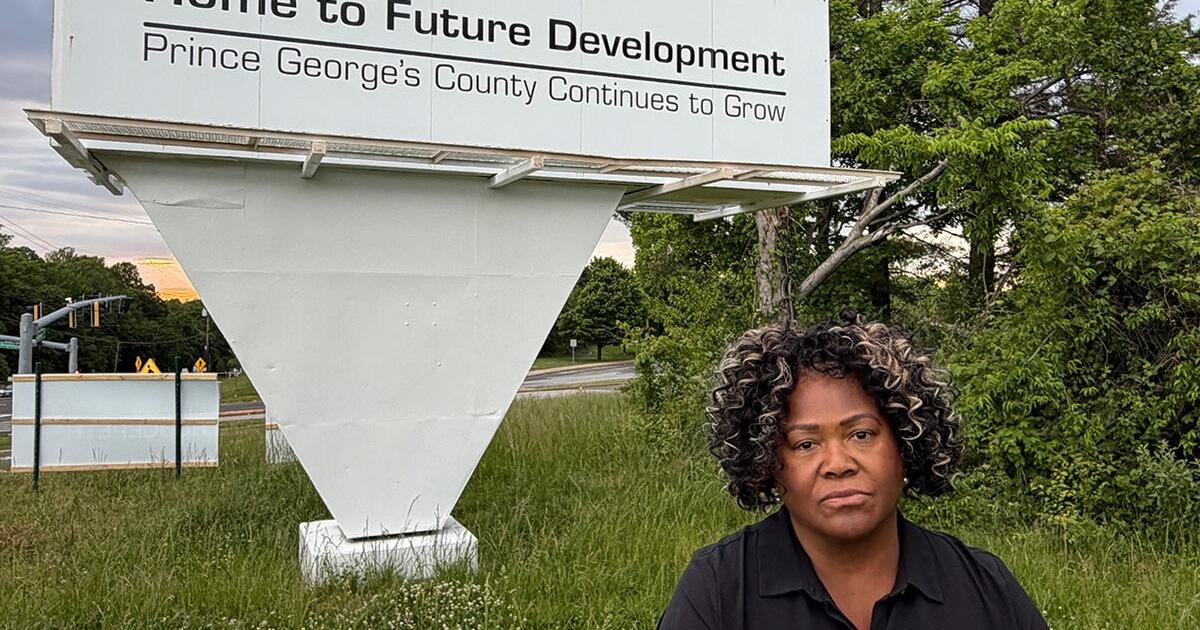

Stacey Hartwell of the South County Environmental Justice Coalition in Prince George’s County, Maryland, said the data center at the former Landover Mall is out of sync with the community.
In Staci Hartwell’s view, her community has far more to lose than to gain from large-scale data center development.
“I don’t think it has to be in the heart of a community that is suffering from cumulative impacts, it just happens to be a majority black and brown community,” said Hartwell, a resident of Prince George’s County, Maryland, and a strategist with the South County Environmental Justice Coalition.
Lerner Enterprises, the real estate company run by the family that owns the Washington Nationals, has proposed building a $5 billion, 4 million-square-foot data center complex on the site of the long-demolished Landover Mall. But those plans were put on hold last September when County Administrator Aisha Braveboy suspended the processing of data center permits.
Hyperscale data centers are vast buildings that house hundreds of thousands of computer servers, often used to power global cloud and AI applications. Their rapid increase in the Chesapeake Bay watershed and beyond has been accompanied by growing concerns about strain on public water supplies, air quality, and the power grid.
Prince George’s County is adding another dimension to the data center debate. They fear the industry will exacerbate health and environmental problems in communities already overburdened by data centers.
“We need to look at what impacts are happening to local communities and make sure data centers aren’t adding to that burden,” said Sacoby Wilson, director of the Center for Community Engagement, Environmental Justice, and Health (CEEJH) at the University of Maryland.
Last November, a 20-member county task force released a report aimed at finalizing data center plans in its jurisdiction near D.C. But that wasn’t the case. In March, the National Office of the NAACP and CEEJH released a “Response Report” thoroughly condemning what they deemed the county report’s failure to address environmental justice.
Of Prince George’s 960,000 residents, nearly 90% identify as people of color and 60% identify as Black. Compared to other parts of Maryland, this county has a higher percentage of people living in poverty and without health insurance. Meanwhile, the county has a history of “concentrating” industrial facilities in marginalized communities, such as the majority-black community of Brandywine, he said.
Wilson, a Bowie resident, worries that given the county’s proximity to Washington, D.C., it will join a growing list of what the county calls “digital victim zones,” communities that are “used to host the negative externalities” of data centers but “cannot benefit from them.”
The opposition report highlights the area surrounding the proposed Landover data center as a prime example. The U.S. Centers for Disease Control and Prevention’s Environmental Justice Index, which integrates environmental exposures and health indicators, gives the contiguous census tract a score of 0.86 on a one-point scale, placing it in the highest burden category.
Landover is not alone. Under a “high growth scenario,” data center contamination could lead to 600,000 asthma cases and 1,300 deaths by 2028, according to an analysis led by researchers at the University of California, Riverside. This represents a national public health burden of more than $20 billion, an increase of 213% from 2023 levels. In the research,
The pain will not be evenly distributed. Low-income groups will bear the brunt. The study noted that the median income level of all 10 counties predicted to have the highest data center-related health costs in 2030 is lower than the national median.
“This large disparity highlights the need to carefully examine local and regional health impacts to support more responsible computing and data center siting,” the authors write.
The paper suggests that Prince George’s County is already paying a high price for hyperscale data centers, even though it does not yet have one within its borders. The downwind area of northern Virginia is home to a large concentration of these facilities, known as data center arrays.
Want to dive deeper?
For more information on how data centers impact the environment, please visit bay journal Backgrounds that can be downloaded for free.
The research team’s modeling showed that if Virginia’s diesel-powered backup generators emitted 10% of acceptable levels of pollutants, Prince George’s would face a $9 million annual health burden. This was the third-highest total, behind Montgomery County, Maryland, which received $20 million, and Fairfax County, Virginia, which received $19 million.
The Prince George’s Data Center Report is based on eight conferences held from May to November 2025, where subject matter experts shared insights on how to manage data center growth. Four community meetings were also held, with a total of 600 participants, officials said.
The county report said the task force considered the data center’s positive and negative impacts and concluded that the “economic and community benefits” outweighed potential downsides, such as higher electricity rates.
Brave Boy’s office did not respond to a request for comment. A representative for Lerner Enterprises also did not respond.
The text of the county report mentions the term “environmental justice” three times over 89 pages. It was mentioned as one of the topics of discussion at the June 11, 2025, task force meeting, in the explanation of another community’s data center ordinance, and as part of Hartwell’s organization name. She was a member of the special committee.
But as the task force process progressed, Hartwell said, “I became increasingly concerned that the core issues of environmental justice were not adequately addressed either in the structure of the task force or in the recommendations that ultimately emerged from it.”
County Councilor Wala Bregay, another task force member, said environmental justice was brought up at the meeting but didn’t have enough time to get the attention it deserved. She and others decided that more science needed to be conducted on the health effects of data centers before drawing any conclusions.
Bregay said he was not in favor of moving forward with building a data center in Landover. “We don’t know the impact because it’s too close to people’s homes,” she added. “We want people to know that we’re not going to make decisions and completely ignore the community.”
Abre Connor, director of the NAACP Center for Environmental and Climate Justice, said what’s happening in Prince George’s County shows that in many parts of the country, locally elected leaders are not listening to the people, especially those in vulnerable communities.
“What the local elected officials were seeing was saying, no matter what community members were saying, ‘We’re going to move forward,'” she said during a data center webinar in May.
