


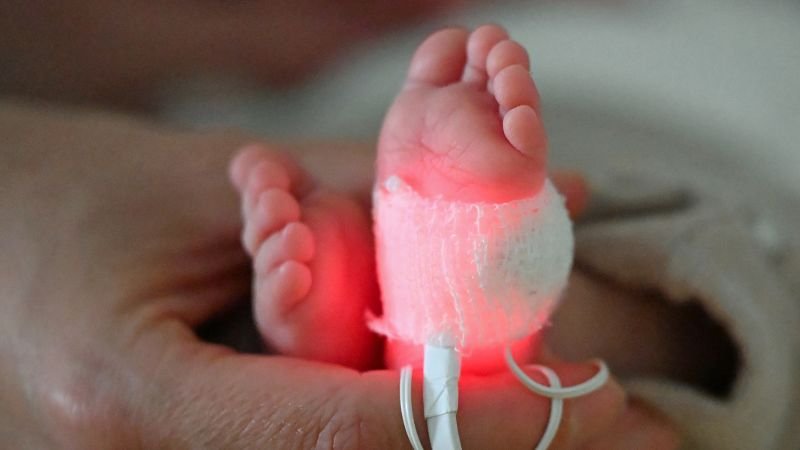
Two chemicals used to make plastics more flexible were linked to nearly 2 million premature births and 74,000 neonatal deaths worldwide in 2018, according to a new study.
Babies born before 37 weeks of pregnancy are considered premature. By 2024, approximately 1 in 10 infants in the United States will be born prematurely. According to the 2025 March of Dimes report card.
According to the Centers for Disease Control and Prevention, “babies that survive may have breathing problems, feeding problems, cerebral palsy, developmental delays, and vision and hearing problems.”
The two chemicals included in this study, di-2-ethylhexyl phthalate (DEHP) and its cousin diisononyl phthalate (DiNP), are part of a family of synthetic chemicals called phthalate esters.
Phthalates are known to interfere with body functions. mechanism for Hormone production, known as the endocrine system, is “associated with developmental, reproductive, brain, immune, and other issues,” according to the National Institute of Environmental Health. The institute says that even minor hormonal disturbances can cause “significant developmental and biological consequences.”
“This is a dangerous class of chemicals,” said the new study’s senior authors Leonardo Trasande, Ph.D., and Jim G. Hendrick, M.D., professor of pediatrics at New York University Langone’s Grossman School of Medicine in New York City.
“Given all the efforts we are making to have more babies in the United States, we also need to make sure they are born healthy,” said Professor Trasande, professor of population health and director of the Center for Environmental Pediatrics and Environmental Hazard Investigation at NYU Langone Health.
“These data further support efforts to negotiate a plastics agreement that limits chemicals of concern commonly used in plastics,” he said.
The American Chemistry Council’s Committee on High Phthalates told CNN in an email that the U.S. Environmental Protection Agency conducted a comprehensive risk assessment of the use of DiNP under the Toxic Substances Control Act and concluded that it does not pose an “unreasonable risk of harm to human health to consumers, the general population, or the environment.”
The council, which represents the U.S. chemical, plastics and chlorine industries, did not comment on di-2-ethylhexyl phthalate (DEHP).
Phthalates are sometimes referred to as “ubiquitous” chemicals because they are used in so many consumer products. This chemical provides flexibility in children’s toys, art supplies, food storage containers, vinyl flooring, shower curtains, garden hoses, medical equipment, and more.
Phthalates also help lubricate substances and carry scents into personal care products such as deodorants. nail polish; perfume; hair gel, spray, shampoo. soap; and body lotion.
“These are additives that are also used in wrap-type packaging plastics that are commonly used for food packaging,” Trazande said.
Studies have linked phthalates to reproductive problems such as genital malformations and undescended testicles in boys, and lower sperm counts and testosterone levels in adult men. Studies have also linked phthalates to childhood obesity, asthma, cardiovascular disease, and cancer.
A 2021 study co-authored by Trazande found that phthalates may contribute to 91,000 to 107,000 premature deaths per year among people aged 55 to 64. In the US. People with the highest levels of phthalates had a higher risk of death from all causes, but especially from heart disease.
How do these chemicals contribute to premature birth and infant death? More research needs to be done, but scientists have some ideas.
“One pathway is disruption of placental function, which has been shown to be affected by phthalates and other endocrine-disrupting chemicals,” said Jane Manke, managing director and chief scientific officer of the Food Packaging Forum, a nonprofit foundation based in Zurich, Switzerland. The organization focuses on scientific communication and research on plastics and other chemicals used in industry.
“Ironically, babies born prematurely are exposed to even more plastic because neonatal units rely on plastic tubes,” said Munke, who was not involved in the latest study. “This is also a strong reminder that innovation for safer materials, especially for use in healthcare, is urgently needed and should be a top priority for policymakers and entrepreneurs.”

The placenta, which attaches to the uterine wall, provides oxygen, nutrients, and immune support to the developing fetus. Experts say placental insufficiency, where organs don’t develop or function properly, is the leading cause of spontaneous premature birth.
“Inflammation is not very good for placenta accreta and can promote rupture of the membranes,” Trazande says. “Rupture of the uterine membranes, lack of attachment to the uterine wall, loss of vital nutrients to the fetus, etc. can cause uterine contractions. There is no single pathway.”
The new study, published Tuesday in the journal eClinicalMedicine, examined the effects of DEHP and DiNP across 200 countries and territories in 2018. Data was drawn from large national surveys in Canada, Europe, and the United States, as well as estimates from previous surveys in regions of the world that do not collect their own data.
Africa, the Middle East, and South Asia bore the brunt of the early health burden. The plastics industry is growing rapidly in some of these regions, producing much of the world’s plastic waste, the study said.
The study did not aim to establish that DEHP and DiNP directly or alone cause preterm birth, nor did it analyze other types of phthalates, the authors said.
That makes sense, said Dr. Donghai Liang, associate professor of environmental health at Emory University’s Rollins School of Public Health in Atlanta.
“Specifically, DEHP is one of the most widely studied phthalates in relation to preterm birth, so we have a stronger epidemiological basis to model its contribution,” Liang, who was not involved in the study, said in an email. “DiNP was included because it is a common replacement for DEHP and is becoming increasingly relevant as the industry moves away from older phthalates.
“However, I would not interpret this to mean that these two phthalates are the only ones that are important,” he said. “The broader concerns are really about phthalates as a class, and focusing on one or two at a time may underestimate the overall risk.”
Manufacturers often look for alternatives to chemicals that have been scientifically linked to health hazards and are regulated by federal and state governments. For example, the United States banned DEHP in concentrations greater than 0.1% in children’s toys and child care products in 2008, and two states, California and North Carolina, are working to ban DEHP in IV fluid bags.
“We are playing a dangerous game of whack-a-mole with harmful chemicals,” Trasande said. “There are situations where concerns are raised about a chemical and industry simply replaces it with a chemical analogue that may have the same or even greater impact.”
The good news is that phthalates have a short half-life and are eliminated from the body within a few days, experts said. Therefore, careful planning to avoid plastic can have a big impact.
“There are some reasonable and practical steps that can be helpful for mothers and expectant family members who want to minimize infection,” Liang said. “This includes choosing personal care products that are labeled ‘phthalate-free.’ Look for terms like diethyl phthalate (DEP), dibutyl phthalate (DBP), and benzyl butyl phthalate (BBzP) on the ingredient list.”
However, product labels do not always list chemicals in a consistent manner. For example, in personal care products, phthalates are often included in broader terms such as “fragrance” or “parfum,” Liang said.
“Phthalates are important additives to maintain the scent of fragrances,” says Trazande. “Another important tip: Avoid putting plastics in the microwave or dishwasher, as the heat leaches chemicals such as phthalates from the plastic.”
Phthalates can accumulate in household dust, so improve indoor air quality with proper ventilation and vacuum regularly, Liang added.
“That said, it is important to emphasize that these exposures are widespread and often difficult to avoid completely,” he said. “Meaningful protection cannot rely solely on individual actions. The most effective solutions lie upstream, including stronger regulation, safer product formulations, better labeling, and improved environmental management and regulatory oversight.”
Get inspired by our weekly roundup of healthy living, made simple. Sign up for CNN’s Life, But Better newsletter for information and tools to improve your health.
