


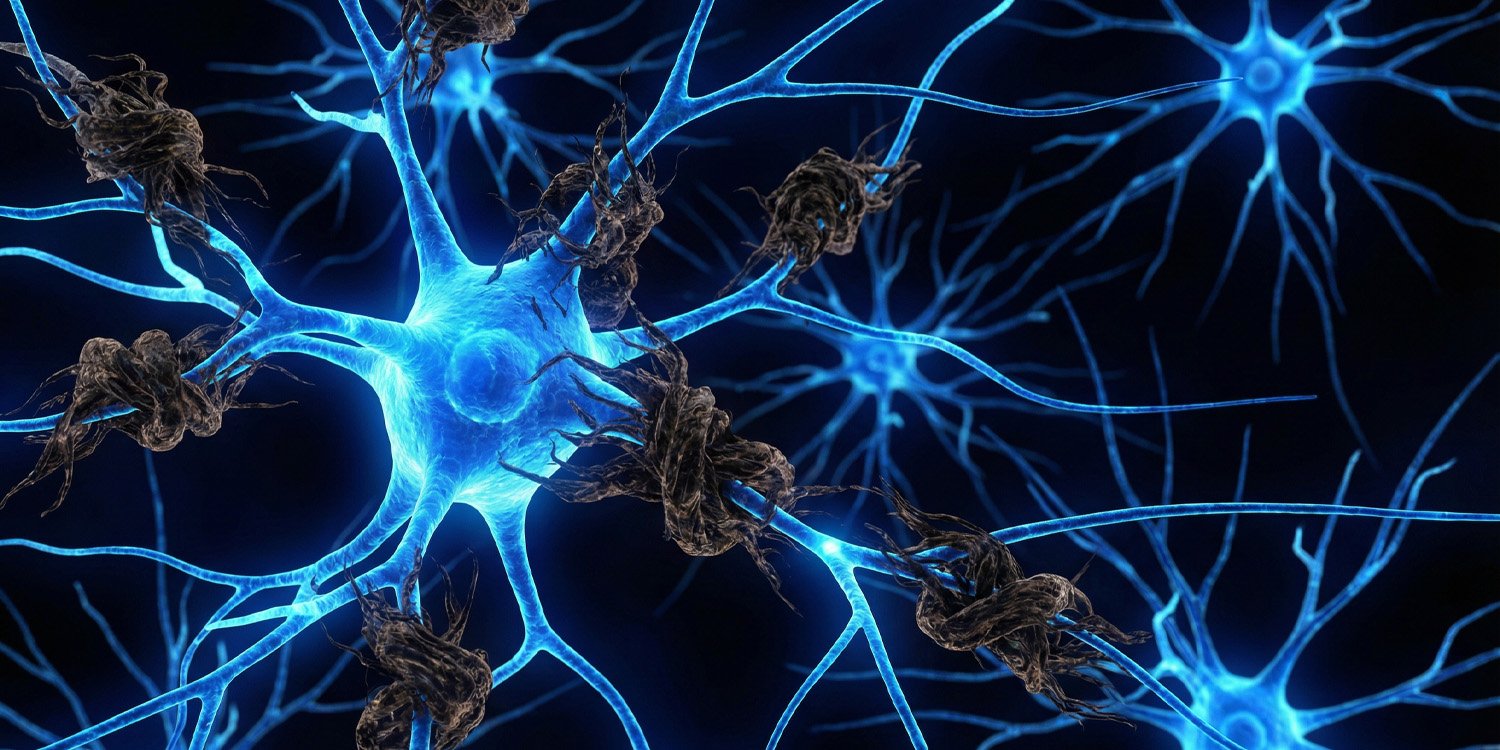
New research published in journal neuropharmacology Our findings suggest that chronic alcohol consumption affects the brain differently depending on the underlying characteristics of Alzheimer’s disease. The findings show that alcohol alters key brain circuits responsible for decision-making in opposite directions, depending on whether the brain is burdened by amyloid plaques or tau tangles. This provides evidence that the relationship between alcohol use and cognitive decline is highly complex and dependent on a person’s unique biological state.
Alzheimer’s disease is a progressive brain disease traditionally characterized by the accumulation of two distinct proteins. Amyloid beta forms sticky plaques on the outside of brain cells, while tau protein forms tangled structures inside the cells. These biological changes disrupt the way brain cells communicate, often leading to memory loss and decline in cognitive function. Apart from these biological markers, lifestyle factors also influence disease progression.
Alcohol consumption is an established risk factor for dementia and is known to alter brain pathways involved in behavioral flexibility and decision-making. Behavioral flexibility is the ability to adjust habits and behaviors when environmental conditions change. Specific neural pathways known as corticostriatal circuits are critically involved in this cognitive ability.
The corticostriatal circuit connects the prefrontal cortex to an area called the dorsomedial striatum. The prefrontal cortex processes complex thinking and planning, and the striatum manages behavior and reward processing. This pathway is often impaired early in both addiction and Alzheimer’s disease. A team of scientists led by postdoctoral researchers Yufei Huang and Jun Wang at Texas A&M University wanted to investigate how chronic alcohol consumption interacts with certain biological changes associated with Alzheimer’s disease.
The researchers aimed to understand whether alcohol alters corticostriatal circuitry differently when amyloid beta is present compared to when tau tangles are the main problem. They used two different genetic mouse models to represent different aspects of Alzheimer’s disease. The first model features a genetic modification that causes rapid accumulation of amyloid beta plaques in the brain. The second model is genetically engineered to develop tau tangles over time.
The researchers used an intermittent drinking procedure, giving mice a choice between water and a 20 percent alcohol solution. Amyloid beta mice were exposed to this routine alcohol for 16 weeks starting at 2 months of age. In another experiment, tau mice started an alcohol habit at 6 months of age and continued for 6 months. This timeline matched the natural progression of tau development in that particular genetic model.
After the drinking period ended, the scientists examined the brain tissue using patch-clamp electrophysiology. The technique involves attaching a microscopic glass pipette to individual brain cells and recording their electrical signals. The researchers also utilized optogenetics, a method that uses light to activate specific genetically engineered nerve endings. To achieve this, they injected a special virus into the prefrontal cortex a few weeks ago, allowing them to use colored light to stimulate only specific connections between the prefrontal cortex and the striatum.
In amyloid beta mice, chronic alcohol exposure increased the overall burden of amyloid plaques in the cortex. Alcohol also increased local electrical activity within the medial prefrontal cortex. The researchers recorded from 35 prefrontal neurons in seven mice and found that excitatory signals were elevated compared to mice that drank only water.
However, long-range signals traveling from the prefrontal cortex to the striatum showed a different pattern. When researchers used light-based stimuli to measure this relationship, they observed a significant decrease in communication strength in amyloid mice that consumed alcohol. Exposure to alcohol essentially suppressed the main output of this decision-making circuit in the presence of amyloid plaques.
Tau-based mouse models showed very different responses to the same alcohol exposure. In these mice, alcohol consumption significantly increased levels of the modified and damaging tau protein. However, local electrical activity in the medial prefrontal cortex remained relatively unchanged compared to tau mice that drank only water.
Investigating long-range connections to the striatum, scientists found that alcohol actually increases the strength of communication signals. They recorded from 21 striatal neurons in seven tau mice and observed increased responses to light stimulation. This was an unexpected result because tau protein normally tends to weaken brain connections on its own.
The research team also focused on immune cells in the brain known as microglia. These cells normally protect the brain by removing debris and supporting nerve cell health. In amyloid beta mice, exposure to alcohol caused significantly more microglia to cluster directly around amyloid plaques. Tau mice did not show increased clustering of immune cells after alcohol consumption, suggesting a specific immune response associated with amyloid accumulation.
To test how these immune cells directly influence brain signals, the researchers conducted additional experiments using wild-type mice, which do not have hallmarks of Alzheimer’s disease. They injected three mice with a drug called PLX5622 for seven days to eliminate most of the microglia. A control group of three mice received a simple saline injection. Recordings from 26 prefrontal neurons in a total of six mice showed that removing immune cells increased the strength of electrical signals. This suggests that immune cells play a direct role in regulating brain activity levels, which may help explain the circuit changes seen in amyloid mice exposed to alcohol.
Several limitations should be kept in mind when interpreting these results. This study is based on animal models and cannot fully reproduce the complex progression of cognitive decline in humans. Humans typically do not experience both amyloid and tau conditions alone, but a combination of both conditions at the same time. Future studies should investigate how alcohol interacts with brain conditions that simultaneously contain both sticky plaques and tau tangles.
The genetic backgrounds of the two mouse models are also slightly different, which of course could influence the extent to which alcohol alters these brain pathways. Human environmental exposures are much more complex than laboratory-controlled drinking schedules. Lifestyle factors such as stress, diet, and sleep patterns are thought to interact with biological markers to shape overall brain health.
Although the researchers measured electrical activity in brain slices, they did not directly test the mice for memory or behavioral deficits. Exactly how changes in these specific brain circuits influence real-world confusion and decision-making problems remains unclear. Future studies are expected to incorporate behavioral tests to determine whether alcohol-induced changes in brain signals directly cause measurable learning deficits in animals.
The study, “Chronic alcohol exposure causes disease-dependent corticostriatal circuit remodeling in an Aβ- and tau-based mouse model of Alzheimer’s disease,” was authored by Yufei Huang, Xueyi Xie, Zhenbo Huang, Himanshu Gangal, Ruifeng Chen, Xuehua Wang, Jianrong Li, and Jun Wang.
