


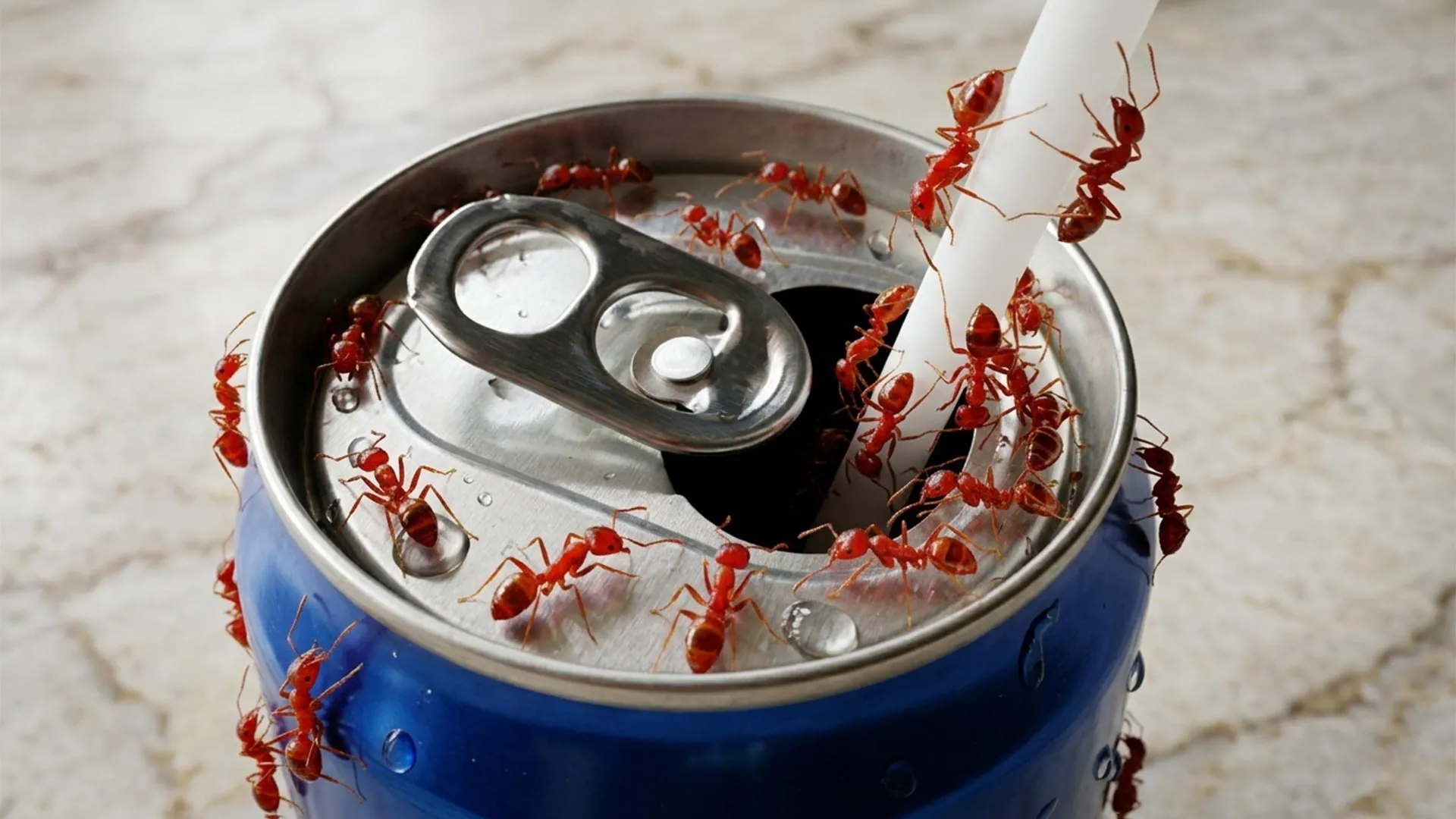
Ants that eat sweet treats laced with caffeine become significantly better at finding their way back there. New research published in iscience These ants show that even though they don’t move faster, they can still obtain rewards by a more direct route. This suggests that caffeine improves the ability to learn and remember locations. The study focused on the Argentine ant (linepitema humility), a widespread invasive species, and the results of this study point to potential new ways to improve pest control by making baits more attractive and effective.
“The idea of this project was to find a cognitive way to make ants eat more of a poisonous bait placed in the field,” says lead author Enrique Galante, a postdoctoral researcher and computational biologist at the University of Regensburg. “We found that intermediate doses of caffeine actually facilitate learning. Giving them a little bit of caffeine helps them stay on a straighter path and reach the reward faster.”
The Argentine ant is one of the most harmful and expensive invasive species in the world. Efforts to control them typically rely on poisonous baits, but these strategies often fail. Colonies may ignore the bait or abandon it before it can spread far and wide. The researchers investigated whether caffeine, which is already known to enhance learning in bees, could help the ants better remember food locations and lead more nestmates to them.
“We’re trying to help the ants find these foods, because the faster they go and come back, the more pheromone footprints they create, the more ants come, and the faster they can spread the poison to the colony before the ants even realize it’s poisonous,” Galante says.
Testing the effects of caffeine in the lab
To investigate this idea, scientists designed a controlled experiment using different levels of caffeine. The ants crossed a small Lego drawbridge to reach a test surface consisting of an A4 sheet placed on top of acrylic. There, they encountered drops of sugar solution containing 0, 25 ppm, 250 ppm, or 2,000 ppm of caffeine.
“The lowest dose we used was the amount found in natural plants, the middle dose is similar to what is found in some energy drinks, and the highest dose was set at the LD50 for honeybees, which kills half of the bees given this dose. So it can be quite toxic to bees,” Galante says.
The researchers used an automated system to track each ant’s movements, measuring the travel time and how straight the ant’s path was. A total of 142 ants participated, and each ant completed four trials. Between experiments, the ants were allowed to unload the collected food, and the surface of the experiment was changed to prevent the ants from following their own pheromone trails.
Straighter paths, faster learning
Ants fed only sugar showed little improvement over time, indicating that the ants were not effectively learning the location of the reward. In contrast, ants given small or moderate amounts of caffeine quickly became more efficient.
For ants exposed to 25 ppm of caffeine, foraging time decreased by 28 percent with each visit. At 250 ppm, the improvement reached 38 percent. For example, ants that initially took 300 seconds to reach the reward were able to reduce that time to 113 seconds at the low dose and only 54 seconds at the intermediate dose by the final trial. Even the highest caffeine levels did not have the same effect.
Concentration over speed
This improvement is not due to increased speed. Instead, ants that consumed caffeine followed a more direct route, suggesting stronger concentration and better spatial memory. Their pace didn’t change at any dose, but their paths became less tortuous at low and moderate levels of caffeine.
“What we’re seeing is that they’re not moving faster, they’re just more focused on where they’re going,” Galante said. “This suggests that they know where they want to go and therefore know where the reward is.”
Caffeine had no effect on how efficiently the ants returned to their nests (how efficiently they returned to their nests), but all ants improved slightly over time regardless of caffeine.
Potential new tools for pest control
The results of this study suggest that caffeine may play a role in improving pest control strategies for Argentine ants. By helping ants learn food locations faster and recruit more nestmates, caffeine may increase the chances that the poison will spread effectively throughout the colony before the ants discover it.
The researchers caution that more work is needed before applying this approach to real-world settings. Ongoing research is testing caffeine-enriched baits in outdoor environments in Spain to see how caffeine interacts with the poison itself.
This research was supported by the European Research Council, the German Foundation and the University of Regensburg.
