


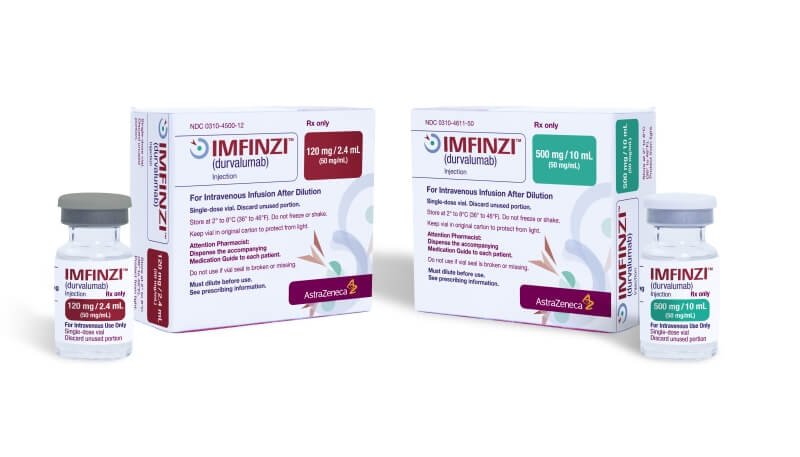
AstraZeneca fires another salvo in its bladder cancer race with Merck’s Keytruda, with the FDA on Thursday approving its PD-L1 inhibitor Imfinzi as part of the first immunotherapy combination therapy for patients with high-risk non-muscle invasive bladder cancer (NMIBC) who have not previously received standard-of-care bacillus Calmette-Guérin (BCG) therapy.
In a May 28 release, AZ said Imfinzi’s indications were given the green light alongside BCG induction and maintenance therapy.
This is the second recent case of a bladder cancer treatment, with Imfinzi approved for muscle-invasive bladder cancer (MIBC) in March of last year. In this case, it would be used in combination with the chemotherapy drugs gemcitabine and cisplatin before cystectomy surgery and alone after surgery.
Imfinzi’s latest OK is supported by results from a Phase 3 trial showing that one year of treatment with immunotherapy reduced the risk of recurrence, progression, or death in high-risk disease by 32% when added to BCG induction and maintenance therapy compared to BCG monotherapy. With a median follow-up of 61 months, AZ said Imfinzi therapy provided an early and sustained disease-free survival benefit starting less than four months after starting treatment.
According to Neil Shore, MD, director of the Carolina Urological Research Center and co-principal investigator of the Imfinzi trial, this regimen represents the first advancement in the treatment of BCG-naive high-risk NMIBC in more than 30 years.
“Unfortunately, many of these patients end up having their bladder surgically removed due to disease recurrence requiring repeated surgical procedures or disease progression,” Dr. Shore said in a statement.
AstraZeneca estimates that more than 31,000 people in the U.S. will be treated for high-risk NMIBC in 2024.
Approximately half of NMIBC patients are at high risk for disease recurrence or progression based on tumor grade, stage, and certain tumor characteristics. Up to 80% of high-risk patients experience disease recurrence within five years of treatment, AZ said.
AZ received FDA approval for Imfinzi as a treatment for advanced bladder cancer in 2017, but regained approval four years later after a confirmatory trial failed. But since then, the British drugmaker has scored in three recent phase 3 bladder cancer trials.
Last week, AZ reported positive results in a study of MIBC patients who were unable or declined cisplatin-based chemotherapy.
The Volga trial showed that perioperative treatment with Imfinzi and the neoadjuvant use of Pfizer and Astellas’ antibody-drug conjugate Padocef significantly improved event-free survival (EFS) and overall survival (OS) compared with standard of care. Patients in the comparison group underwent cystectomy with or without approved adjuvant therapy.
Imfinzi became a huge hit in its second year on the market, and sales continue to grow. It generated $6.1 billion in revenue in 2025, an increase of 37% from the previous year. In the first quarter of 2026, Imfinzi’s sales increased 30% to $1.7 billion.
Meanwhile, Keytruda has been the world’s best-selling cancer drug for the past decade, with sales of $32 billion in 2025 and $8 billion in the first quarter of this year.
The FDA approved Keytruda in combination with Pfizer and Astellas’ Padoseb for advanced bladder cancer in 2023, and last November approved the combination as a perioperative treatment for patients with MIBC who are ineligible for cisplatin. Keytruda also received approval in 2020 for BCG-unresponsive high-risk NMIBC.
