



From tickling monkeys to laughing children, a new study traces how the rhythms of laughter reveal the deep evolutionary roots of human speech.

Research: The rhythm and timing of laughter reveals that human vocal plasticity belongs to the hominid continuum. Image credit: Andrea Izzotti / Shutterstock
In a recent study published in the journal Communications Biology, researchers conducted a comparative analysis of laughter among representatives of the major living ape lineages, including humans.
Because sounds do not fossilize, it remains difficult to trace the audio origins of languages, voices, and songs. Although the major lineages of hominids have distinct repertoires of calls, one vocalization, laughter, is conserved across species. Given the inherently periodic and repetitive nature of human and great ape laughter, changes in its temporal organization and structure may provide a means to study evolutionary changes in vocal and respiratory coordination across hominids.
About research
In the new study, researchers compared the laughter of orangutans, gorillas, bonobos, chimpanzees, and humans. First, hilarious audio recordings were collected from four non-human primate species and a human. Non-human primates included two gorillas, four orangutans, four chimpanzees, and three bonobos. The human participants were four children aged 6 months to 7 years, whose natural and playful interactions with their mothers were recorded. Because the dataset contained a small number of individuals per taxon, this result is strongest as a pattern of phylogenetic and behavioral status rather than a final species-level estimate.
Recordings of non-human apes, collected primarily ex situ from 2004 to 2006, were obtained during controlled interactions with familiar humans that elicited both play and tickling vocalizations. Audio recordings were resampled to 22 kHz and high-pass filtered to reduce electrical noise interference. Recordings with a signal-to-noise difference of less than 2 dB were excluded. The length and starting point of each call was annotated.
The call was a continuous sound element with no interruptions. Consecutive calls separated by less than 8 ms or in the same acoustic mode belonged to the same match. The two matches, which took place less than a second apart, belonged to the same series. For this study, we selected bouts with at least three calls, resulting in 140 bouts: 42 bouts from bonobos, 34 bouts from gorillas, 35 bouts from chimpanzees, 16 bouts from orangutans, and 13 bouts from humans.
The intervals between the start times of calls in the same match are calculated, and these intervals serve as a proxy for the timing of laughs. A linear mixed effects model then assessed how tempo varied as a function of systematic distance. The researchers also estimated rhythm ratios, which compare successive timing intervals, to assess the rhythmic structure of laughter. We analyzed these proportions using generalized linear mixed models to test whether laughter is isochronous or variable.
Survey results
The researchers found that the laughter of sampled great apes, including humans, was isochronous, meaning it followed a fixed timing between vocalizations. Additionally, the authors interpreted this pattern to suggest that the isochronous structure of laughter may have been present in, or developed earlier, the last common ancestor of great apes about 15 million years ago. Notably, isochrony was dependent on the behavioral context of laughter, with playful laughter deviating significantly from regularity, whereas ticklish laughter showed high regularity.
Furthermore, the pace of laughter was inferred to accelerate along the phylogenetic order of hominids. Tickle laughter expressed this acceleration better than playful laughter. Remarkably, only humans showed context-dependent tempo adjustment, producing faster laughter in response to tickling than play. Nonhuman great apes did not show such situational changes.
Moreover, the variability in laughter timing gradually increased, with the highest variability among humans. This variability decreased with increasing phylogenetic distance from humans, highlighting the tendency for hominid vocal flexibility to evolve gradually. However, the authors noted that the number of individuals per species was limited, meaning that more samples were needed to refine estimates of species-level variability.
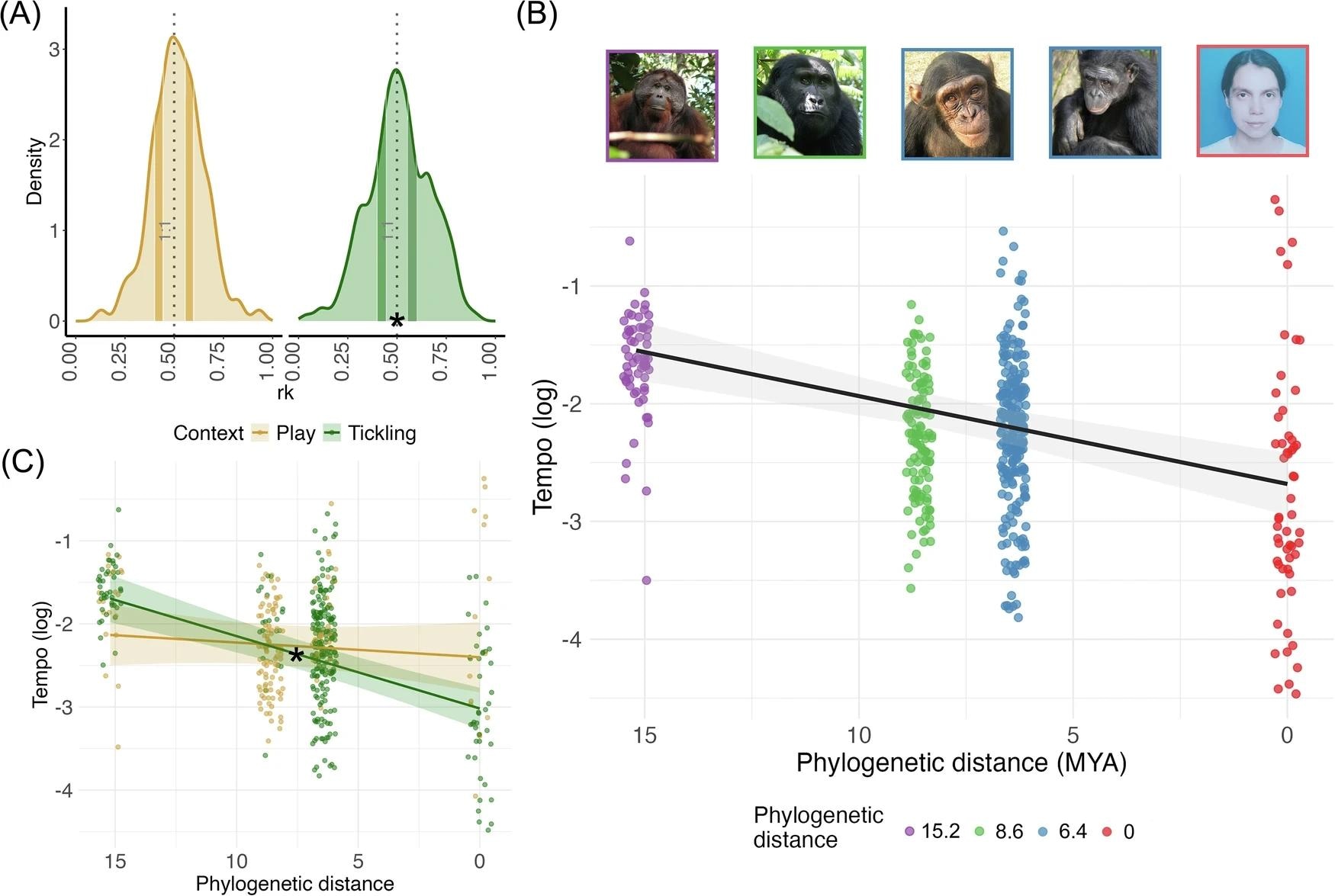
a Probability density functions of rhythm ratios (rk) in two behavioral situations (play, yellow, tickling, green) from 140 laughter bouts across 17 individuals. The white line highlights the ratio range of on integers (0.440 < rk < 0.555, light shade) and off integers (0.400 k < 0.440 and 0.555 < rk < 0.600, dark shade). * indicates p < 0.05, indicating a statistically significant correspondence between the empirical distribution and small integer rhythm ratio categories. B Differences in the tempo of laughter depending on the species. Each dot represents an individual observation. Colors indicate phylogenetic distance (million years ago, MYA). Each square contains an image of the corresponding species, with a corresponding dot color for intuitive reference. Credit to ME Hardus, M. Davila-Ross, and E. Demuru. C Changes in the tempo of laughter across behavioral contexts (play, yellow, tickling, green). * indicates p < 0.05. Sample size: orangutans n = 4 biologically independent animals, gorillas n = 2, bonobos n = 3, chimpanzees n = 4, and children n = 4.
conclusion
Taken together, these results provide evidence that human rhythms have become more varied and situationally faster, which may reflect evolutionary changes in vocal control abilities associated with the later emergence of language and speech. By demonstrating both derived and conserved rhythmic features of laughter, the findings map an evolutionary pathway toward increased vocal flexibility in a behavior that has been conserved over millions of years.
Want to read it later? Click here to download a PDF copy.
Reference magazines:
- De Gregorio C, Davila-Ross M, Lameira AR (2026). The rhythm and timing of laughter reveal that the plasticity of the human voice belongs to a continuum of humanity. Communication Biology, 9(1):824. Doi: 10.1038/s42003-026-10499-z, https://www.nature.com/articles/s42003-026-10499-z
