


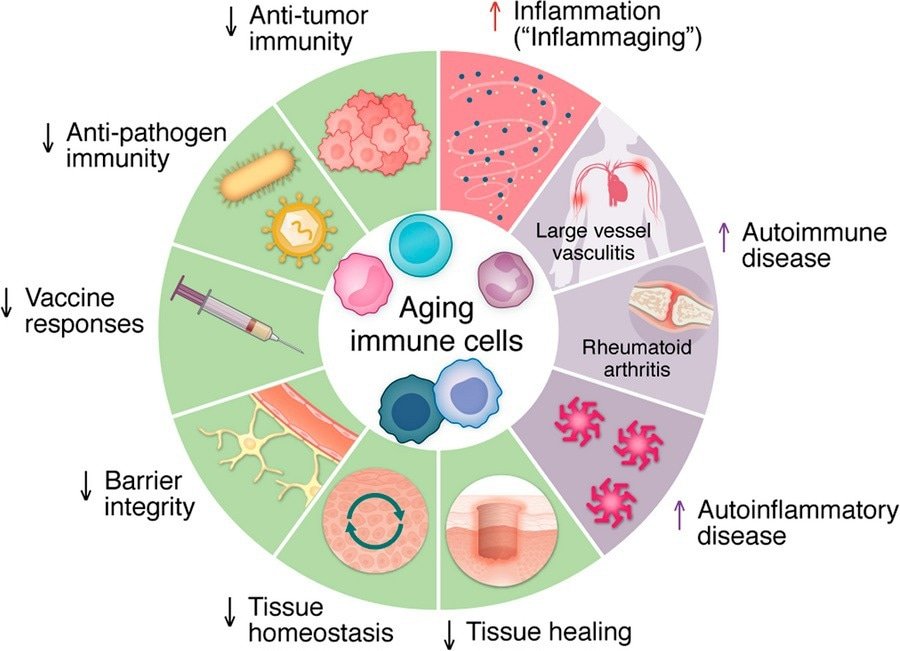
Immune aging weakens defense responses to infections, cancer, and defective tissue repair, and increases the risk of chronic inflammation and autoimmunity.
Area of immunosenescence. As we age, many protective functions of the immune system, such as antitumor surveillance, antimicrobial defense, barrier integrity, and wound healing, gradually decline. Aging affects both innate and adaptive immune cells, making them more susceptible to inflammatory responses. As a result, aging hosts are at increased risk not only of infections and malignancies, but also of chronic inflammation and autoimmune diseases.
Recent reviews published in clinical research journal We synthesized how immunosenescence contributes to immune dysregulation, functional decline, and autoimmunity.
Human healthy life expectancy and life expectancy have increased significantly over the past century. This increase in lifespan poses a variety of biomedical and social challenges. The immune system is continuously exposed to internal and external stressors, making it highly susceptible to the effects of aging. Recent research has revealed that there is an inflection point in aging around age 50, with the spleen and lymph nodes showing the earliest molecular signatures among immune organs.
Meanwhile, epidemiological data show that most of the 19 most prevalent autoimmune diseases occur after age 50, with type 1 diabetes being the major exception in childhood and adolescence. The idea that aging T cells are less effective against tumors and pathogens but more pathogenic in autoimmune diseases has prompted research into the effects of aging on T cell resilience, function, and effector programming. In this review, the authors summarized recent achievements demonstrating the role of immunosenescence in immune dysregulation, functional decline, and autoimmunity.
Mechanisms underlying immunosenescence
The continuous need for new immune cells is the main cause of immunosenescence. Studies have shown that the lymphocyte pool remains relatively stable throughout adulthood, indicating that lymphocytes are constantly being replenished. Approximately 70 million naive B cells, 65 million naive CD4+ T cells, 17 million naive CD8+ T cells, approximately 600 million memory T cells across the CD4+ and CD8+ compartments, and 60 million memory B cells are generated daily, highlighting their proliferative load. Conversely, myeloid cells have a shorter lifespan than lymphocytes, making replicative aging more pronounced.
Meeting the high demand for monocytes and neutrophils requires extensive expansion of hematopoietic stem cells (HSCs). Clonal expansion of HSCs increases with age, and these cells also develop an age-related myeloid lineage bias. HSC mutations that result in proliferation, increased self-renewal, evasion of senescence, or promotion of inflammatory resilience promote clonal expansion, which is recognized as clonal hematopoiesis with clinically indeterminate potential.
Dispersion of the immune system is one of the hallmarks of immunosenescence, resulting in B cells and T cells occupying non-classical anatomical niches after leaving primary tissues. For example, tertiary lymphoid structures are perivascular clusters of B and T cells that form outside the spleen, bone marrow, and lymph nodes. These structures are characteristic of the periaortic tissues of some autoimmune diseases, particularly giant cell arteritis (GCA), and occur in the synovium of some patients with rheumatoid arthritis (RA), usually those with more severe disease.
In addition to immune cells, aging also reshapes the extracellular matrix, stromal niche, tissue architecture, and chemokine environment. Thymic involution is an example of an immune environment that promotes aging. Age-related loss of thymic epithelial cells leads to a marked decrease in naive T cell production and a reduction in the T cell repertoire. This process highlights how tissue aging shapes the diversity and number of immune cells available throughout life.
Importantly, this review highlights that T cell aging is not uniform. Naive CD8+ T cells decline significantly with age, whereas naive CD4+ T cells are more resilient and remain diverse. Memory T cell aging is also highly context-dependent, shaped by antigen specificity, exposure history, and lineage-specific programs. This heterogeneity helps explain why some T cell pools remain functionally robust while others shift toward a state biased toward innate-like, inflammatory, or senescent phenotypes.
RA and GCA: models of age-related autoimmunity
Rheumatoid arthritis usually becomes clinically apparent later in life. Early studies of cluster of differentiation 4 (CD4+) T cells from RA patients identified accelerated immunosenescence phenotypes, including age-inappropriate telomere erosion, reduced clonal diversity, and early loss of CD28 expression. Senescent T cells develop pathogenic effector functions. This is not only due to the accumulation of damage, but also because aging reshapes the communication and coordination of intracellular organelles.
Specifically, organelle stress and disruption of organelle crosstalk reprograms T cells toward a tissue-destructive state. These T cells become trapped in maladaptive activation loops, perpetuating chronic inflammation. Additionally, CD4+ T cells in RA have compromised mitochondrial health due to defects in mitochondrial DNA (mtDNA) repair. Although essential repair machinery is produced in the nucleus, these cells are unable to import it into the mitochondria.
mtDNA fragments that escape into the cytosol and extracellular space act as damage-associated molecular patterns (DAMPs), causing inflammation and amplifying immune activation. Defective mtDNA repair in CD4+ T cells in RA leads to a sharp decrease in mitochondrial adenosine triphosphate (ATP) synthesis and disruption of tricarboxylic acid cycle activity. Additionally, CD4+ T cells in RA have lower levels of late-cycle metabolites and higher levels of early-cycle intermediates.
Excess acetyl coenzyme A causes post-translational modifications, and hyperacetylation of cytoskeletal proteins causes organelle misalignment and changes in cell morphology. These defects result in CD4+ T cells being highly tissue infiltrative and mobile in RA. Mitochondrial-lysosomal crosstalk is disrupted in CD4+ T cells in RA, AMP-activated protein kinase (AMPK) fails to localize to lysosomes, and mechanistic target of rapamycin complex 1 (mTORC1) remains poorly suppressed.
As a result, mTORC1 is uncoupled from ATP status, allowing T cells to proliferate and grow despite bioenergetic stress. This overactivation of mTORC1 in energy-starved cells contributes to evasion of immune response limiting mechanisms. Overall, impaired mitochondrial resilience leads to maladaptive remodeling and ultimately to the release of DAMPs from T cells. These defects are associated with accelerated immunosenescence in RA and reprogram T cells toward a pathogenic state.
This review also highlights GCA as a contrasting model of aging-related autoimmunity. Unlike RA, which reflects accelerated immunosenescence of T cells, GCA may be involved in halting or delaying immunosenescence, with stem-like CD4+ T cells retaining their youthful proliferative capacity, while aged arterial tissue accumulates neoantigens. This discrepancy between immunosenescence and tissue aging may help explain why GCA occurs only after approximately 50 years of age, with a median age of diagnosis of nearly 75 years.
In GCA, stem-like CD4+ T cells have been identified in aortic tissue and may reside within tertiary lymphoid structures near vascular vessels. These cells maintain self-renewal and responsiveness, which is unusual in the elderly, and are able to generate differentiated effector T cells that infiltrate the aged neoantigen-rich vascular tissue. This discrepancy suggests that autoimmune diseases in the elderly may arise not only from weakened immunity but also from discordant aging between immune cells and peripheral tissues.
conclusion
Aging causes a progressive decline in immune integrity through metabolic stress, stem cell depletion, organelle dysfunction, and decline in lymphocyte stemness. As tolerance mechanisms weaken, B and T cells adopt more innate-like characteristics, increasing their vulnerability to autoimmunity. At the same time, immune regulation is disrupted by aging of the lymph nodes, vasculature, and bone marrow. Collectively, this creates conditions for inflammation and autoimmunity.
The authors suggest that future therapeutic strategies should aim to restore metabolic resilience, improve organelle communication, maintain lymphocyte stemness, enhance mitochondrial repair, suppress sustained mTOR signaling, and correct maladaptive endoplasmic reticulum stress. Understanding the mechanisms of delayed immunosenescence may also lead to approaches to rejuvenate immune function, enhance vaccine responsiveness, and prevent age-related autoimmunity.
