


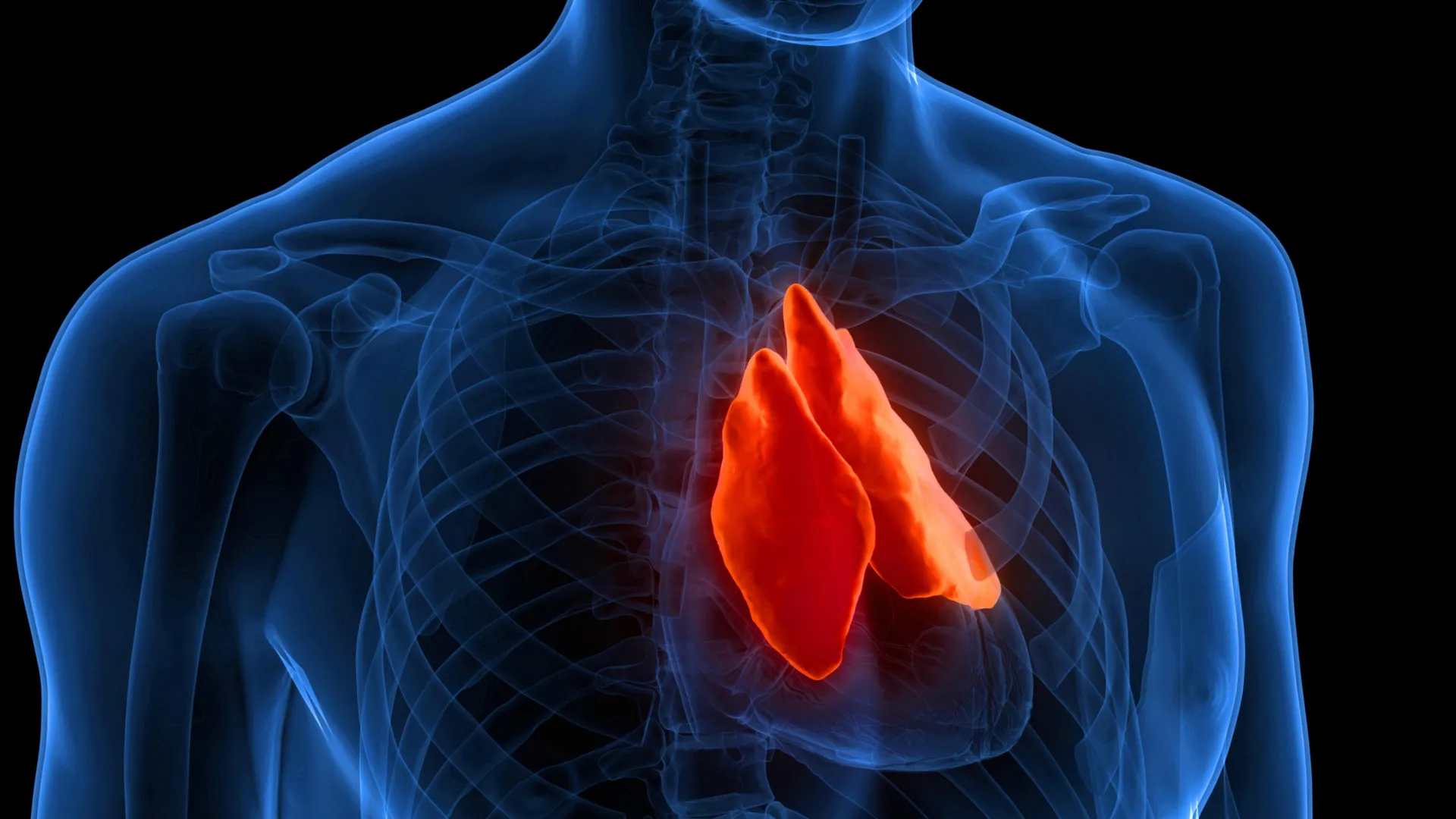
Researchers at Massachusetts General Brigham have found evidence that the thymus, a small immune system organ long thought to lose its importance after childhood, may play a major role in adult health. Two new studies have found that adults with healthy thymuses are more likely to live longer and less likely to develop serious illnesses. This study also suggests that thymic health may influence cancer patients’ response to immunotherapy.
The findings were published in two papers in the same issue. nature and challenges decades-old assumptions about the thymus. The results indicate that this organ remains important throughout adulthood and may ultimately inform disease prevention strategies and cancer treatment decisions.
“The thymus gland has been ignored for decades, but it may be the missing piece in explaining why people age differently and why cancer treatments fail in some patients,” said corresponding author Dr. Hugo Aerts, director of the Artificial Intelligence in Medicine (AIM) Program at Massachusetts General Brigham. “Our findings suggest that thymic health deserves more attention and may open new avenues for understanding how to protect the immune system as we age.”
thymus gland function
The thymus gland is located in the chest and helps train T cells, a type of immune cell that protects the body from infection and disease. Many scientists believed that this organ played a limited role in adult health because it gradually shrinks after puberty and produces fewer new T cells over time.
As a result, the thymus has received relatively little attention in studies of large populations. Previous studies have linked T cell diversity to aging and weakened immune function, but those studies were typically small and focused on blood samples.
The new study took a broader approach. Researchers analyzed data from more than 25,000 adults who participated in a national lung cancer screening trial and more than 2,500 participants in the Framingham Heart Study, a long-term study that tracks the health of generally healthy adults.
AI reveals link between longevity and disease risk
Researchers used artificial intelligence (AI) to evaluate routine CT scans to measure the size, structure, and composition of the thymus gland. From these measurements, they created a “thymus health” score.
Those with higher thymic health scores experienced significantly better outcomes. Compared to people with poorer thymic health, they had about a 50% lower risk of dying from any cause, a 63% lower risk of dying from cardiovascular disease, and a 36% lower risk of developing lung cancer. These relationships remained strong even after accounting for age and other health factors.
Researchers believe that poor thymus health may reduce T-cell diversity, making it harder for the immune system to recognize and respond to new threats such as cancer and other diseases.
Their analysis also identified several factors associated with poor thymic health, including chronic inflammation, smoking, and weight gain. These findings suggest that lifestyle factors and ongoing inflammation may influence the immune system’s ability to maintain resilience over the long term.
Thymus health and cancer immunotherapy
In a separate study, the team looked at CT scans and clinical outcomes of more than 1,200 cancer patients treated with immunotherapy.
The results showed that patients with healthier thymus tended to respond better to treatment. They had about a 37% lower risk of cancer progression and a 44% lower risk of death, even after researchers adjusted for differences in patients, tumors, and treatment approaches.
According to the researchers, these findings highlight the potentially important, but previously underappreciated, role of the thymus gland in determining how effectively modern cancer immunotherapies work.
Further research required
Scientists stress that additional research is needed to confirm the results. They also note that the imaging techniques used to measure thymus health are not yet ready for routine use in clinical settings.
Although lifestyle factors have been associated with thymic health, studies have not investigated whether changing these factors can directly improve thymic function.
The research team continues to investigate other effects on thymus health. One ongoing study is investigating whether unintentional radiation exposure to the thymus during lung cancer treatment affects patient outcomes.
“Improved understanding and monitoring of thymus health could ultimately help doctors better assess disease risk and make treatment decisions,” Aerts said.
In addition to Aerts, study co-authors on the entire adult health paper include Simon Bernatz, Vasco Prudente, Suraj Pai, Asbjörn Kjær, Yumeng Kao, Jiachen Chen, Dr. Asha Lias, and Borek Fordina. Mr. Leonard Nuremberg, Mr. Christopher Abosh, Mr. Charles Swanton, Maryam Jamal Khanjani, MD, Mr. Michael T. Lu, Joanne M. Murabito, Kathryn L. Lunetta, and Nikolai J. Birkbach.
Co-authors of the Arts immunotherapy outcome paper include Simon Bernatz, Vasco Prudente, Suraj Pai, Asbjørn Kjær, Alessandro Di Federico, Andrew Rowan, Selvaraju Veeriah, Lars Dyrskjøt, Leonard Nürnberg, Joao V. Alessi, Patrick A. Ottshaw, El Hacks, Nicholas Hacks, and Allan. hack. McGranahan, Christopher Abbosh, Raymond H. Mak, Danielle Bitterman, Mark Awad, Biagio Ricciuti, Charles Swanton, Mariam Jamal-Hanjani, and Dr. Nicolai J Birkbak.
This study received financial support from the National Institutes of Health, the European Research Council, the German Research Foundation (DFG), the Lundbeck Foundation, the Novo Nordisk Foundation, and the Savvaerksejer Jeppe Juhl and Hustru Ovita Juhl Research Stipend.
