


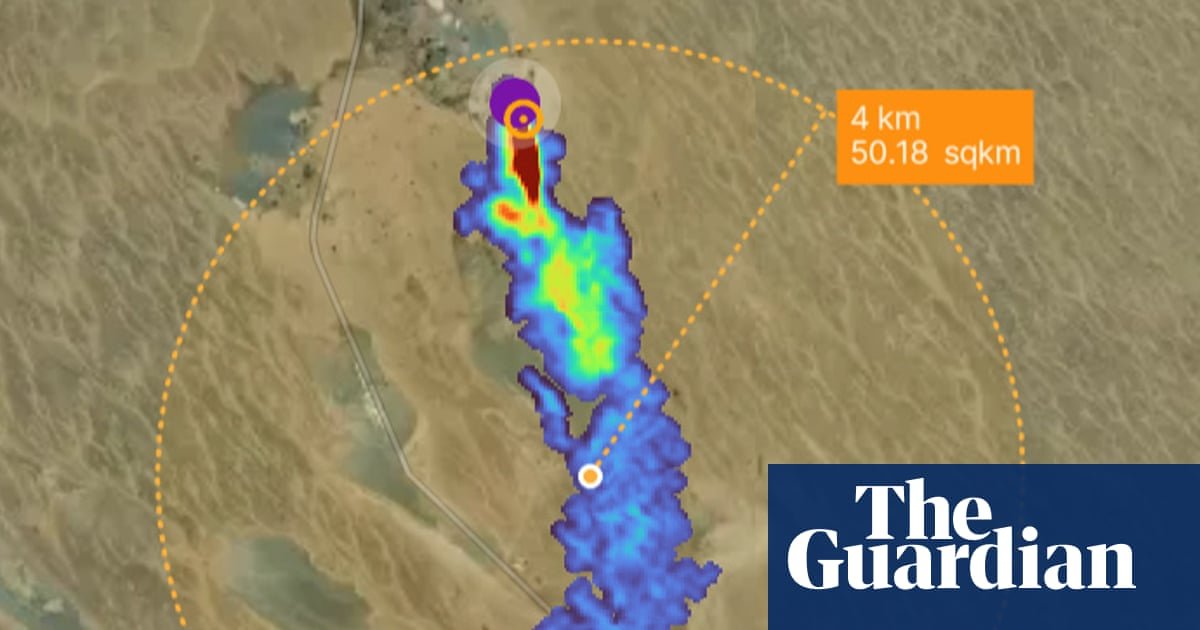
Analysis of satellite data has revealed the world’s worst large-scale leak of methane, a powerful greenhouse gas, in 2025.
Super-polluting plumes from oil and gas facilities have a significant heating impact on the climate, but are often caused by poor maintenance and are easily remedied. The assessment uncovered dozens of large leaks, each with the same global heating impact as a coal-fired power plant.
Researchers said it was “frustrating” that such easy-to-follow action was not taken to combat the climate crisis and said people should be angry. Stopping a leak is even free, given that the recovered gas can be sold. Methane is “natural gas” that is used as fuel for power plants.
Although large leaks occur all over the world, facilities in Turkmenistan dominate the top 25 list compiled by the Methane Interdiction Project at the University of California, Los Angeles (UCLA). The scale of the methane leak in the secretive and authoritarian state has previously been described as “mind-boggling”.
Super-polluting plumes have also been identified in the United States, with the largest plume detected in 2025 occurring in Texas, leaking 5.5 tons of methane per hour, the equivalent of driving around 1 million fuel-guzzling SUVs. Venezuela (5) and Iran (3) also experienced multiple large-scale leaks from state-owned facilities.
The Stop Methane Project also analyzed super-polluting plumes from landfills. In landfills, rotting organic waste can release large amounts of methane if poorly managed. The worst sites were spread all over the world, from Türkiye to Algeria and Malaysia to the United States.
Turkmenistan methane leak map
Methane emissions are responsible for 25% of today’s global warming, with an “alarming” spike occurring since 2007, scientists say. They warn that this acceleration risks triggering a catastrophic climate tipping point. But methane gas is naturally removed from the atmosphere much faster than carbon dioxide, so reducing methane emissions has a rapid effect. Some experts call methane reduction an “emergency brake” for the climate.
“It’s really frustrating,” said UCLA’s Kara Horowitz. “These sites are the result of poor maintenance. A few infrastructure upgrades and proper management could solve a very important part of the problem.
“We hope that by making these key issues visible, we can help build public and political pressure to do something.”
Unlike previous plume listings, the UCLA project investigated presumed operators at large leak sites.
The super polluting plume in Texas appears to be operated by Energy Transfer. The company did not respond to requests for comment.
“Methane has been a stealth polluting gas for many years: invisible, out of sight, out of mind,” Horowitz said. “But we can now use satellites to observe these very powerful emissions and use them as a wake-up call to the world.”
The UCLA Stop Methane Analysis is based on Carbon Mapper data and found 4,400 significant plumes in 2025, each emitting approximately 100 kg or more per hour, the equivalent of driving 20,000 SUVs. In the United States, nine out of the 10 worst breaches occurred in Texas.
“Americans should be surprised and outraged by the fact that the United States is so high on this list of top pollution plumes,” Horowitz said. “We Americans tend to think of our industry as running pretty well and cleanly, but this shows we still have work to do.”
Turkmen officials claimed in October that major methane leaks had been reduced. “The management has put it under special control and the leaks are being repaired on site within two to three days,” Muhammetberdi Byasiev, head of environmental protection at state company Turkmengas, said, citing cooperation with the United Nations, the International Energy Agency and the European Union. But new analysis shows that a significant amount of mega-leakage remains.
Graph shows major landfills causing methane leaks around the world
“It’s clear that Turkmenistan is trying to access the European market,” Horowitz said. “Potential European buyers should take note of our results and consider this a ‘buyer beware’ moment.” The EU is gradually introducing tougher limits on methane leaks linked to imported gas.
“Methane is a more powerful climate villain than any other air pollutant because it acts quickly and is emitted in large quantities. It’s also relatively cheap and easy to control. New detailed satellite images will help us target countries and companies that need to be held accountable,” said Mary Nichols, former chair of the California Air Resources Board and member of Carbon Mapper’s Policy Impact Committee.
The Guardian contacted Turkmennevit, Turkmengas, Petroleos de Venezuela SA, Iranian National Oil Company and Iranian National Gas Company, but did not receive a response.
-
A note on methodology: Carbon Mapper uses data from two satellites to measure plumes passing overhead. The leakage rate from the plume on different days is averaged and days without leakage are taken into account. Satellites cannot collect data at night or through thick clouds, so not all plumes may be detected. The Stop Methane Project only considered plumes that were detected at least twice. The top 25 oil and gas plumes were each detected an average of 7 times, and the top 25 landfill plumes were each detected an average of 11 times.
