


Listen to the audio version of this article (generated by AI).
A new analysis links heavy use of the herbicide glyphosate to increased rates of non-Hodgkin’s lymphoma (NHL), particularly in the Midwest, confirming years of research linking cancer to the herbicide popularized by Monsanto.
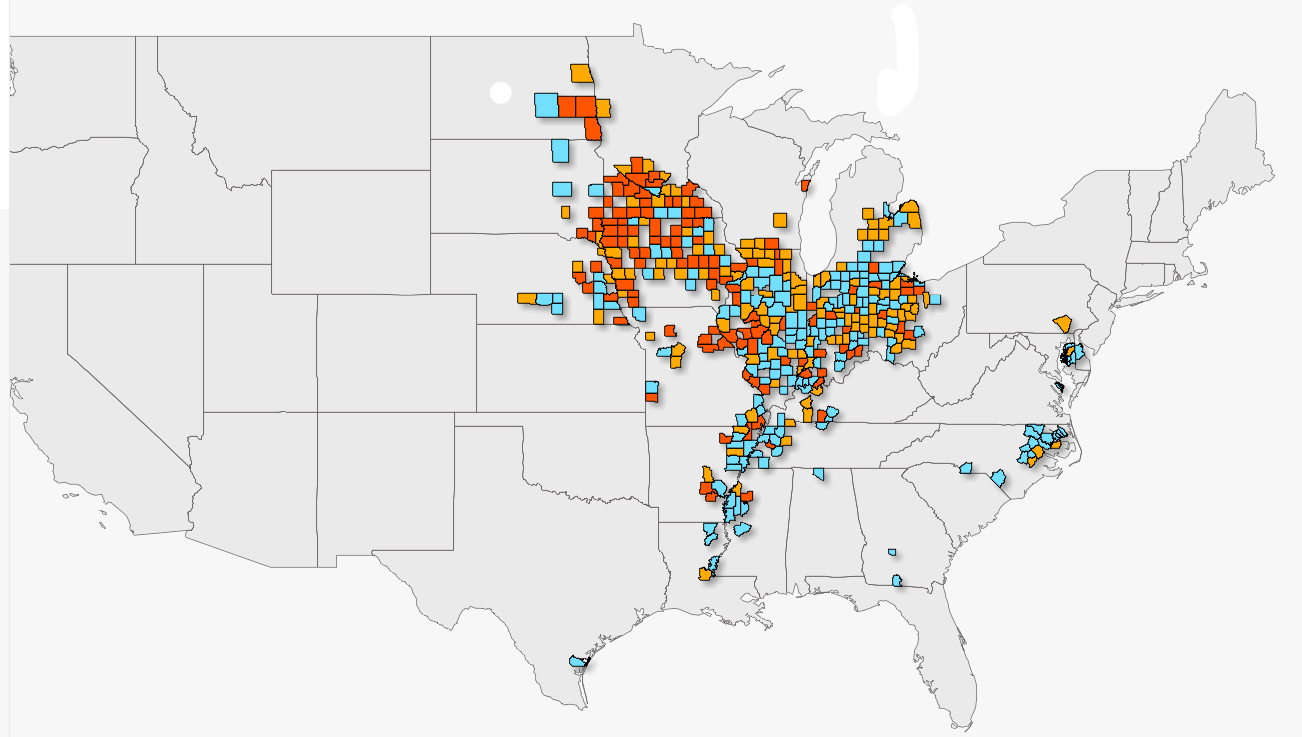
An analysis by Food & Water Watch (FWW), a nonprofit public health advocacy group, looked at the counties that spray the most glyphosate herbicides in the country, focusing on the top 20% of counties using glyphosate on commercial crops.
The research group then overlaid that data with NHL incidence rates. In its findings, the group said 60% of counties with high glyphosate use had NHL rates above the national average.
The greatest overlap between glyphosate applications and NHL was in the Midwest, a major agricultural region of the United States.
 Looking at the hotspot map, clusters with especially high NHL rates have been identified in many areas of Iowa, which is the top corn-growing state in the nation and is among the top five soybean-growing states. Both crops have been genetically modified to withstand glyphosate spraying.
According to the National Institutes of Health, Iowa has the second-highest cancer rate in the nation and is only one of three states where cancer rates are increasing. FWW analysis found increased NHL incidence in 82% of areas with high glyphosate application.
FWW said it based its analysis on data from the U.S. Department of Agriculture’s (USDA) Pesticide Use Program and the National Cancer Institute’s State Cancer Profile Database. The map only shows counties that are in the top 20% for total glyphosate applied per square mile and also have county-level data on NHL incidence, FWW said.
“It is compelling that many of the counties that use the most glyphosate are also ‘hot spots’ for non-Hodgkin’s lymphoma, a cancer associated with glyphosate exposure,” said Amanda Starbuck, FWW research director.
The new analysis is not surprising, said Sarah Green, executive director of the Iowa Environmental Council, which is working to study the relationship between environmental risk factors and cancer rates in Iowa.
“We know that cancer rates in Iowa are at crisis levels, and growing research shows that Iowans face tremendous risks from exposure to pesticides such as glyphosate, atrazine, acetochlor, and nitrates from fertilizers and fertilizer applications,” she said. “Of particular note is that Iowans are not exposed to just one risk factor, but are often exposed to multiple risk factors at the same time.”
Professor Green cautioned that correlation did not equal causation and said more comprehensive research was needed into the health effects of environmental exposures.
Glyphosate is a herbicide that was introduced by Monsanto in the 1970s and has been widely used in agriculture as well as a variety of commercial and residential applications for many years. Use of the chemical, commonly known as the “Roundup” brand product, has skyrocketed since Monsanto introduced genetically modified crops engineered to withstand glyphosate, making it easier for farmers to kill weeds in their fields without harming the genetically modified crops.
As use has increased, so has scientific scrutiny of the chemical’s potential environmental and human health risks.
In 2015, the International Agency for Research on Cancer, part of the World Health Organization, classified the pesticide as probably carcinogenic to humans, noting a link to NHL.
In 2019, researchers published a study showing that people with high exposure to glyphosate herbicides had a 41% increased risk of developing NHL, and claimed that this evidence showed a “compelling link” between glyphosate herbicides and cancer.
Several scientists will gather at a symposium later this month to review research on glyphosate regarding its potential health effects.
Leanne Shepard, a professor at the University of Washington who organized the symposium and authored the 2019 study, said evidence about glyphosate’s potential health effects continues to grow.
“Since our study was published, evidence has accumulated that glyphosate-based herbicides cause DNA damage and affect DNA repair mechanisms, both of which can cause cancer, with blood cancers such as NHL most likely to be affected,” she said.
Tens of thousands of people across the United States are suing Monsanto and Bayer, the German company that acquired Monsanto in 2018, alleging that exposure to the company’s glyphosate herbicide caused them to develop NHL.
Monsanto, and later Bayer, claim that their products do not cause cancer. The Environmental Protection Agency says glyphosate is “unlikely to be carcinogenic to humans.”
-

Carrie Gillum is editor-in-chief of The New Lede and a veteran investigative journalist with more than 30 years of experience covering U.S. news, including 17 years (1998-2015) as a senior correspondent for Reuters International. She is the author of Whitewashing: A Story of Herbicides, Cancer, and the Corruption of Science, which exposed the agricultural corruption of the Monsanto corporation. The book won the coveted Rachel Carson Book Award from the Association of Environmental Journalists in 2018. Her second book, the narrative law thriller The Monsanto Documents, was released on March 2, 2021.
She also contributed chapters to a textbook on environmental journalism and a book on pesticide use in Africa.
Mr. Gillum testified about his research as an invited expert before the European Parliament in 2017 and was a featured speaker at the World Democracy Forum in Strasbourg, France in 2019. He has also been a keynote speaker and panel speaker at events and universities in North America, Australia, the Netherlands, Brussels, and France.
Gillam is a regular contributor to the Guardian. Her work has also appeared in The New York Times, Huffington Post, Time, and other outlets.
In 2022, Gillum helped launch The New Lede as a journalism initiative of the Environmental Working Group.
Gillum is a member of the Association of Environmental Journalists.
