


Published October 3, 2026 – 8:00 GMT+1
Futuristic technology, including heavy-lift robots, is being deployed to help clean up Europe’s trash-filled seas as part of an EU-funded trial.

advertisement
advertisement
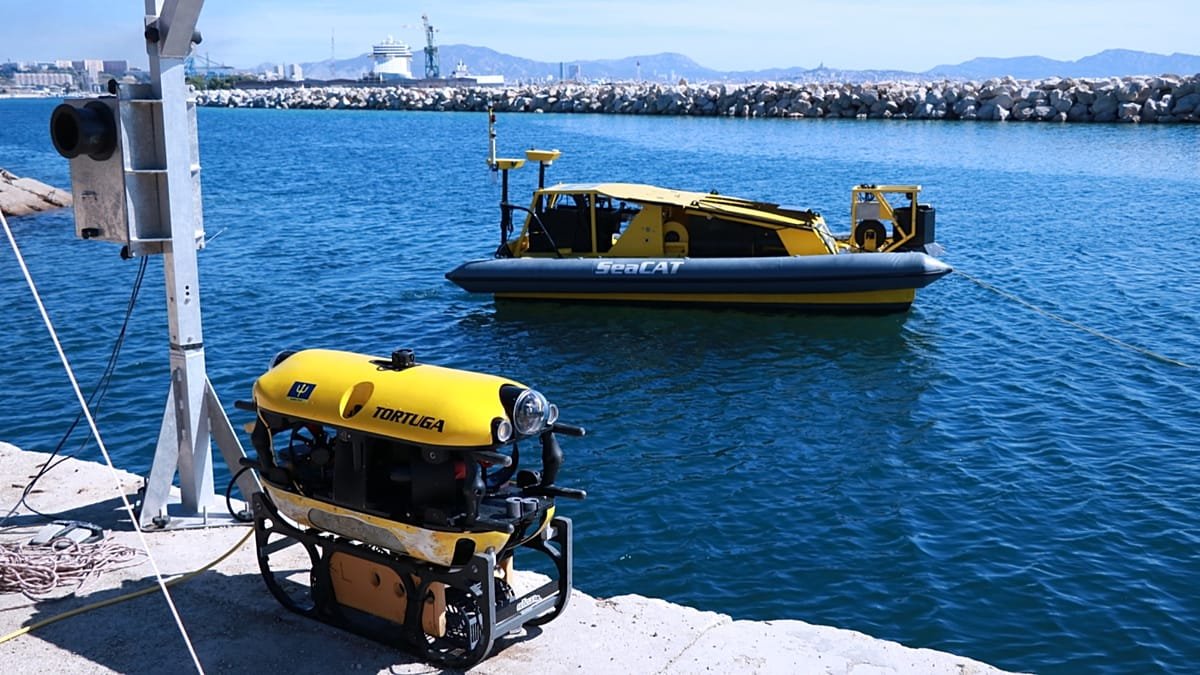
The scientists and companies behind SeaClear2.0 and its predecessor, SeaClear, have developed a fleet of drones that can uniquely identify debris on the ocean floor. Powered by AI and supervised by humans, robots can also find everyday items such as bottles, tires, and other debris, and distinguish trash from rocks, plants, and marine life.
The initiative is part of the bloc’s mission to ‘take back our oceans and waters’, which aims to reduce marine debris by about half by 2030. Tests are already being carried out in Germany as well as at the marina in Marseille, France.
Further trials are planned in Venice, Dubrovnik and Tarragona, but experts warn the technology still needs refinement.
‘Tons of garbage’ in European seas
“A huge amount of garbage is ending up in the ocean,” says Bart De Schutter, a professor at Delft University of Technology in the Netherlands and coordinator of SeaClear and SeaClear2.0.
Most of this waste sinks from the earth’s surface to the ocean floor and is no longer visible to the naked eye.
“Many projects target debris on the surface, but we are focusing on the ocean floor,” De Schutter added. “It’s important to get rid of the trash that’s there because it can contaminate the environment.”
When plastic sinks to the ocean floor, it gradually breaks down into smaller pieces. They eventually break down into microplastics, which are notoriously difficult to remove and have become ubiquitous on Earth.
How does a garbage picking robot work?
A typical cleanup operation involves sending divers to the ocean floor to collect trash. For heavy objects, divers may need to attach cables to the debris so they can bring it up to the surface and remove it.
However, this process is very expensive and can put divers at risk. SeaClear 2.0 aims to address this problem by dispatching unmanned surface vessels to target areas.
Aerial detection drones are then deployed to identify the trash, record its location, and then sent to retrieve the trash by either grabbing it or sucking it up. For heavier objects, the smart gripper can be lowered from the crane.
Researchers are also testing additional systems, including autonomous barges that function like “floating trash trucks.” This will collect the waste collected by the drone and transport it to the shore.
“In the tests, we have already removed rubber tires, metal fences and parts of the ship,” says de Schutter. “Surface ship cranes can lift even heavier objects.”
Streamline technology
Although tests have yielded positive results, researchers say the technology needs further refinement before the project concludes at the end of 2026.
“We are not exactly where we want to be yet,” says Yves Chardard, CEO of French company Subsea Tech, a partner in both versions of SeaClear. “But we have goals that are not too far away. Our current goal is to streamline the technology.”
Researchers are also exploring the possibility of using robots to detect unexploded mines on the ocean floor left behind by historic wars. The team hopes that by the end of the year, cleaners will be able to work with local authorities across Europe.
