


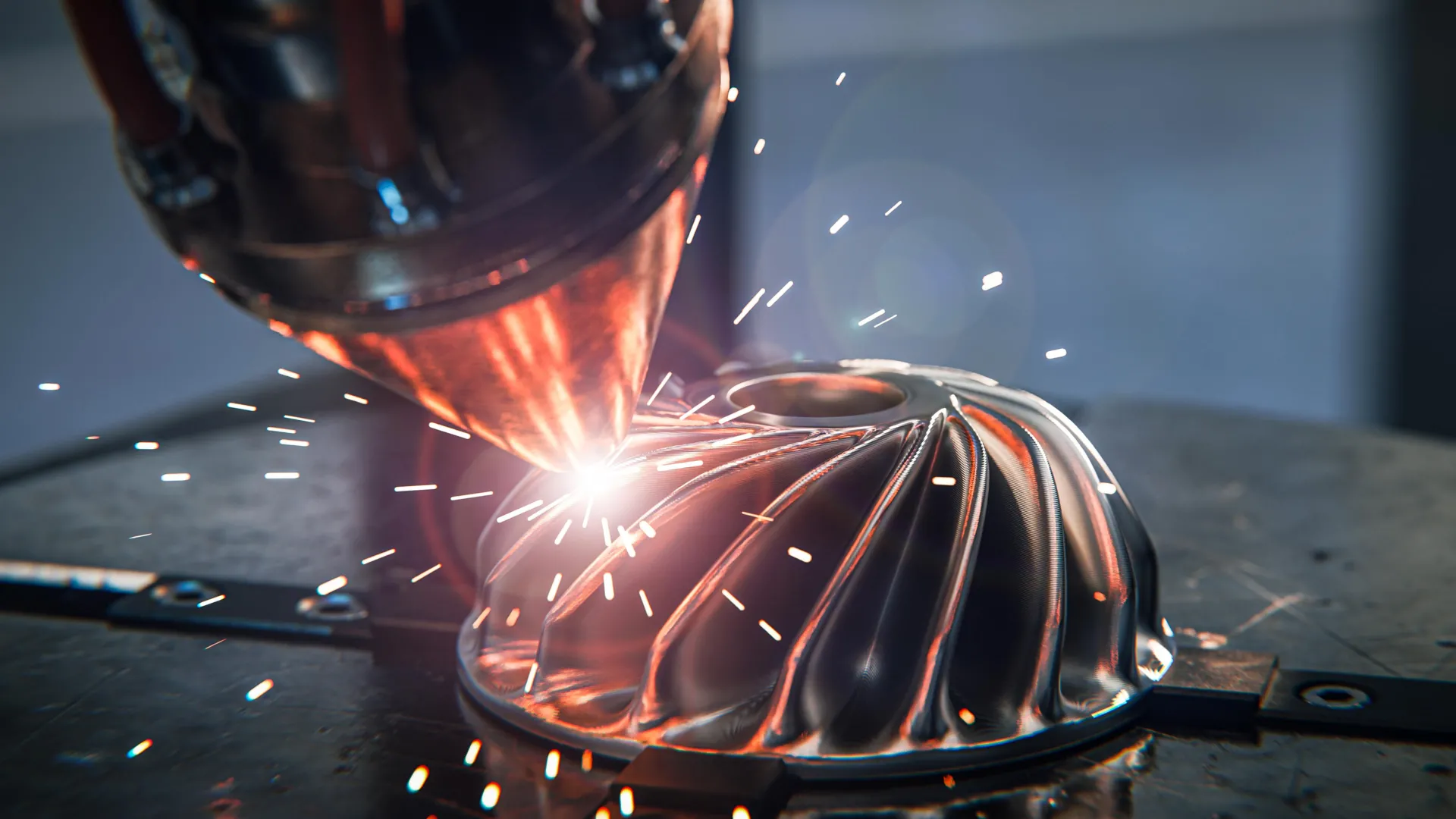
Tungsten cobalt carbide (WC-Co) is widely praised for its extremely high hardness, but its strength makes it extremely difficult to shape and manufacture. Current production methods consume large amounts of expensive materials while achieving relatively modest yields. As a result, researchers have sought more efficient and economical ways to produce these extremely durable materials.
WC-Co cemented carbide is essential for applications where strong wear resistance and high hardness are required, such as cutting tools and construction tools. Traditionally, these materials are produced by powder metallurgy. In this process, WC and Co powders are compressed under high pressure and heated in a sintering machine to form a solid cemented carbide. Although this method produces a very durable final product, it uses large amounts of expensive raw materials and has inefficient yields.
To address this issue, researchers considered another approach using additive manufacturing (AM, also commonly referred to as 3D printing). Their work also incorporates a technique called thermal laser irradiation. By combining these methods, we aim to create a cemented carbide that maintains strength and durability while reducing both material waste and production costs.
The survey results are International Journal of Refractory Metals and Hard Materials It will be published in the April 2026 print issue of the journal.
Laser-based additive manufacturing approach
In this study, we explored additive manufacturing using hot laser irradiation and tested two different manufacturing strategies. Hot-wire laser irradiation (also known as laser hot-wire welding) combines a laser beam with a heated filler wire. This combination increases the deposition rate (filler metal addition) and improves overall manufacturing efficiency.
In one experimental approach, a cemented carbide rod guides the fabrication, and a laser shines directly onto the top of the rod. In the second approach, a laser guides the process, sending energy between the bottom of the cemented carbide rod and the base metal (steel). With both techniques, the material softens during manufacturing rather than completely melting to form a cemented carbide structure.
“Cemented carbide is a very hard material used for cutting tool edges and similar applications, but it is made from very expensive raw materials such as tungsten and cobalt, so reducing material usage is highly desirable. “By using modeling, we can deposit cemented carbide only where it is needed, thereby reducing material consumption,” said corresponding author Keita Marumoto, assistant professor at Hiroshima University’s Graduate School of Advanced Science and Engineering.
Achieving defect-free industrial hardness
Experiments have shown that this additive manufacturing strategy can maintain the hardness and mechanical strength typically achieved with traditional manufacturing methods. The resulting material reached hardness levels exceeding 1400 HV (a unit of resistance to penetration) while avoiding defects and material failure.
Materials with this level of hardness are among the toughest materials used in industrial applications, ranking just below superhard materials such as sapphire and diamond. The production of defect-free cemented carbide molds appears to be achievable with this approach, and this was the main objective of the study. However, the results varied depending on the manufacturing method used.
For example, the rod leading technique caused WC decomposition near the top of the build, resulting in defects in the finished material. Laser-based methods also struggled to maintain the hardness necessary for success.
The researchers addressed these issues by introducing a nickel alloy-based interlayer. Combined with careful control of temperature conditions (above the melting point of cobalt and below the particle growth temperature), this adjustment made it possible to produce the cemented carbide using additive manufacturing while maintaining the material’s hardness.
Future improvements and applications
This result provides a promising starting point for further development. Future efforts will focus on reducing cracking during manufacturing and enabling the creation of more complex shapes.
“The approach of softening and forming metal materials rather than completely melting them is a novel approach, and it has the potential to be applied not only to cemented carbide, which was the subject of this research, but also to other materials,” says Professor Marumoto.
Looking ahead, the researchers aim to manufacture cutting tools, explore the use of other materials, and continue researching ways to improve the durability of parts made with this technology.
This research was conducted by Keita Marumoto and Motomichi Yamamoto of the Graduate School of Advanced Science and Engineering, Hiroshima University.
