


Approximately 40% of non-organic fruits and vegetables grown in California contain trace amounts of pesticides, which are also PFAS (“forever chemicals”), according to a new study.
California supplies nearly half of the vegetables and more than three-quarters of the fruits and nuts consumed in the United States.
Perfluoroalkyl and polyfluoroalkyl substances (PFAS) are called “forever chemicals” because the strong molecular bonds of carbon and fluoride can take years, decades, or even centuries to completely break down in the environment. It is estimated that there are approximately 15,000 fluorinated chemicals (PFAS) in existence today.
“PFAS pesticides are the active ingredients in these products because they have a killing effect, which is why they are such a concern to public health and the environment in general,” said Bernadette Del Chiaro, senior vice president of California operations for the Environmental Working Group (EWG), a health advocacy group that authored the report released Wednesday.
“Unfortunately, there is no way to limit the damage,” Del Chiaro said. “Just by harming mold spores and insects on peaches, you can’t eliminate the possibility of harm to small children who eat peaches. The fact that we’re intentionally permanently spraying the produce we buy at the grocery store with chemicals is truly eye-opening.”
Legacy PFAS, which have been manufactured since the 1940s to make products non-stick, stain-resistant and water-repellent, have been linked to cancer, obesity, thyroid disease, high cholesterol, reduced fertility, liver damage, hormonal disruption and immune system damage, according to the U.S. Environmental Protection Agency. Some of these chemicals can be harmful at levels as low as parts per billion of a gram.
Newer PFAS pesticides have also shown alarming effects on human cells and the reproductive and nervous systems of animals, but exposure levels are difficult to determine. For example, fludioxonil, which is added to produce after harvest to prevent mold and mildew, killed human cells and damaged DNA in clinical tests.
“It’s not going to rain to wash away the PFAS pesticides, so that’s a little concerning,” said Nathan Donley, director of environmental health sciences at the Center for Biological Diversity, a Tucson, Ariz.-based nonprofit dedicated to preserving endangered species.
“This is the last place you want to see that kind of contamination because these foods are actually what nourish us and feed our children,” said Donley, who was not involved in the EWG analysis. “And I don’t think most people understand that this is happening at all.”
According to the EWG report, lemons have the highest concentrations of fludioxonil at more than 1 ppm, followed by peaches, nectarines, pears, plums, blueberries and apricots. In addition, fludioxonil was detected in 90% of tested samples of nectarines, peaches, and plums.
“The European Food Safety Authority also considers fludioxonil to be an endocrine-disrupting chemical that can harm the reproductive systems of animals,” said report co-author Varun Subramaniam, a scientific analyst at EWG.
In response, the EPA said in an email to CNN, “EPA evaluates all new and existing pesticides based on gold standard science to ensure that the products on the market keep the American people and our food supply safe and healthy without unreasonable risk of harm. Fungicides like fludioxonil keep America’s food supply safe, abundant, and affordable.”
Despite health and environmental concerns, the use of PFAS pesticides in the United States has increased over the past several decades, Donley said.
“The new generation of pesticides are PFAS, and they’re really scary,” he says. “While most industries are transitioning away from PFAS, the pesticide industry is doubling down. We are definitely moving in the wrong direction.”
CropLife America, which represents the pesticide industry, told CNN in an email that some pesticides are “intentionally fluoridated” to make them more durable, more resistant to heat and water, better able to adhere to leaf surfaces, and provide greater protection against pests.

“Regardless of their chemical composition, all pesticides are subject to the same rigorous scientific review and data requirements under the Federal Insecticide, Fungicide, and Rodenticide Act, the Federal Food, Drug, and Cosmetic Act, and EPA’s implementing regulations and policies,” the statement said.
An EWG analysis using 2023 testing data collected by the California Department of Pesticide Regulation found 17 PFAS pesticides in 40 of 78 non-organic fruits and vegetables. Overall, 37% of the 930 samples contained chemicals of concern, the report said.
Bifenthrin, which attacks the nervous system of insects and is considered a possible human carcinogen, was found in strawberries, blueberries, blackberries, collards, celery, bok choy and green beans, the report said. Penthiopyrad, which stops fungal respiration and is toxic to aquatic life, was found in strawberries, peaches, plums, green beans, celery, carrots, and peppers. Lambda-cyhalothrin starves insects, is deadly to bees, and is found in cherries, nectarines, peaches, plums, lettuce, and broccoli.
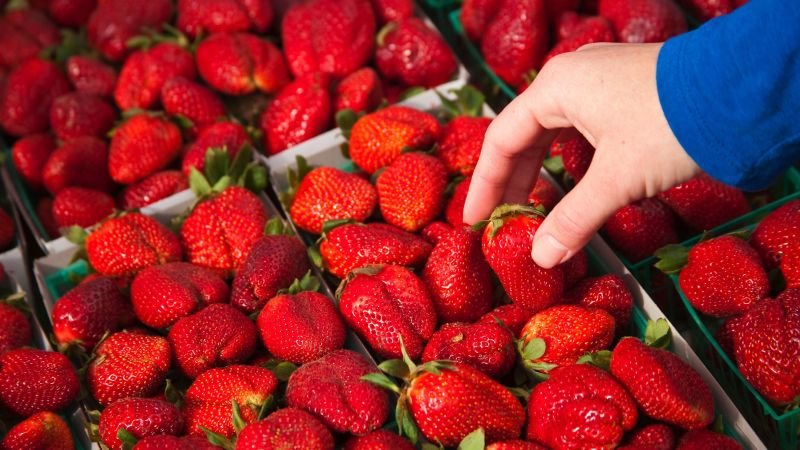
Testing showed that it was common for multiple permanent chemicals to be detected in each type of produce. For example, strawberries were contaminated with 10 different PFAS pesticides. Cherries and peaches contained seven chemicals, grapes, celery, and collards contained six, and spinach contained five.
“What we know about pesticides and PFAS is that the sum is often greater than its parts,” Subramaniam said. “Exposure to a cocktail of pesticides is often much more dangerous than exposure to the same amount of each pesticide individually.”
The U.S. Environmental Protection Agency evaluates pesticides by weighing the health risks against the potential benefits of producing more crops, and in many cases determines that the level of human exposure to pesticides is very small, Donley said.
“But the EPA has not considered what would happen if humans were exposed to these 10 pesticides in their diets for 20 consecutive years,” he said. “That’s a big question mark. No one knows, not even the EPA, because these complex mixtures have never been tested before.”
The Trump administration has so far approved two PFAS pesticides for use on lettuce, oranges, tomatoes, almonds, peas, and oats, and is considering approving a third PFAS pesticide to combat weeds in corn, soybeans, and wheat crops. In late February, the EPA also announced it was considering an emergency exemption without safety review for the use of PFAS pesticides on rice.
One reason this is happening is because the EPA does not consider many new monofluorocarbon pesticides to be PFAS, or “permanent chemicals,” even though they are defined as such by the Organization for Economic Co-operation and Development. The United States is a founding member.
The OECD definition is endorsed by more than 150 leading PFAS researchers and is used by the European Union and nearly half of the states in the United States, most notably in past versions of the National Defense Authorization Act.
“The OECD is not a regulatory agency and does not have any authority here,” an EPA spokesperson told CNN. Additionally, EPA’s rejection of monofluorinated carbons as PFAS is “rooted in gold standard scientific review and supports EPA’s legal obligation to protect human health and the environment.”
Many of the chemicals that don’t meet the EPA’s definition of PFAS are “incredibly persistent,” Donley says. “For example, the half-life of carbon tetrafluoride in the atmosphere is 50,000 years, and the half-life of TFA in water is thought to be hundreds of years.”
Trifluoroacetic acid (TFA), produced when PFAS, pesticides, pharmaceuticals, and other industrial chemicals biodegrade, is “irreversibly increasing” worldwide, according to a 2024 study. This long-lasting chemical damages the liver, is reproductively toxic in animal studies, and has already been detected in human blood, but little research has been done into its risks to human health.
Either way, TFA is present in soils and drinking water around the world and is bioconcentrated in plants. TFA concentrations are now “orders of magnitude higher” than other per- and polyfluoroalkyl substances and are rapidly becoming a threat to the planet, the 2024 review concluded.
Avoiding all PFAS is difficult. PFAS have been added to popcorn bags, pizza boxes, nonstick frying pans, household cleaners, dental floss, cosmetics, shampoos, sunscreens, water- and stain-resistant clothing, carpets and upholstery, and the list goes on for decades. Because of their long half-lives, even traditional PFAS that have been phased out or banned persist in soil and drinking water.
In fact, a report from the National Academies of Sciences, Engineering, and Medicine says that various PFAS chemicals are found in the blood of 98% of Americans and can accumulate in various organs in the body over many years.
Stephanie Icke, assistant professor of environmental health and epidemiology at Emory University’s Rollins School of Public Health in Atlanta, said that when it comes to avoiding new PFAS pesticides, organic produce contains fewer chemicals and is a good option if possible.
“If you can’t afford organic products, it’s best to thoroughly wash produce under running water and use a brush for hard items like carrots, potatoes and cucumbers,” said Eyck, who was not involved in the EWG study.
All produce, even organic produce, must be washed before peeling. This should prevent dirt and bacteria from transferring from the knife to your fruits and vegetables. After washing, dry with a clean cloth or paper towel, according to the U.S. Food and Drug Administration.
There is no need to use bleach, soap or produce cleaners, and fruits and vegetables are porous and can absorb these chemicals, the FDA said.
Remove the outermost leaves of cabbage, lettuce, and other leafy vegetables and carefully wash each leaf. However, do not spray the vegetables with water. Otherwise, it will be damaged. Experts said it’s best to use low-pressure water that’s warmer than the produce and spin-dry the vegetables in a colander. Do not forget to wash the colander afterwards. The exception is bagged vegetables that have been “triple washed,” which the FDA says requires no additional cleaning.
Get inspired by our weekly roundup of healthy living, made simple. Sign up for CNN’s Life, But Better newsletter for information and tools to improve your health.
