


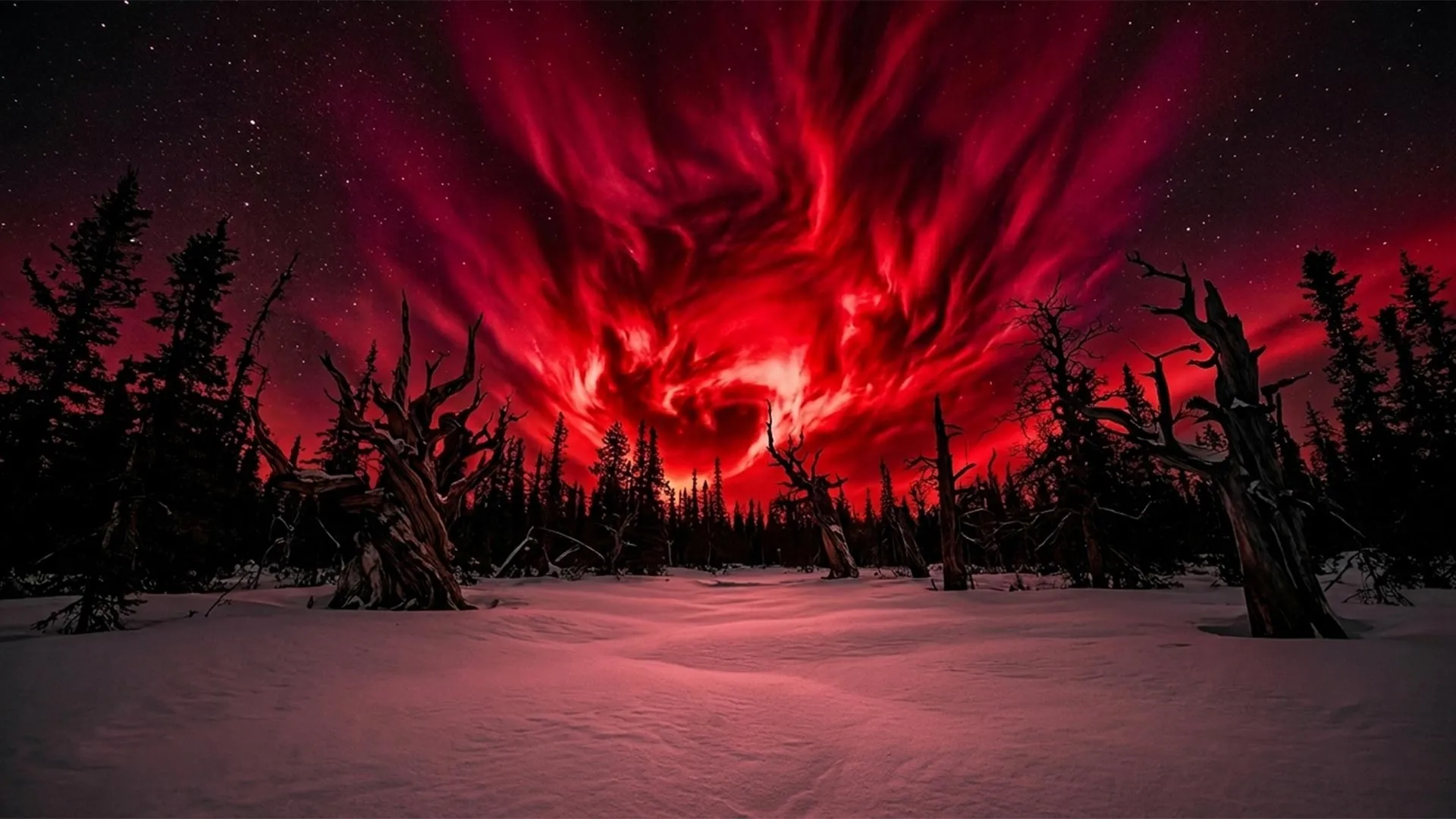
Strong solar activity can produce amazing aurora borealis on Earth, but without the protection of Earth’s magnetic field, the sun could be extremely dangerous. Violent eruptions, such as solar flares and coronal mass ejections, can send high-energy particles into space, posing serious danger to astronauts and spacecraft.
Some of these eruptions cause solar proton events (SPE), during which charged particles hurtle towards Earth at speeds up to 90% of the speed of light. In 1972, several SPEs exploded during the Apollo 16 and Apollo 17 lunar missions. If astronauts had been exposed during their lunar missions, they could have been exposed to lethal doses of radiation. As space agencies prepare for future lunar exploration, scientists are working to better understand these unpredictable solar phenomena.
Researchers at Okinawa Institute of Science and Technology University (OIST) have recently developed a new method to uncover evidence of past SPEs. The research team combined medieval historical records with ultra-high-precision carbon-14 measurements taken from buried Asunaro trees in northern Japan. Using this method, they identified a solar proton event that appears to have occurred sometime between the winter of 1200 AD and the spring of 1201 AD, a period marked by unusually intense solar activity. The survey results are Japan Academy Proceedings Series B.
Professor Yuko Miyahara of OIST’s Solar, Earth Environment and Climate Unit said: “Previous research on historical SPEs has focused on rare and extremely strong phenomena. Our paper provides the basis for detecting sub-extreme SPEs. Although they occur frequently and are about 10-30% of the magnitude of the most extreme cases, they are still dangerous. Sub-extreme SPEs are more difficult to detect, but our method allows us to efficiently identify them and better understand the situation.” more likely to occur. ”
Ancient tree preserves clues about solar storms
The Earth’s magnetic field blocks most of the high-energy particles emitted during SPE. But near the poles, magnetic field lines spread out into space, allowing some particles to enter the atmosphere. In particularly powerful events, these particles collide with atmospheric gases and produce carbon-14 compounds that can spread around the world and get trapped inside living organisms.
By analyzing carbon-14 levels in preserved organic matter, such as ancient buried trees, scientists can track changes in solar activity over thousands of years. The OIST team used ultra-precise measurement techniques that they had refined over a decade. The method can detect much smaller fluctuations in carbon-14 than traditional techniques, making it possible to identify weak, “sub-extreme” solar proton events that were previously invisible.
Analyzing carbon-14 is very time-consuming, so researchers first needed clues about when the unusual solar activity was occurring.
Medieval Japanese diary reveals ‘red light’ in the sky
One important clue came from Meigetsuki, the diary of the Japanese poet and courtier Fujiwara no Teika (1162-1241). In February 1204 A.D., he said he saw “a red light in the northern sky over Kyoto.”
Although solar proton events do not directly produce auroras, they are often associated with the same types of solar disturbances that produce auroras. This historical observation gave researchers a time frame to investigate in more detail.
The scientists then measured carbon-14 levels in buried Asunaro wood recovered from Aomori Prefecture in northern Japan. They found spikes in carbon-14 that indicate a sub-extreme solar proton phenomenon. By combining these measurements with dendritic climate studies, a dating method based on comparing tree-ring growth patterns in relation to local climate, the researchers determined that the event likely occurred sometime between the winter of 1200 AD and the spring of 1201 AD. Chinese historical records mention that red auroras were seen at unusually low latitudes around the same time.
Evidence of a very active sun
“With high-precision data, we can not only determine the exact age of the sub-extreme solar proton event, but also unambiguously reconstruct the solar cycle during that period,” Miyahara said. “Today, the Sun’s activity fluctuates on an 11-year cycle, but we find that the cycle was only seven to eight years long back then, indicating that the Sun was very active. The SPE that we dated occurred at the peak of one of these cycles.”
This research helps fill an important gap in the history of solar activity and improves scientists’ understanding of dangerous space weather phenomena. According to Miyahara, carbon-14 analysis alone is not enough. Historical records and other scientific methods are also essential to reconstructing the Sun’s behavior in the past.
“Historical literature provides candidate time windows, and dendroclimatology allows direct cross-comparisons between detected SPEs and reports of sunspots and auroras recorded in the literature. Such an integrated approach is needed to accurately reconstruct past solar activity and will help us better understand the characteristics of extreme space weather,” concluded Miyahara. “For example, the SPEs we discovered occurred near the peak of the solar cycle, whereas some of the long-term, low-latitude auroras recorded in the literature appear to be near the minimum of the reconstructed solar cycle. This is unexpected, and we are excited to further investigate what solar conditions could cause this.”
