


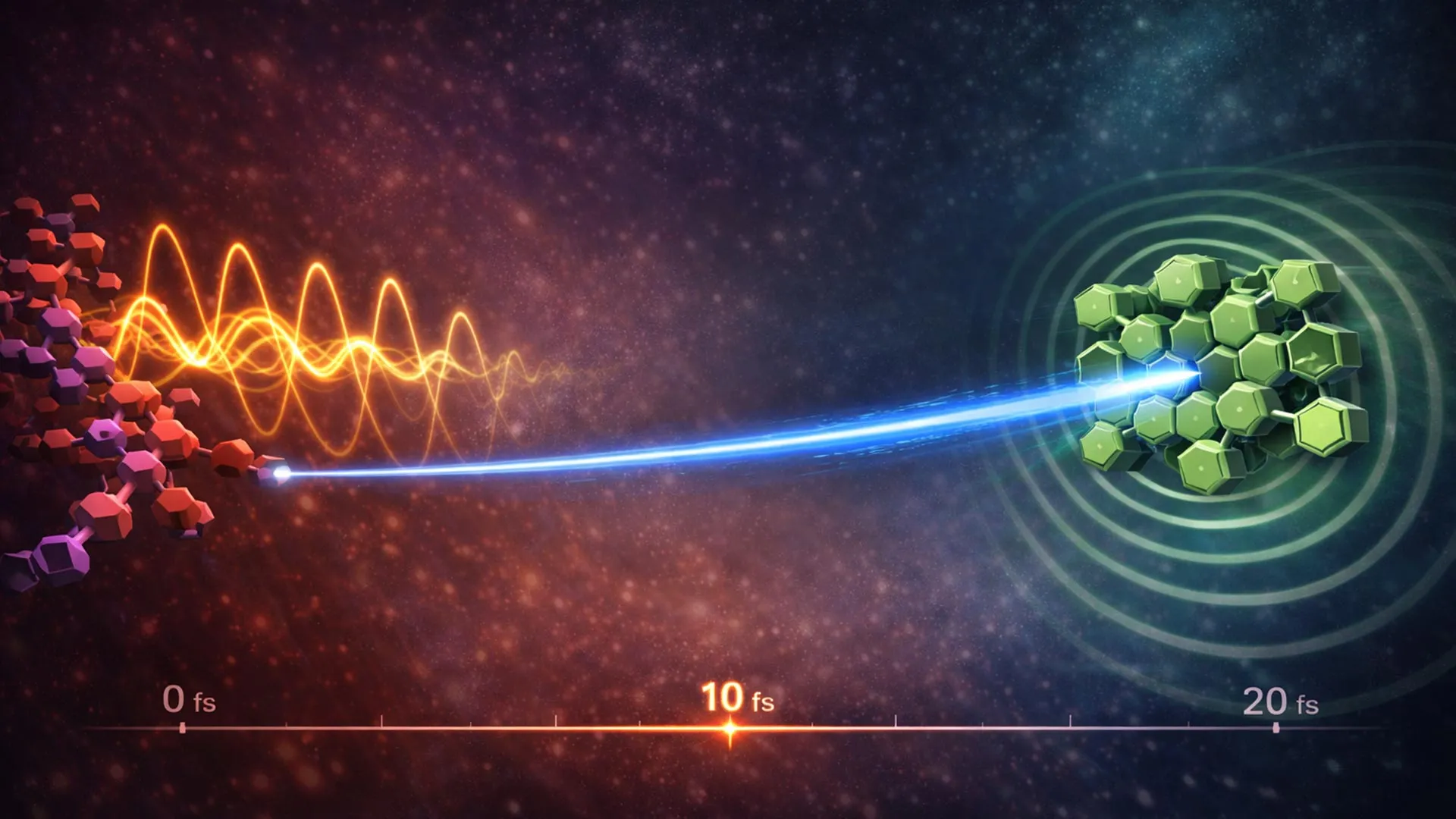
Scientists have discovered that electrons can be propelled through solar materials at nearly the fastest speeds allowed by nature. This is a result that challenges long-accepted ideas about how solar energy systems work.
The discovery could open new avenues for designing technologies that more efficiently capture sunlight and convert it into electricity.
Researchers at the University of Cambridge observed the separation of charges during a single molecular vibration in a laboratory experiment that tracked an event lasting just 18 femtoseconds (less than one quintillionth of a second).
“We intentionally designed a system that, according to conventional theory, should not transfer charge this fast,” said Dr. Pratyush Ghosh, a research fellow at St. John’s University in Cambridge and lead author of the study. “According to traditional design rules, this system should be slow, which is what makes the results so impressive.
“Rather than drifting around randomly, the electrons are fired in coherent bursts. The vibrations act like molecular catapults. They don’t just accompany the process, they actively drive it.”
Observe electrons moving on atomic time scales
A femtosecond is one quintillionth of a second. One second contains about eight times as many femtoseconds as the entire time that has elapsed since the beginning of the universe. On this incredibly small time scale, the atoms in molecules are constantly vibrating.
The researchers observed that electrons move between materials at essentially the same pace as atoms move. As Ghosh explained, “We are effectively watching the electrons move on the same clock as the atoms themselves.”
This study nature communications March 5, 2026 Long-standing design assumptions in solar energy science are called into question. Until now, scientists generally believed that ultrafast charge transfer required large energy differences and strong electronic bonds between materials. In such situations, efficiency may decrease due to voltage limitations and increased energy losses.
How light produces energy in solar cell materials
When light hits many carbon-based materials, it creates tightly bound packets of energy called excitons, pairs of electrons and holes. For devices such as solar cells, photodetectors, and photocatalytic systems to function effectively, this pair must quickly separate into free charges.
The sooner the split occurs, the less energy is wasted. This ultra-fast separation plays a key role in determining how efficiently solar panels and other light concentration technologies convert sunlight into usable electricity.
To investigate whether this trade-off is inevitable, the Cambridge researchers intentionally created a system that was expected to perform poorly. They placed a polymer donor next to a non-fullerene acceptor with little energy difference and only weak interactions. Under this condition, charge transfer should be significantly slower.
Instead, the electrons passed through the interface in just 18 femtoseconds. That speed is faster than in many organic systems previously studied and matches the natural rhythms of atomic motion. “It’s extraordinary to see it happen on such a timescale within a single molecular vibration,” Dr. Ghosh said.
Molecular vibrations drive ultrafast electron motion
Ultrafast laser experiments helped reveal the mechanism behind this unexpected result. When a polymer absorbs light, it begins to vibrate in a specific high-frequency pattern.
These oscillations mix electronic states and effectively push electrons across boundaries, creating directional ballistic motion rather than slow, random diffusion.
When the electron reaches the acceptor molecule, new coherent vibrations occur. This unique signal is rarely observed in organic materials and shows how quickly transfer occurs. “That coherent vibration clearly shows how fast and how cleanly the transfer took place.
“Our results show that the ultimate rate of charge separation is not determined solely by the static electronic structure,” said Dr. Ghosh. “It depends on how the molecules vibrate. This gives us new design principles. In a sense, this gives us a new rulebook. Instead of fighting molecular vibrations, we can learn how to use the correct rulebook.”
Effects on solar energy and light concentration
This finding suggests new strategies for designing more efficient light-harvesting technologies. Ultrafast charge separation is the basis for systems such as organic solar cells, photodetectors, and photocatalytic devices that can produce clean hydrogen fuel. A similar process occurs naturally during photosynthesis.
“Instead of trying to suppress molecular motion, we can now design materials that take advantage of molecular motion, which means we can turn vibrations from a restriction into a tool,” said study co-author Professor Akshay Rao, professor of physics at the Cavendish Laboratory and former research fellow at St. John’s University.
The project involved scientists from the University of Cambridge’s Cavendish Laboratory and Yusuf Hameed Department of Chemistry, including St John’s University Research Fellow Dr Rakesh Arul. Collaborators from Italy, Sweden, the United States, Poland and Belgium also contributed to the study.
